Advertisements
Advertisements
प्रश्न
The molar conductivity of 0.025 mol L−1 methanoic acid is 46.1 S cm2 mol−1. Calculate its degree of dissociation and dissociation constant. Given \[\ce{λ^0_{(H^+)}}\] = 349.6 S cm2 mol−1 and \[\ce{λ^0_{(HCOO^-)}}\] = 54.6 S cm2 mol−1.
Advertisements
उत्तर
Given: \[\ce{\Lambda_{m(HCOOH)}}\] = 46.1 S cm2 mol−1
\[\ce{λ^0_{(H^+)}}\] = 349.6 S cm2 mol−1
\[\ce{λ^0_{(HCOO^-)}}\] = 54.6 S cm2 mol−1
\[\ce{\Lambda^0_{m(HCOOH)} = \lambda^0_{(H^+)} + \lambda^0_{(HCOO^-)}}\]
= 349.6 + 54.6
= 404.2 S cm2 mol−1
Degree of dissociation (α) = \[\ce{\frac{\Lambda_m}{\Lambda{^0_m}}}\]
= `46.1/404.2`
= 0.114
⇒ α = 11.4%
\[\ce{HCOOH <=> HCOO- + H+}\]
| Initial concentration | c mol L−1 | 0 | 0 |
| Concentration at equilibrium | c(1 − α) | cα | cα |
∴ Kα = `(c alpha * c alpha)/(c (1 - alpha))`
= `(c alpha^2)/(1 - alpha)`
= `(0.025 xx (0.114)^2)/(1 - 0.114)`
= 3.67 × 10⁻⁴
APPEARS IN
संबंधित प्रश्न
Define “Molar conductivity”.
The conductivity of 0.20 mol L−1 solution of KCl is 2.48 × 10⁻² S cm−1. Calculate its molar conductivity and degree of dissociation (α). Given λ0 (K+) = 73.5 S cm2 mol−1 and λ0 (C1−) = 76.5 S cm2 mol−1.
Why does the conductivity of a solution decrease with dilution?
Calculate the degree of dissociation (α) of acetic acid if its molar conductivity (Λm) is 39.05 S cm2 mol−1.
(Given \[\ce{\lambda^{\circ}_{(H^+)}}\] = 349.6 S cm2 mol−1 and \[\ce{\lambda^{\circ}_{(CH_3COO^-)}}\] = 40.95 S cm2 mol−1)
In the plot of molar conductivity (∧m) vs square root of concentration (c1/2), following curves are obtained for two electrolytes A and B:
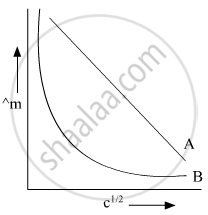
Answer the following:
(i) Predict the nature of electrolytes A and B.
(ii) What happens on extrapolation of ∧m to concentration approaching zero for electrolytes A and B?
Which of the statements about solutions of electrolytes is not correct?
\[\ce{\Lambda^0_m(NH4OH)}\] is equal to ______.
\[\ce{Λ^0_m H2O}\] is equal to:
(i) \[\ce{Λ^0_m_{(HCl)} + \ce{Λ^0_m_{(NaOH)} - \ce{Λ^0_m_{(NaCl)}}}}\]
(ii) \[\ce{Λ^0_m_{(HNO_3)} + \ce{Λ^0_m_{(NaNO_3)} - \ce{Λ^0_m_{(NaOH)}}}}\]
(iii) \[\ce{Λ^0_{(HNO_3)} + \ce{Λ^0_m_{(NaOH)} - \ce{Λ^0_m_{(NaNO_3)}}}}\]
(iv) \[\ce{Λ^0_m_{(NH_4OH)} + \ce{Λ^0_m_{(HCl)} - \ce{Λ^0_m_{(NH_4Cl)}}}}\]
An increase in equivalent conductance of a strong electrolyte with dilution is mainly due to :-
Which of the following increases with the increase in the concentration of the solution?
The molar conductivity of 0.007 M acetic acid is 20 S cm2 mol−1. What is the dissociation constant of acetic acid? Choose the correct option.
\[\begin{array}{cc}
\end{array}\]\[\begin{bmatrix}
\ce{\Lambda^{\circ}_{H^+} = 350 S cm^2 mol^{-1}}\\
\ce{\Lambda^{\circ}_{CH_3COO^-} = 50 S cm^2 mol^{-1}}
\end{bmatrix}\]
The molar conductance of NaCl, HCl, and CH3COONa at infinite dilution are 126.45, 426.16, and 91.0 S cm2 mol−1 respectively. The molar conductance of CH3COOH at infinite dilution is. Choose the right option for your answer.
The molar conductivity of CH3COOH at infinite dilution is 390 Scm2/mol. Using the graph and given information, the molar conductivity of CH3COOK will be:

Given below are two statements:
Statements I: The limiting molar conductivity of KCl (strong electrolyte) is higher compared to that of CH3COOH (weak electrolyte).
Statement II: Molar conductivity decreases with decrease in concentration of electrolyte.
In the light of the above statements, choose the most appropriate answer from the options given below:
The variation of molar conductivity with concentration of an electrolyte (X) m aqueous solution is shown in the given figure.

The electrolyte X is ______.
Assertion (A) : Conductivity decreases with decrease in concentration of electrolyte.
Reason (R) : Number of ions per unit volume that carry the current in a solution decreases on dilution.
Conductivity of 2 × 10⁻³ M methanoic acid is 8 × 10⁻⁵ S cm−1. Calculate its molar conductivity and degree of dissociation if `∧_"m"^0` for methanoic acid, is 404 S cm2 mol−3.
The unit of molar conductivity is ______.
The resistance of a conductivity cell with a 0.1 M KCl solution is 200 ohm. When the same cell is filled with a 0.02 M NaCl solution, the resistance is 1100 ohm. If the conductivity of 0.1 M KCl solution is 0.0129 ohm-1 cm-1, calculate the cell constant and molar conductivity of 0.02 M NaCl solution.
Discuss the variation of conductivity and molar conductivity with concentration.
