Advertisements
Advertisements
प्रश्न
The conductivity of sodium chloride at 298 K has been determined at different concentrations and the results are given below:
| Concentration/M | 0.001 | 0.010 | 0.020 | 0.050 | 0.100 |
| 102 × κ/S m−1 | 1.237 | 11.85 | 23.15 | 55.53 | 106.74 |
Calculate ∧m for all concentrations and draw a plot between ∧m and c1/2. Find the value of `Lambda_m^0`.
Advertisements
उत्तर
| Concentration (M) | C1/2 (M1/2) |
κ(S m−1) | κ(S cm−1) | Λm = `bb((kappa xx 1000)/M)` (S cm2 mol−1) |
| 0.001 | 0.032 | 1.237 × 10⁻² | 1.237 × 10⁻⁴ |
`(1.237 xx 10^-4 xx 1000)/0.001` = 123.7 |
| 0.010 | 0.100 | 11.85 × 10⁻² | 11.85 × 10⁻⁴ | `(11.85 xx 10^-4 xx 1000)/(0.010)` = 118.5 |
| 0.020 | 0.141 | 23.15 × 10⁻² | 23.15 × 10⁻⁴ | `(23.15 xx 10^-4 xx 1000)/0.020` = 115.8 |
| 0.050 | 0.224 | 55.53 × 10⁻² | 55.53 × 10⁻⁴ | `(55.53 xx 10^-4 xx 1000)/(0.050)` = 111.1 |
| 0.100 | 0.316 | 106.74 × 10⁻² | 106.74 × 10⁻⁴ | `(106.74 xx 10^-4 xx 1000)/(0.100)` = 106.7 |
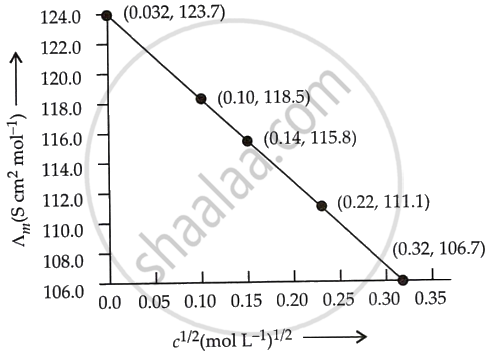
When the straight line is drawn backwards, it meets the ∧m axis at 124.0 S cm2 mol−1, which is the value of `Lambda_m^0`.
APPEARS IN
संबंधित प्रश्न
The conductivity of 0.20 M solution of KCl at 298 K is 0.025 S cm−1. Calculate its molar conductivity.
The conductivity of 0.001 mol L-1 solution of CH3COOH is 3.905× 10⁻⁵ S cm-1. Calculate its molar conductivity and degree of dissociation (α) Given λ°(H+)= 349.6 S cm2 mol-1 and λ°(CH3COO)= 40.9S cm2mol-1.
The conductivity of 0.20 mol L−1 solution of KCl is 2.48 × 10⁻² S cm−1. Calculate its molar conductivity and degree of dissociation (α). Given λ0 (K+) = 73.5 S cm2 mol−1 and λ0 (C1−) = 76.5 S cm2 mol−1.
Define the following terms: Molar conductivity (⋀m)
10.0 grams of caustic soda when dissolved in 250 cm3 of water, the resultant gram molarity of solution is _______.
(A) 0.25 M
(B) 0.5 M
(C) 1.0 M
(D) 0.1 M
A steady current of 2 amperes was passed through two electrolytic cells X and Y connected in series containing electrolytes FeSO4and ZnSO4 until 2.8g of Fe deposited at the cathode of cell X. How long did the current flow? Calculate the mass of Zn deposited at the cathode of cell Y.
(Molar mass: Fe=56g mol-1,Zn=65.3g mol-1,1F=96500C mol-1)
Conductivity always decreases with decrease in concentration both, for weak and strong electrolytes because of the fact that ____________.
Kohlrausch law of independent migration of ions states ____________.
Why on dilution the m Λm of \[\ce{CH3COOH}\] increases very fast, while that of \[\ce{CH3COONa}\] increases gradually?
Assertion: `"E"_("Ag"^+ //"Ag")` increases with increase in concentration of Ag+ ions.
Reason: `"E"_("Ag"^+ //"Ag")` has a positive value.
Solutions of two electrolytes ‘A’ and ‘B’ are diluted. The Λm of ‘B’ increases 1.5 times while that of A increases 25 times. Which of the two is a strong electrolyte? Justify your answer. Graphically show the behavior of ‘A’ and ‘B’.
The limiting molar conductivities Λ° for NaCl, KBr and KCl are 126, 152 and 150 S cm2 mol–1 respectively. The limiting molar conductivity Λ° for NaBr is ______.
Which of the following halogen acids is the strongest reducing agent?
The molar conductance of NaCl, HCl and CH3COONa at infinite dilution are 126.45, 426.16 and 91.0 S cm2 mol−1 respectively. The molar conductance of CH3COOH at infinite dilution is ______.
Choose the right option for your answer.
The molar conductance of NaCl, HCl, and CH3COONa at infinite dilution are 126.45, 426.16, and 91.0 S cm2 mol−1 respectively. The molar conductance of CH3COOH at infinite dilution is. Choose the right option for your answer.
The variation of molar conductivity with concentration of an electrolyte (X) m aqueous solution is shown in the given figure.

The electrolyte X is ______.
Which of the following solutions of KCl will have the highest value of molar conductivity?
The following questions are case-based questions. Read the passage carefully and answer the questions that follow:
| Rahul set up an experiment to find the resistance of aqueous KCl solution for different concentrations at 298 K using a conductivity cell connected to a Wheatstone bridge. He fed the Wheatstone bridge with a.c. power in the audio frequency range 550 to 5000 cycles per second. Once the resistance was calculated from the null point, he also calculated the conductivity K and molar conductivity ∧m and recorded his readings in tabular form. |
| S. No. | Conc. (M) |
k S cm−1 | ∧m S cm2 mol−1 |
| 1. | 1.00 | 111.3 × 10⁻³ | 111.3 |
| 2. | 0.10 | 12.9 × 10⁻³ | 129.0 |
| 3. | 0.01 | 1.41 × 10⁻³ | 141.0 |
Answer the following questions:
(a) Why does conductivity decrease with dilution? (1)
(b) If `∧_"m"^0` of KCl is 150.0 S cm2 mol−1, calculate the degree of dissociation of 0.01 M KCI. (1)
(c) If Rahul had used HCl instead of KCl then would you expect the ∧m values to be more or less than those per KCl for a given concentration? Justify. (2)
OR
(c) Amit a classmate of Rahul repeated the same experiment with CH3COOH solution instead of KCl solution. Give one point that would be similar and one that would be different in his observations as compared to Rahul. (2)
Which of the following solutions will have the highest conductivity at 298 K?
Suggest a way to determine the \[\ce{\Lambda^{\circ}_m}\] value of water.
