Advertisements
Advertisements
प्रश्न
The half-life period for the first order reaction is 1.7 hrs. How long will it take for 20% of the reactant to disappear?
Advertisements
उत्तर
Given: Half life (t1/2) = 1.7 hours, [A]0 = 100%, [A]t = 100 − 20 = 80%
To find: Time for 20% of reactant to react = t
Formulae:
- `"t"_(1/2) = 0.693/"k"`
- `"t" = 2.303/"K" log_10 ["A"]_0/["A"]_"t"`
Calculation: `"t"_(1/2) = 0.693/"k"`
k = `0.693/"t"_(1/2) = 0.693/(1.7 "h")` = 0.4076 h−1
t = `2.303/"k" log_10 ["A"]_0/["A"]_"t"`
= `2.303/(0.4076 "h"^-1) log 100/80`
t = `2.303/(0.4076 "h"^-1) xx 0.0969`
`= 0.5475 "h" xx (60 "min")/(1 "h")`
= 32.9 min
The time required for 20% of reaction to react is 0.5475 h or 32.9 min.
संबंधित प्रश्न
Answer the following in brief.
What are the units of the rate constant?
Answer the following in brief.
Give one example and explain why it is pseudo-first-order.
Write order of the following reaction:
\[\ce{2NH_{3(g)} -> N_{2(g)} + 3H_{2(g)}}\]
For a first order reaction \[\ce{A ->Product}\] with initial concentration x mol L−1, has a half life period of 2.5 hours. For the same reaction with initial concentration `("x"/2)` mol L−1 the half life is
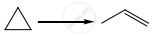
This reaction follows first-order kinetics. The rate constant at particular temperature is 2.303 × 10⁻² hour−1. The initial concentration of cyclopropane is 0.25 M. What will be the concentration of cyclopropane after 1806 minutes? (log 2 = 0.3010)
Write the rate law for the following reaction.
A reaction that is second order in NO and first order in Br2.
The time for half change in a first order decomposition of a substance A is 60 seconds. Calculate the rate constant. How much of A will be left after 180 seconds?
From the following data, show that the decomposition of hydrogen peroxide is a reaction of the first order:
| t (min) | 0 | 10 | 20 |
| V (ml) | 46.1 | 29.8 | 19.3 |
Where t is the time in minutes and V is the volume of standard KMnO4 solution required for titrating the same volume of the reaction mixture.
A first order reaction is 40% complete in 50 minutes. Calculate the value of the rate constant. In what time will the reaction be 80% complete?
A first order reaction has a rate constant 0.00813 min-1. How long will it take for 60% completion?
How long would it take to electroplate a spoon with 0.1 mol of silver (108 g/mol) at a constant current of 2.0 A using AgNO3?
If time required to decrease concentration of reactant from 0.8 M to 0.2 M is 12 hours, the half life of this first order reaction is ____________.
Which of the following represents the expression for `(3/4)^"th"` life of 1st order reaction?
For the first order reaction, plot of log10 [A]t against time 't' is a straight line with a negative slope equal to ____________.
The order of the reaction for which the unit of rate constant is s−1 is ____________.
In the reaction \[\ce{2SO2 + O2 -> 2SO3}\] the rate of appearance of SO3 is 4 × 10⁻⁴ M/s, the rate of disappearance of O2 is ____________.
For a zero order reaction, the plot of [A]t vs t is linear. The slope of the line is equal to ____________.
A first order reaction takes 40 minutes for 30% completion. Calculate the half-life of reaction.
A first order reaction, A → B takes 100 minutes for it's 90% completion. What is the rate constant of reaction?
For zero order reaction, when [A]t is plotted against time (t), the slope of the straight line obtained is equal to ______.
The integrated rate equation is Rt = log C0 – log Ct, then the straight-line graph is obtained by plotting.
The integrated rate law is a direct relationship between time and ______
If the rate constant for a first-order reaction is k, the time (t) required for the completion of 99% of the reaction is given by:
The rate constant and half-life of a first order reaction are related to each other as ______.
Which among the following reactions is an example of pseudo first order reaction?
Consider the following reaction.
\[\ce{SO2(g) + 1/2 O2(g) <=>[K1] SO3(g)}\]
\[\ce{2SO3(g)<=>[K2] 2SO2(g) + O2(g)}\]
What is the relation between K1 and K2?
The plot that represents the zero order reaction is:
If the half-life of a first-order reaction is 10 minutes, find the time required to decrease the concentration of the reactant from 0.08 M to 0.02 M.
