Advertisements
Advertisements
प्रश्न
Describe the graphical representation of first order reaction.
Describe the graphical method for the determination of the order of a first order reaction.
How would you represent a first order reaction graphically?
Advertisements
उत्तर १
The rate constant for first order reaction is,
kt = ln `([A_0])/([A])`
kt = In [A0] – In [A]
In [A] = In [A0] – kt
y = c + mx
If we follow the reaction by measuring the concentration of the reactants at regular time intervals ‘t’, a plot of ln [A] against ‘t’ yields a straight line with a negative slope. From this, the rate constant is calculated.

A plot of ln [A] vs t for a first-order reaction, \[\ce{A -> product}\] with initial concentration of [A] = 1.00 M and k = 2.5 × 10⁻² min−1
उत्तर २
A first order reaction can be represented graphically in several ways. Some important graphical representations and their characteristics are as follows.
Reaction rate vs concentration plot: The rate law for a first-order reaction is given by
Rate = k[A]

A plot of reaction rate vs concentration of reactant for a first order reaction.
The equation y = mx indicates a straight line that passes through the origin. Plotting reaction rates against reactant concentration yields a straight line that passes through the origin, as illustrated in the picture above. The slope of the line corresponds to the rate constant of the reaction.
\[\ce{Slope of the line = \frac{CB}{AC} = k}\]
Concentration vs. time plot: We know that
[A] = [A]0 e−kt

Exponential decay of the conc. of reactant as a function of time for a first order reaction.
The equation shows that a first-order process is exponential, with the concentration of reactant decreasing exponentially over time. Graphing reactant concentrations over time yields an exponential decay curve, as illustrated in the image above.
log10 [A] vs time plot: We know that
\[\ce{k = \frac{2.303}{t} log_10 \frac{[A]_0}{[A]}}\]
This equation can be written as
\[\ce{log_10 [A] = - \frac{kt}{2.303} + log_10[A]_0}\]
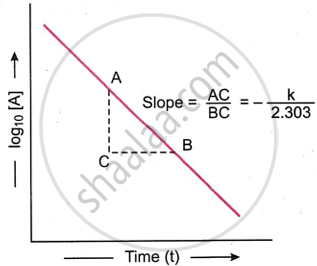
The above equation is of the type y = mx + c and represents a straight line. Therefore, on plotting log10 [A] against t, a straight line (as shown in the figure above) is obtained. The slope of the line is equal to \[\ce{\frac{-k}{2.303}}\] while the intercept of the line on log10 [A] axis is equal to log10 [A]0. Thus,
\[\ce{Slope of the line = \frac{AC}{BC} = - \frac{k}{2.303}}\]
Intercept on log10 [A] axis = log10 [A]0
Thus, the value of k can be obtained from the slope of the line.
संबंधित प्रश्न
Answer the following in brief.
How will you represent the zeroth-order reaction graphically?
Solve
The half-life of a first-order reaction is 1.7 hours. How long will it take for 20% of the reactant to react?
Write units of rate constants for:
- First-order reaction
- Zero-order reaction
A first order reaction has a rate constant 0.00813 min-1. How long will it take for 60% completion?
A first order reaction has rate constant 1 × 10⁻² s−1. What time will, it take for 20 g or reactant to reduce to 5 g?
If time required to decrease concentration of reactant from 0.8 M to 0.2 M is 12 hours, the half life of this first order reaction is ____________.
A first order reaction takes 40 minutes for 30% decomposition. What is the half-life of reaction?
0.0210 M solution of N2O5 is allowed to decompose at 43°C. How long will it take to reduce to 0.0150 M?
(Given k = 6.0 × 10⁻⁴ sec−1)
The integrated rate equation is Rt = log C0 – log Ct, then the straight-line graph is obtained by plotting.
The plot that represents the zero order reaction is:
