Advertisements
Advertisements
प्रश्न
The rate of catalysed reaction is large than the uncatalysed reaction as _______.
पर्याय
Ea is larger
Ea is lower
Ea is same
threshold energy is absent
Advertisements
उत्तर
The rate of catalysed reaction is large than the uncatalysed reaction as Ea is lower.
APPEARS IN
संबंधित प्रश्न
Answer the following in brief.
What is a zeroth-order reaction?
Solve
The half-life of a first-order reaction is 1.7 hours. How long will it take for 20% of the reactant to react?
Answer the following in brief.
Give one example and explain why it is pseudo-first-order.
Time required for 100% completion of a zero order reaction is _______.
What is half life of first order reaction if time required to decrease concentration of reactants from 0.8 M to 0.2 M is 12 hours?
The decomposition of phosphine (PH3) on tungsten at low pressure is a first-order reaction. It is because the
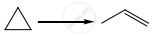
This reaction follows first-order kinetics. The rate constant at particular temperature is 2.303 × 10⁻² hour−1. The initial concentration of cyclopropane is 0.25 M. What will be the concentration of cyclopropane after 1806 minutes? (log 2 = 0.3010)
For a first-order reaction, the rate constant is 6.909 min−1 the time taken for 75% conversion in minutes is
The rate constant of a reaction is 5.8 × 10⁻² s−1. The order of the reaction is ____________.
Write the rate law for the following reaction.
A reaction that is `3/2` order in x and zero order in y.
The rate of the reaction \[\ce{A + B -> C}\] is 3.6 × 10⁻² mol dm−3 s−1 when [A] = 0.3 mol dm−3 and [B] = 0.2 mol dm−3. Calculate k if reaction is first order in A and zero order in B.
For first order reaction the concentration of reactant decreases from 0.2 to 0.1 M in 100 minutes. What is the rate constant of the reaction?
The integrated rate equation for first-order reaction, A → product, is ______.
Which of the following represents the expression for `(3/4)^"th"` life of 1st order reaction?
The order of the reaction for which the unit of rate constant is s−1 is ____________.
A first order reaction is 75% completed in 60 minutes, the time required for it's 50% completion is ____________.
For a zero order reaction, the plot of [A]t vs t is linear. The slope of the line is equal to ____________.
In a reaction \[\ce{N2_{(g)} + 3H2_{(g)} -> 2NH3_{(g)}}\], if the rate of disappearance of N2(g) is 2.6 × 10⁻⁴ M/s, the rate of disappearance of H2(g) in M/s is ____________.
0.0210 M solution of N2O5 is allowed to decompose at 43°C. How long will it take to reduce to 0.0150 M?
(Given k = 6.0 × 10⁻⁴ sec−1)
A certain zero order reaction has rate constant 0.025 M s-1. What will be the concentration of reactant 'A' after 15 seconds, if initial concentration is 0.50 M?
The integrated rate law is a direct relationship between time and ______
Define the half-life of a first-order reaction.
Which of the following reactions is not of the first order?
Which among the following reactions is an example of pseudo first order reaction?
Half-life of a first order reaction is 30 minutes and initial concentration of reactant is 0.1 M.
What is half-life of the reaction if initial concentration of reactant is doubled?
Which of the following correctly represents integrated rate law equation for a first order reaction in a gas phase?
