Advertisements
Advertisements
प्रश्न
Explain pseudo first order reaction with a suitable example.
Advertisements
उत्तर
- Certain reactions which are expected to be of higher order follow the first-order kinetics. Such reactions are said to be pseudo-first-order reactions.
- Example: Consider hydrolysis of methyl acetate.
\[\ce{CH3COOCH_{3(aq)} + H2O_{(l)} -> CH3COOH_{(aq)} + CH3OH_{(aq)}}\]
The rate law is rate = k' [CH3COOCH3] [H2O] - Explanation: The reaction was expected to follow the second-order kinetics, however, obeys the first order. The reason is that solvent water is present in such large excess that the change in its concentration is negligible compared to the initial one or its concentration remains constant.
Thus [H2O] = constant = k''.
The rate law becomes rate = k' [CH3COOCH3] k'' = k [CH3COOCH3]
where, k = k' k''
The reaction is thus of first order.
APPEARS IN
संबंधित प्रश्न
Answer the following in brief.
Derive the integrated rate law for the first-order reaction,
\[\ce{A_{(g)} -> B_{(g)} + C_{(g)}}\] in terms of pressure.
In a first-order reaction, the concentration of the reactant decreases from 20 mmol dm−3 to 8 mmol dm−3 in 38 minutes. What is the half-life of reaction?
Derive the integrated rate law for the zeroth order reaction.
Time required for 100% completion of a zero order reaction is _______.
Give one example of a pseudo first-order reaction.
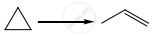
This reaction follows first-order kinetics. The rate constant at particular temperature is 2.303 × 10⁻² hour−1. The initial concentration of cyclopropane is 0.25 M. What will be the concentration of cyclopropane after 1806 minutes? (log 2 = 0.3010)
In a first order reaction \[\ce{x -> y}\]; if k is the rate constant and the initial concentration of the reactant x is 0.1 M, then, the half life is
Describe the graphical representation of first order reaction.
From the following data, show that the decomposition of hydrogen peroxide is a reaction of the first order:
| t (min) | 0 | 10 | 20 |
| V (ml) | 46.1 | 29.8 | 19.3 |
Where t is the time in minutes and V is the volume of standard KMnO4 solution required for titrating the same volume of the reaction mixture.
A first order reaction is 40% complete in 50 minutes. Calculate the value of the rate constant. In what time will the reaction be 80% complete?
How long would it take to electroplate a spoon with 0.1 mol of silver (108 g/mol) at a constant current of 2.0 A using AgNO3?
A first order reaction has rate constant 1 × 10⁻² s−1. What time will, it take for 20 g or reactant to reduce to 5 g?
A reaction that is of the first order with respect to reactant A has a rate constant 6 min−1. If we start with [A]0 = 0.5 mol dm−3, when would [A] reach the value 0.05 mol dm−3?
The rate constant of a first order reaction is 3 × 10⁻⁶ per s. If the initial concentration is 0.10 mol dm−3, the initial rate of reaction is ____________.
In a first order reaction, the concentration of the reactant is reduced to 25% in one hour. The half-life period of the reaction is ____________.
The integrated rate equation for first-order reaction, A → product, is ______.
For a first order reaction, \[\ce{A -> B}\], if [A] = 1 M and rate is 4 × 10⁻² M s−1. What is the rate constant of the reaction?
0.0210 M solution of N2O5 is allowed to decompose at 43°C. How long will it take to reduce to 0.0150 M?
(Given k = 6.0 × 10⁻⁴ sec−1)
A first order reaction, A → B takes 100 minutes for it's 90% completion. What is the rate constant of reaction?
The integrated rate equation is Rt = log C0 – log Ct, then the straight-line graph is obtained by plotting.
If the rate constant for a first-order reaction is k, the time (t) required for the completion of 99% of the reaction is given by:
Calculate half-life of a first order reaction in minute if the rate constant is 1 × 10⁻³ s-1.
Half-life of a first order reaction is 30 minutes and initial concentration of reactant is 0.1 M.
What is half-life of the reaction if initial concentration of reactant is doubled?
What is the rate constant of a first order reaction if 0.08 mole of reactant reduces to 0.02 mole in 23.03 minutes?
The half-life period for the first order reaction is 1.7 hrs. How long will it take for 20% of the reactant to disappear?
A first order reaction takes 10 minute for 30% completion. Find rate constant of the reaction.
For a first order reaction, the plot of log k against 1/T is a straight line. The slope of the line is equal to ______.
