Advertisements
Advertisements
प्रश्न
The following table shows the electronic configuration of the elements W, X, Y, Z:
|
Element |
W |
X |
Y |
Z |
|
Electronic |
2,8,1 |
2,8,7 |
2,5 |
1 |
Answer the following questions based on the table above:
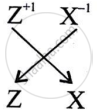
What is the formula of the compound formed between X and Z.
Advertisements
उत्तर
XZ is the formula of the compound formed between X and Z.

APPEARS IN
संबंधित प्रश्न
What type of bond is formed between two atoms, when the electronegative difference between them is High ?
Separate the following compounds into three categories - ionic, polar and covalent compounds; N2, NH4Cl, NH3, NO, NH4NO3, NCl3.
Element X is a metal with a valency 2; Y is a non-metal with a valency 3.
(a) Write an equation to show how Y forms as ion
(b) If Y is a diatomic gas, write an equation for the direct combination of X and Y to form a compound.
How many atoms of each kind are present in the following molecule:
Calcium oxide
Elements X, Y, and Z have atomic numbers 6, 9 and 12 respectively. Which one forms a cation?
What do you think would be the observation of `alpha` particle scattering experiment if carried out on (i) heavy nucleus like platinum (ii) light nuclei like litheum.
\[\ce{^24_12Mg}\] and \[\ce{^26_12Mg}\] are symbols of isotopes of magnesium.
(a) Compare the atoms of these isotopes with respect to :
i. the composition of their nuclei
ii. their electronic configurations
(b) Give reasons why the two isotopes of magnesium have different mass numbers.
Copy and complete the following table relating to the atomic structure of some elements:
| Element | Atomic Number | Mass Number | Number of protons | Number of Neutrons | Number of Electrons |
| Beryllium | 4 | 9 | |||
| Fluorine | 9 | 10 | |||
| Sodium | 12 | 11 | |||
| Aluminium | 27 | 13 | |||
| Phosphorus | 31 | 15 |
Match the following:
| 1. | Atomic bond | a. | Oxygen and hydrogen |
| 2. | Atoms with different electronegativities | b. | acceptor bond |
| 3. | An atom that accepts electron pair | c. | covalent bond |
| 4. | Rusting of iron | d. | donor atom |
| 5. | An atom that provides electron pair | e. | oxidation |
| f. | ionic bond |
How many atoms of each kind are present in the following molecule:
carbon tetrachloride
