Advertisements
Advertisements
प्रश्न
The cathode of a diode valve is replaced by another cathode of double the surface area. Keeping the voltage and temperature conditions the same, will the place current decrease, increase or remain the same?
Advertisements
उत्तर
As the rate of emission of thermions is directly proportional to the surface area of the surface emitting it, the plate current doubles if the cathode of a diode valve is replaced by another cathode of double the surface area.Hence plate current increases.
APPEARS IN
संबंधित प्रश्न
Find the (a) maximum frequency and (b) minimum wavelength of X-rays produced by 30 kV electrons.
The work function of caesium metal is 2.14 eV. When light of frequency 6 × 10¹⁴ Hz is incident on the metal surface, photoemission of electrons occurs. What is the
- maximum kinetic energy of the emitted electrons,
- Stopping potential, and
- maximum speed of the emitted photoelectrons?
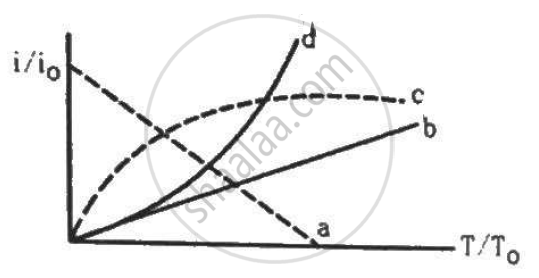
Let i0 be the thermionic current from a metal surface when the absolute temperature of the surface is T0. The temperature is slowly increased and the thermionic current is measured as a function of temperature. Which of the following plots may represent the variation in (i/i0) against (T/T0)?
Answer the following question.
Define the term "Threshold frequency", in the context of photoelectric emission.
The work function of aluminum is 4⋅2 eV. If two photons each of energy 2⋅5 eV are incident on its surface, will the emission of electrons take place? Justify your answer.
The wave associated with a moving particle of mass 3 × 10⁻⁶ g has the same wavelength as an electron moving with a velocity 6 × 10⁶ ms–1. The velocity of the particle is
Emission of electrons by the absorption of heat energy is called ____________ emission.
Define the work function of a metal. Give its unit.
What do you mean by electron emission? Explain briefly various methods of electron emission.
Photoelectric emission is observed from a metallic surface for frequencies ν1 and ν2 of the incident light (ν1 > ν2). If the maximum value of kinetic energy of the photoelectrons emitted in the two cases are in the ration 1 : n then the threshold frequency of the metallic surface is ______.
Consider Figure for photoemission.

How would you reconcile with momentum conservation? Note light (photons) have momentum in a different direction than the emitted electrons.
The work function of a metal is 2.31 eV. Photoelectric emission occurs when the light of frequency 6.4 × 10¹⁴ Hz is incident on the metal surface. Calculate
- the energy of the incident radiation,
- the maximum kinetic energy of the emitted electron and
- the stopping potential of the surface.
In the boundary-wall analogy, what does the metal surface represent?
Which unit is used for the work function?
What is the value of \[1\,\mathrm{eV}\] in joules?
Which are the three main ways electrons can be emitted from a metal surface?
What causes field emission?
Which is an example associated with photoelectric emission?
