Advertisements
Advertisements
प्रश्न
What do you mean by electron emission? Explain briefly various methods of electron emission.
Advertisements
उत्तर
Electron emission:
- Free electrons possess some kinetic energy and this energy is different for different electrons. The kinetic energy of the free electrons is not sufficient to overcome the surface barrier.
- Whenever additional energy is given to the free electrons, they will have sufficient energy to cross the surface barrier. And they escape from the metallic surface.
-
The liberation of electrons from any surface of a substance is called electron emission.
There are mainly four types of electron emission which are given below.
(i) Thermionic emission: When a metal is heated to a high temperature, the free electrons on the surface of the metal get sufficient energy in the form of thermal energy so that they are emitted from the metallic surface. This type of emission is known as thermionic emission.

Electrons in the (a) metal (b) heated metal
The intensity of the thermionic emission (the number of electrons emitted) depends on the metal used and its temperature.

Thermionic emission from hot filament of cathode ray tube or x-ray tube
Examples: cathode ray tubes, electron microscopes, X-ray tubes, etc.
(ii) Field emission: Electric field emission occurs when a very strong electric field is applied across the metal. This strong field pulls the free electrons and helps them to overcome the surface barrier of the metal.

Field emission
Examples: Field emission scanning electron microscopes, Field-emission display, etc.
(iii) Photo electric emission: When electromagnetic radiation of suitable frequency is incident on the surface of the metal, the energy is transferred from the radiation to the free electrons. Hence, the free electrons get sufficient energy to cross the surface barrier and the photo electric emission takes place. The number of electrons emitted depends on the intensity of the incident radiation.

Photo electric emission
Examples: Photo diodes, photo electric cells, etc.
(iv) Secondary emission: When a beam of fast-moving electrons strikes the surface of the metal, the kinetic energy of the striking electrons is transferred to the free electrons on the metal surface. Thus the free electrons get sufficient kinetic energy so that the secondary emission of, electron occurs.
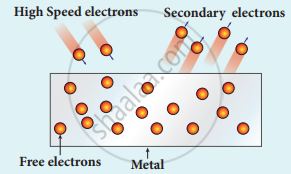
Secondary emission of electrons
Examples: Image intensifies, photo multiplier tubes, etc.
APPEARS IN
संबंधित प्रश्न
Quarks inside protons and neutrons are thought to carry fractional charges [(+2/3)e; (–1/3)e]. Why do they not show up in Millikan’s oil-drop experiment?
Would you prefer a material with a high work-function or a low work-function to be used as a cathode in a diode?
The cathode of a diode valve is replaced by another cathode of double the surface area. Keeping the voltage and temperature conditions the same, will the place current decrease, increase or remain the same?
The work function of aluminum is 4⋅2 eV. If two photons each of energy 2⋅5 eV are incident on its surface, will the emission of electrons take place? Justify your answer.
Name the factors on which photoelectric emission from a surface depends.
The work function of a metal is 2.31 eV. Photoelectric emission occurs when the light of frequency 6.4 × 10¹⁴ Hz is incident on the metal surface. Calculate
- the energy of the incident radiation,
- the maximum kinetic energy of the emitted electron and
- the stopping potential of the surface.
What prevents electrons from escaping a metal surface under ordinary conditions?
What is the work function (\[\phi_0\]) of a metal?
What must fall on a metal surface for photoelectric emission to occur?
Which is an example associated with photoelectric emission?
