Advertisements
Advertisements
प्रश्न
State two changes that were seen in the game of cricket around 1780.
Advertisements
उत्तर
By 1780, a Test match was played for average three days. It was also the period when the first six-seam cricket ball was created.
संबंधित प्रश्न
The Shehnai of Bismillah Khan Thinking about the text :
Tick the right answer.
Bismillah Khan learnt to play the shehnai from (Ali Bux, Paigambar Bux, Ustad Faiyaaz
Khan).
Answer these question in 30–40 words.
When and how did Bismillah Khan get his big break?
When does he realize that he has lost his way? How have his anxiety and insecurity been described?
Answer these question in one or two sentences. (The paragraph numbers within brackets provide clues to the answer.)
Why was the ‘holy man’ who gave Santosh’s mother his blessings surprised?
Sometimes the choices we make have far-reaching consequences. Think about choices you make on a daily basis, and the importance of these choices.
On the basis of your understanding of the poem, answer the following question
by ticking the correct option.
The tone and mood of the rain in the poem reflects its_________.
Now, it is your turn. Write and produce your own radio programme. You will need to select your own content. The following are some ideas. You are free, of course, to add your own ideas. Remember, the programme must be in English.
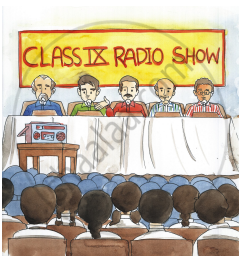
- News stories: about people in your class, about school, about sports (school and local), about the local community
- Comedy: jokes, short plays
- Interviews: with teachers, with exstudents of your school, with a Class IX student who has recently done something very interesting
- Games: general knowledge quiz, panel game, word game
- Advertisements: for shops/industries in the local community, things ‘for sale’ and ‘wanted’ by students
- Local sites: monuments/sites of historical importance and of tourist interest
- Special reports: e.g. safety at school, examination results, school uniform, school assemblies
- Interesting people: role-play interviews with film stars, sports personalities, TV personalities, etc.
- Entertainment reviews: music, films, videos, books, etc.
- Plays
- Songs with lyrics
- Speeches on important personalities
- Tele conference video conference with students, teachers, experts
Some are Purple and gold flecked grey
For she who has journeyed through life midway,
Whose hands have cherished , whose love has blest,
And cradled fair sons on her faithful breast,
And serves her household in fruitful pride,
And worship the gods at her husband's side.
Read the lines given above and answer the question that follow:
Explain with reference to context.
There was a time when our people covered the land as the waves of a wind-ruffled sea cover its shell-paved floor, but that time long since passed away with the greatness of tribes that are now but a mournful memory. 1 will not dwell on, nor mourn over, our untimely decay, nor reproach my paleface brothers with hastening it, as we too may have been somewhat to blame.
Youth is impulsive. When our young men grow angry at some real or imaginary wrong, and disfigure their faces with black paint, it denotes that their hearts are black, and that they are often cruel and relentless, and our old men and old women are unable to restrain them. Thus it has ever been. Thus it was when the white man began to push our forefathers ever westward. But let us hope that the hostilities between us may never return. We would have everything to lose and nothing to gain. Revenge by young men is considered gain, even at the cost of their own lives, but old men who stay at home in times of war, and mothers who have sons to lose, know better.
Read the extract given below and answer the question that follow.
When did the hostilities between the Trials and the White men begin?
“If you are rested I would go,” I urged. “Get up and try to walk now.”
“Thank you,” he said and got to his feet, swayed from side to side and then sat down backwards in the dust.
“I was taking care of animals,” he said dully, but no longer to me. “I was only taking care of animals.”
There was nothing to do about him. It was Easter Sunday and the Fascists were advancing toward the Ebro. It was a grey overcast day with a low ceiling so their planes were not up. That and the fact that cats know how to look after themselves was all the good luck that the old man would ever have.
Read the extract given below and answer the question that follow.
Explain the line, ‘There was nothing to do about him.’
Margot stood alone. She was a very frail girl who looked as if she had been lost in the rain for years and the rain had washed out the blue from her eyes and the red from her mouth and the yellow from her hair. She was an old photograph dusted from an album, whitened away, and if she spoke at all her voice would be a ghost. Now she stood, separate, staring at the rain and the loud wet world beyond the huge glass. “What’re you looking at ?” said William. Margot said nothing. “Speak when you’re spoken to.” He gave her a shove. But she did not move; rather she let herself be moved only by him and nothing else. They edged away from her, they would not look at her. She felt them go away. And this was because she would play no games with them in the echoing tunnels of the underground city. If they tagged her and ran, she stood blinking after them and did not follow. When the class sang songs about happiness and life and games her lips barely moved. Only when they sang about the sun and the summer did her lips move as she watched the drenched windows.
Read the extract given below and answer the question that follow.
Why was Margot sad?
Read the following sentence.
(a) If she knows we have a cat, Paati will leave the house.
(b) She won’t be so upset if she knows about the poor beggar with sores on his feet.
(c) If the chappals do fit, will you really not mind?
Notice that the sentence consists of two parts. The first part begins with ‘if’. It is known as if-clause. Rewrite each of the following pairs of sentences as a single sentence. Use ‘if’ at the beginning of the sentence.
Don’t tire yourself now. You won’t be able to work in the evening.
Why did the wicked couple drop their tools?
Where did the old flea collected by Mr Wonka live?
Narrate the story of the reptiles as told by Zai Whitaker in not more than 80 words.
Which line in the poem suggests that you need a keen eye and a sharp ear to enjoy a meadow? Read aloud the stanza that contains this line.
Multiple Choice Question:
The child in this poem seems to be ____________.
- Notice the way Mr Gessler speaks English. His English is influenced by his mother tongue. He speaks English with an accent.
- When Mr Gessler speaks, p, t, k, sound like b,d,g. Can you say these words as Mr Gessler would say them?
It comes and never stops. Does it bother me? Not at all. Ask my brother, please.
Referring closely to the short story, The Singing Lesson, show how the Headmistress’ summons to Miss Meadows eventually brings the latter out from cold despair to a realm of hope, love and joy.
How does the poem, Crossing the Bar, portray the poet's deep affirmation and faith in God?
