Advertisements
Advertisements
प्रश्न
Thinking about the Poem
What do the following phrases mean to you? Discuss in class.
(i) humid shadows
(ii) starry spheres
(iii) what a bliss
(iv) a thousand dreamy fancies into busy being start
(v) a thousand recollections weave their air-threads into woof
Advertisements
उत्तर
(i) “Humid shadows” refer to the dark clouds that produce rain.
(ii) “Starry spheres” refer to the night sky abounding in stars.
(iii) “What a bliss” refers to the happiness of the poet. When it rains poet gets into his cottage and enjoy the patter of rain upon the roof.
(iv) This refers to the various imaginary thoughts and fantasies that are aroused in the poet’s mind.
(v) This phrase means that numerous memories intermingle to form a beautiful picture that the poet recollects.
संबंधित प्रश्न
Use the suffixes −ion or −tion to form nuns from the following verbs. Make the necessary changes in the spellings of the words.
Example:proclaim − proclamation
| cremate ___ | act ___ | exhaust ___ |
| invent ___ | tempt ___ | immigrate ___ |
| direct ___ | meditate ___ | imagine ___ |
| dislocate ___ | associate ___ | dedicate ___ |
Thinking about the Text
Answer these question.
They can’t hang me twice.”
(i) Who says this?
(ii) Why does the speaker say it?
Go to the local library or talk to older persons in your locality and find legends in your own language. Tell the class these legends.
Do you think the feeling of depression Johnsy has is common among teenagers?
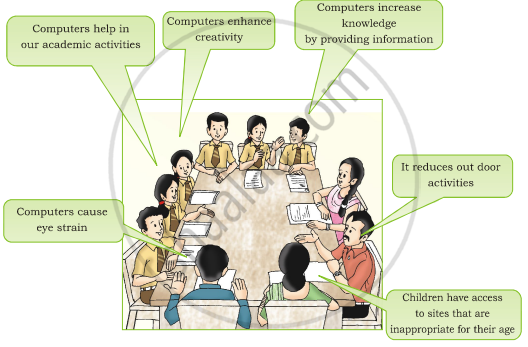
This is a meeting of the school’s Parent-Teacher Association. Some student representatives have also been invited to participate to discuss the role that Information technology/computers play in the growth and development of children.
Some are Purple and gold flecked grey
For she who has journeyed through life midway,
Whose hands have cherished , whose love has blest,
And cradled fair sons on her faithful breast,
And serves her household in fruitful pride,
And worship the gods at her husband's side.
Read the lines given above and answer the question that follow:
What do the purple and grey colours of bangles signify in this stanza?
Such wondrous, fine, fantastic tales
Of dragons, gypsies, queens, and whales
And treasure isles, and distant shores
Where smugglers rowed with muffled oars,
And pirates wearing purple pants,
And sailing ships and elephants,
And cannibals crouching 'round the pot,
Stirring away at something hot.
(It smells so good , what can it be?
Good gracious, it's Penelope.)
The younger ones had Beatrix Potter
With Mr.Tod,the dirty rotter,
And Squirrel Nutkin,Pigling Bland,
And Mrs.Tiggy-Winkle and-
Just How The Camel Got His Hump,
And How the Monkey Lost His Rump,
And Mr. Toad, and bless my soul,
There's Mr.Rat and Mr. Mole-
Oh, books, what books they used to know,
Those children living long ago!
Read the lines given above and answer the question given below.
Which animal characters does Dahl mention?’
She lighted another match, and then she found herself sitting under a beautiful Christmas-tree. It was larger and more beautifully decorated than the one which she had seen through the glass door at the rich merchant’s. Thousands of tapers were burning upon the green branches, and colored pictures, like those she had seen in the show- windows, looked down upon it all. The little one stretched out her hand towards them, and the match went out.
The Christmas lights rose higher and higher, till they looked to her like the stars in the sky. Then she saw a star fall, leaving behind it a bright streak of fire. “Someone is dying,” thought the little girl, for her old grandmother, the only one who had ever loved her, and who was now dead, had told her that when a star falls, a soul was going up to God.
Read the extract given below and answer the question that follow.
What did she see when she lighted another match?
Why did Mrs. Pegg come lo see Braithwaite? Wh• reply did Braithwaite give to her?
Is there a room in your house or a house in your neighborhood/locality where you would rather not go alone, and never at night? If there is such a place and a story to go with it, let others hear all about it.
What did the narrator do with the hatchet?
Why and when did Dad say the following?
Funny joke
How does the poet describe the facts/journey or antics of a kite in the sky?
With your partner, complete the following sentence in your own word using the ideas in the poem.
Words are the __________________ of thought.
Now that you have completed the above project, write a brief report stating what you did, how you did it, and the conclusion.
What did the squirrel do if someone came too close to his tree?
Why is the window dusty?
Add im- or in- to each of the following words and use them in place of the italicised words in the sentences given below.
| patient, proper, possible, sensitive, competent |
The project appears very difficult at first sight but it can be completed if we work very hard.
Read the lines given below and answer the following question:
| “But my darling, if you love me,” thought Miss Meadows, “I don’t Mind how much it is. Love me as little as you like.” |
What was the effect of Basil’s letter on Miss Meadows?
What does Prospero intend to do with his book before his interaction with Alonso in Act V of the play, The Tempest?
