Advertisements
Advertisements
प्रश्न
State the steps involved in the process of gene therapy for the treatment of ADA-deficiency.
Advertisements
उत्तर
- Stem cells from the bone marrow, responsible for producing lymphocytes in ADA-deficient patients, are extracted. These cells harbor the faulty ADA gene.
- A retrovirus, a specialized RNA virus, serves as a vector in this process.
- The normal ADA gene is replicated through recombinant DNA technology and incorporated into the nucleic acid of a retrovirus, engineered to be non-pathogenic.
- The bone marrow stem cells from ADA-deficient individuals undergo infection with the retrovirus.
- The virus introduces its nucleic acid (rDNA), which includes the functional ADA gene, into the chromosome of the stem cell.
- This provides these bone marrow stem cells with a functional copy of the gene alongside the pre-existing defective gene.
- The treated stem cells continue to replicate over the patient's lifetime. Possessing a fully functional ADA gene, they produce the ADA enzyme. These modified cells supply the lacking enzyme, leading to the cure of the ADA-deficient patient.
संबंधित प्रश्न
What is the cell that receives a recombinant gene called?
In vitro amplification of DNA or RNA segment is known as ___________.
Which of the following is an INCORRECT match?
Which of the following is the right combination of primers in a PCR to amplify the DNA product?
The vector Baculovirus is used for gene transfer in ____________.
Name and describe the technique that helps in separation of DNA fragments.
Explain the mechanism of PCR.
Give a reason for the following:
The diagram given below represents vector pBr322 which was modified by a research scholar Dr. Rayon, but the vector was rejected by his guide.
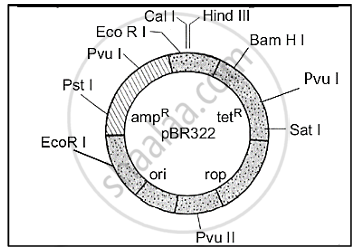
What is the relationship between alien DNA and the origin of replication in the concept of cloning?
What is the function of DNA ligase in the creation of recombinant DNA?
