Advertisements
Advertisements
प्रश्न
Represent graphically a displacement of 40 km, 30° east of north.
Advertisements
उत्तर
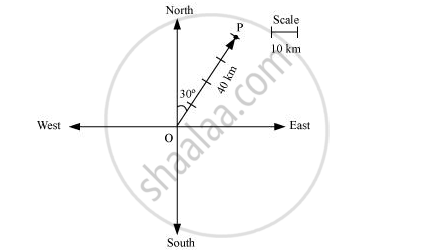
Here, vector `bar(OP)` represents the displacement of 40 km, 30° East of North.
APPEARS IN
संबंधित प्रश्न
If `bara, barb, bar c` are the position vectors of the points A, B, C respectively and ` 2bara + 3barb - 5barc = 0` , then find the ratio in which the point C divides line segment AB.
Write the position vector of the point which divides the join of points with position vectors `3veca-2vecb and 2veca+3vecb` in the ratio 2 : 1.
Find the value of 'p' for which the vectors `3hati+2hatj+9hatk and hati-2phatj+3hatk` are parallel
Classify the following as scalar and vector quantity.
Time period
In Figure, identify the following vector.

Coinitial
Two collinear vectors are always equal in magnitude.
Show that the vector `hati + hatj + hatk` is equally inclined to the axes OX, OY, and OZ.
Show that the points A, B and C with position vectors `veca = 3hati - 4hatj - 4hatk`, `vecb = 2hati - hatj + hatk` and `vecc = hati - 3hatj - 5hatk`, respectively form the vertices of a right angled triangle.
If θ is the angle between two vectors `veca` and `vecb`, then `veca . vecb >= 0` only when ______.
Let `veca` and `vecb` be two unit vectors, and θ is the angle between them. Then `veca + vecb` is a unit vector if ______.
ABCD is a parallelogram. If the coordinates of A, B, C are (−2, −1), (3, 0) and (1, −2) respectively, find the coordinates of D.
Find the angle between the vectors \[\vec{a} \text{ and } \vec{b}\] where \[\vec{a} = \hat{i} - \hat{j} \text{ and } \vec{b} = \hat{j} + \hat{k}\]
Find the angle between the vectors \[\vec{a} = \hat{i} + 2 \hat{j} - \hat{k} , \vec{b} = \hat{i} - \hat{j} + \hat{k}\]
Find the angles which the vector \[\vec{a} = \hat{i} -\hat {j} + \sqrt{2} \hat{k}\] makes with the coordinate axes.
Dot product of a vector with \[\hat{i} + \hat{j} - 3\hat{k} , \hat{i} + 3\hat{j} - 2 \hat{k} \text{ and } 2 \hat{i} + \hat{j} + 4 \hat{k}\] are 0, 5 and 8 respectively. Find the vector.
If \[\vec{a,} \vec{b,} \vec{c}\] are three mutually perpendicular unit vectors, then prove that \[\left| \vec{a} + \vec{b} + \vec{c} \right| = \sqrt{3}\]
If \[\vec{\alpha} = 3 \hat{i} + 4 \hat{j} + 5 \hat{k} \text{ and } \vec{\beta} = 2 \hat{i} + \hat{j} - 4 \hat{k} ,\] then express \[\vec{\beta}\] in the form of \[\vec{\beta} = \vec{\beta_1} + \vec{\beta_2} ,\] where \[\vec{\beta_1}\] is parallel to \[\vec{\alpha} \text{ and } \vec{\beta_2}\] is perpendicular to \[\vec{\alpha}\]
If either \[\vec{a} = \vec{0} \text{ or } \vec{b} = \vec{0}\] then \[\vec{a} \cdot \vec{b} = 0 .\] But the converse need not be true. Justify your answer with an example.
Find the magnitude of two vectors \[\vec{a} \text{ and } \vec{b}\] that are of the same magnitude, are inclined at 60° and whose scalar product is 1/2.
Show that the points whose position vectors are \[\vec{a} = 4 \hat{i} - 3 \hat{j} + \hat{k} , \vec{b} = 2 \hat{i} - 4 \hat{j} + 5 \hat{k} , \vec{c} = \hat{i} - \hat{j}\] form a right triangle.
If the vertices A, B and C of ∆ABC have position vectors (1, 2, 3), (−1, 0, 0) and (0, 1, 2), respectively, what is the magnitude of ∠ABC?
Find the vector from the origin O to the centroid of the triangle whose vertices are (1, −1, 2), (2, 1, 3) and (−1, 2, −1).
if `hat"i" + hat"j" + hat"k", 2hat"i" + 5hat"j", 3hat"i" + 2 hat"j" - 3hat"k" and hat"i" - 6hat"j" - hat"k"` respectively are the position vectors A, B, C and D, then find the angle between the straight lines AB and CD. Find whether `vec"AB" and vec"CD"` are collinear or not.
If `vec"a"` and `vec"b"` are the position vectors of A and B, respectively, find the position vector of a point C in BA produced such that BC = 1.5 BA.
Position vector of a point P is a vector whose initial point is origin.
The unit normal to the plane 2x + y + 2z = 6 can be expressed in the vector form as
Area of rectangle having vertices A, B, C and D will position vector `(- hati + 1/2hatj + 4hatk), (hati + 1/2hatj + 4hatk) (hati - 1/2hatj + 4hatk)` and `(-hati - 1/2hatj + 4hatk)` is
Find the direction ratio and direction cosines of a line parallel to the line whose equations are 6x − 12 = 3y + 9 = 2z − 2
Assertion (A): If a line makes angles α, β, γ with positive direction of the coordinate axes, then sin2 α + sin2 β + sin2 γ = 2.
Reason (R): The sum of squares of the direction cosines of a line is 1.
Find the position vector of a point R which divides the line joining two points P and Q whose position vectors are `hati + 2hatj - hatk` and `-hati + hatj + hatk` respectively, internally the ratio 2:1.
Which physical quantity has magnitude as well as direction?
Geometrically, a vector is represented by which of the following?
What is the magnitude of the position vector of \[P(3,4,0)\]?
