Advertisements
Advertisements
प्रश्न
Represent graphically a displacement of 40 km, 30° east of north.
Advertisements
उत्तर
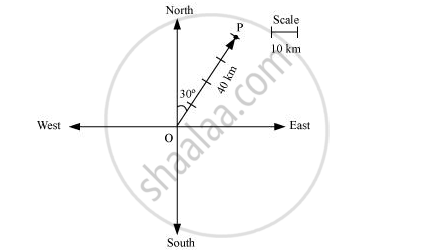
Here, vector `bar(OP)` represents the displacement of 40 km, 30° East of North.
APPEARS IN
संबंधित प्रश्न
Find the direction ratios of a vector perpendicular to the two lines whose direction ratios are -2, 1, -1, and -3, -4, 1.
If `bara, barb, bar c` are the position vectors of the points A, B, C respectively and ` 2bara + 3barb - 5barc = 0` , then find the ratio in which the point C divides line segment AB.
Write the position vector of the point which divides the join of points with position vectors `3veca-2vecb and 2veca+3vecb` in the ratio 2 : 1.
Find the position vector of a point which divides the join of points with position vectors `veca-2vecb" and "2veca+vecb`externally in the ratio 2 : 1
If `bara, barb, barc` are position vectors of the points A, B, C respectively such that `3bara+ 5barb-8barc = 0`, find the ratio in which A divides BC.
In Figure, identify the following vector.

Coinitial
Find the direction cosines of the vector `hati + 2hatj + 3hatk`.
Show that the vector `hati + hatj + hatk` is equally inclined to the axes OX, OY, and OZ.
Find the position vector of a point R which divides the line joining two points P and Q whose position vectors are `hati + 2hatj - hatk` and `-hati + hatj + hatk` respectively, externally in the ratio 2:1.
Express \[\vec{AB}\] in terms of unit vectors \[\hat{i}\] and \[\hat{j}\], when the points are A (4, −1), B (1, 3)
Find \[\left| \vec{A} B \right|\] in each case.
ABCD is a parallelogram. If the coordinates of A, B, C are (−2, −1), (3, 0) and (1, −2) respectively, find the coordinates of D.
Find the angle between the vectors \[\vec{a} \text{ and } \vec{b}\] where \[\vec{a} = \hat{i} - \hat{j} \text{ and } \vec{b} = \hat{j} + \hat{k}\]
Find the angle between the vectors \[\vec{a} \text{ and } \vec{b}\] \[\vec{a} = 3\hat{i} - 2\hat{j} - 6\hat{k} \text{ and } \vec{b} = 4 \hat{i} - \hat{j} + 8 \hat{k}\]
Find a unit vector parallel to the vector \[\hat{i} + \sqrt{3} \hat{j}\]
Find the angles which the vector \[\vec{a} = \hat{i} -\hat {j} + \sqrt{2} \hat{k}\] makes with the coordinate axes.
If \[\hat{a} \text{ and } \hat{b}\] are unit vectors inclined at an angle θ, prove that \[\cos\frac{\theta}{2} = \frac{1}{2}\left| \hat{a} + \hat{b} \right|\]
If \[\hat{ a } \text{ and } \hat{b }\] are unit vectors inclined at an angle θ, prove that
\[\tan\frac{\theta}{2} = \frac{\left| \hat{a} -\hat{b} \right|}{\left| \hat{a} + \hat{b} \right|}\]
If \[\left| \vec{a} + \vec{b} \right| = 60, \left| \vec{a} - \vec{b} \right| = 40 \text{ and } \left| \vec{b} \right| = 46, \text{ find } \left| \vec{a} \right|\]
Show that the vector \[\hat{i} + \hat{j} + \hat{k}\] is equally inclined to the coordinate axes.
Show that the vectors \[\vec{a} = \frac{1}{7}\left( 2 \hat{i} + 3 \hat{j} + 6 \hat{k} \right), \vec{b} = \frac{1}{7}\left( 3\hat{i} - 6 {j} + 2 \hat{k} \right), \vec{c} = \frac{1}{7}\left( 6 \hat{i} + 2 \hat{j} - 3 {k} \right)\] are mutually perpendicular unit vectors.
If \[\vec{a} = 2 \hat{i} + 2 \hat{j} + 3 \hat{k} , \vec{b} = - \hat{i} + 2 \hat{j} + \hat{k} \text{ and } \vec{c} = 3 \hat{i} + \hat{j}\] \[\vec{a} + \lambda \vec{b}\] is perpendicular to \[\vec{c}\] then find the value of λ.
Find the magnitude of two vectors \[\vec{a} \text{ and } \vec{b}\] that are of the same magnitude, are inclined at 60° and whose scalar product is 1/2.
If A, B and C have position vectors (0, 1, 1), (3, 1, 5) and (0, 3, 3) respectively, show that ∆ ABC is right-angled at C.
Find the unit vector in the direction of vector \[\overrightarrow{PQ} ,\]
where P and Q are the points (1, 2, 3) and (4, 5, 6).
Show that the vectors \[2 \hat{i} - 3 \hat{j} + 4 \hat{k}\text{ and }- 4 \hat{i} + 6 \hat{j} - 8 \hat{k}\] are collinear.
If `vec"a"` and `vec"b"` are the position vectors of A and B, respectively, find the position vector of a point C in BA produced such that BC = 1.5 BA.
Position vector of a point P is a vector whose initial point is origin.
Let (h, k) be a fixed point where h > 0, k > 0. A straight line passing through this point cuts the positive direction of the coordinate axes at the points P and Q. Then the minimum area of the ΔOPQ. O being the origin, is
The altitude through vertex C of a triangle ABC, with position vectors of vertices `veca, vecb, vecc` respectively is:
Assertion (A): If a line makes angles α, β, γ with positive direction of the coordinate axes, then sin2 α + sin2 β + sin2 γ = 2.
Reason (R): The sum of squares of the direction cosines of a line is 1.
Find the position vector of a point R which divides the line joining two points P and Q whose position vectors are `hati + 2hatj - hatk` and `-hati + hatj + hatk` respectively, internally the ratio 2:1.
What does \[\vec{AB}\] represent?
Which notation is the position vector of point \[P(x,y,z)\]?
