Advertisements
Advertisements
प्रश्न
Look at these words:
...peace comes dropping slow
Dropping from the veils of the morning to where the cricket sings
What do these words mean to you? What do you think “comes dropping slow...from the veils of the morning”? What does “to where the cricket sings” mean?
Advertisements
उत्तर
The given lines indicate that peace of mind can be slowly acquired from the natural surroundings.
It is peace that “comes dropping slow...from the veils of the morning”.
The phrase “to where the cricket sings” indicates a peaceful place where one can hear the vibrant sounds of nature− sounds such as the songs of the crickets at the time of dawn.
संबंधित प्रश्न
Expressions used to show fear
Can you find the expressions in the story that tell you that the author was frightened?
Read the story and complete the following sentences.
1. I was turned ______.
2. I sat there holding ______.
3. In the light of the lamp I sat there like ______.
Why does the author say that Iswaran seemed to more than make up for the absence of a TV in Mahendra’s living quarters?
Listen to this extract from Shakespeare's play As You Like It. As you listen, read
the poem aloud; you can do this more than once.
All the world's a stage
And all the men and women merely players:
They have their exits and their entrances;
And one man in his time plays many parts,
His acts being seven ages. At first the infant,
Mewling and puking in the nurse's arms.
Then the whining schoolboy, with his satchel
And shining morning face, creeping like snail
Unwillingly to school. And then the lover,
Sighing like furnace, with a woeful ballad
Made to his mistress' eyebrow. Then a soldier.
Full of strange oaths, and bearded like the pard,
Jealous in honour, sudden and quick in quarrel,
Seeking the bubble reputation.
Even in the cannon's mouth. And then the justice,
In fair round belly with good capon lined,
With eyes severe and beard of formal cut,
Full of wise saws and modern instances;
And so he plays his part. The sixth age shifts
Into the lean and slippered pantaloon,
With spectacles on nose and pouch on side,
His youthful hose, well saved, a world too wide
For his shrunk shank; and his big manly voice,
Turning again toward childish treble, pipes
And whistles in his sound. Last scene of all,
That ends this strange eventful history,
Is second childishness and mere oblivion,
Sans teeth, sans eyes, sans taste, sans everything.
About the Poet
William Shakespeare (1564-1616) was born in Stratford-upon-Avon. He is
considered by many to be the greatest dramatist of all time. He wrote 154 sonnets, two
long narrative poems and about three dozen plays. Shakespeare used poetic and
dramatic means to create unified aesthetic effects. In verse, he perfected the dramatic
blank verse.
Now, read the play.
List of Characters.
Julliette - The owner of the villa
Maid - Juliette’s maid
Gaston - A shrewd businessman
Jeanne - His young wife
Mrs Al Smith - A rich American lady
Maid: Won't Madame be sorry?
Juliette: Not at all. Mind you, if someone had bought it on the very day I placed it for sale, then I might have felt sorry because I would have wondered if I hadn't been a fool to sell at all. But the sign has been hanging on the gate for over a month now and I am beginning to be afraid that the day I bought it, was when I was the real fool.
Maid: All the same, Madame, when they brought you the 'For Sale' sign, you wouldn't let them put it up. You waited until it was night. Then you went and hung it yourself, Madame.
Juliette: I know! You see, I thought that as they could not read it in the dark, the house would belong to me for one more night. I was so sure that the next day the entire world would be fighting to purchase it. For the first week, I was annoyed every time I passed that 'Villa for Sale' sign. The neighbours seemed to look at me in such a strange kind of way that I began to think the whole thing was going to be much more of a sell than a sale. That was a month ago and now, I have only one thought, that is to get the wretched place off my hands. I would sacrifice it at any price. One hundred thousand francs if necessary and that's only twice what it cost me. I thought, I would get two hundred thousand but I suppose I must cut my loss. Besides, in the past two weeks, four people almost bought it, so I have begun to feel as though it no longer belongs to me. Oh! I'm fed up with the place, because nobody really wants it! What time did those agency people say the lady would call?
Maid: Between four and five, Madame.
Juliette: Then we must wait for her.
Maid: It was a nice little place for you to spend the weekends, Madame.
Juliette: Yes . . . but times are hard and business is as bad as it can be.
Maid: In that case, Madame, is it a good time to sell?
Juliette: No, perhaps not. But still. . . there are moments in life when it's the right time to buy, but it's never the right time to sell. For fifteen years everybody has had money at the same time and nobody wanted to sell. Now nobody has any money and nobody wants to buy. But still. .. even so ... it would be funny if I couldn't manage to sell a place here, a stone's throw from Joinville, the French Hollywood, when all I'm asking is a paltry hundred thousand!
Maid: That reminds me, there is a favour I want to ask you, Madame.
Juliette: Yes, what is it my girl?
Maid: Will you be kind enough to let me off between nine and noon tomorrow morning?
Juliette: From nine till noon?
Maid: They have asked me to play in a film at the Joinville Studio.
Juliette: You are going to act for the cinema?
Maid: Yes, Madame.
Juliette: What kind of part are you going to play?
Maid: A maid, Madame. They prefer the real article. They say maids are born; maids not made maids. They are giving me a hundred francs a morning for doing it.
Juliette: One hundred francs!
Maid: Yes, Madame. And as you only pay me four hundred a month, I can't very well refuse, can I, Madame?
Juliette: A hundred francs! It's unbelievable!
Maid: Will you permit me, Madame, to tell you something I've suddenly thought of?
Juliette: What?
Maid: They want a cook in the film as well. They asked me if I knew of anybody suitable. You said just now, Madame, that times were hard. ... Would you like me to get you the engagement?
Juliette: What?
Maid: Every little helps, Madame. Especially, Madame, as you have such a funny face.
Juliette: Thank you.
Maid (taking no notice). They might take you on for eight days, Madame. That would mean
eight hundred francs. It's really money for nothing. You would only have to peel
potatoes one minute and make an omlette the next, quite easy. I could show you
how to do it, Madame.
Juliette: But how kind of you. ... Thank God I'm not quite so hard up as that yet!
Maid: Oh, Madame, I hope you are not angry with me ?
Juliette: Not in the least.
Maid: You see, Madame, film acting is rather looked up to round here. Everybody wants to do it. Yesterday the butcher didn't open his shop, he was being shot all the morning. Today, nobody could find the four policemen, they were taking part in Monsieur Milton's fight scene in his new film. Nobody thinks about anything else round here now. You see, they pay so well. The manager is offering a thousand francs for a real beggar who has had nothing to eat for two days. Some people have all the luck! Think it over, Madame.
Juliette: Thanks, I will.
Maid: If you would go and see them with your hair slicked back the way you do when you are dressing, Madame, I am sure they would engage you right away. Because really, Madame, you look too comical!
Juliette: Thank you! (The bell rings.) I am going upstairs for a moment. If that is the lady, tell
her I will not be long. It won't do to give her the impression that I am waiting for her.
Maid: Very good, Madame. (Exit JULIETTE, as she runs off to open the front door.) Oh, if I could become a Greta Garbo! Why can't I? Oh! (Voices heard off, a second later, the MAID returns showing in GASTON and JEANNE.)
Maid: If you will be kind enough to sit down, I will tell Madame you are here.
Jeanne: Thank you.
(Exit MAID)
Gaston: And they call that a garden! Why, it's a yard with a patch of grass in the middle!
Jeanne: But the inside of the house seems very nice, Gaston.
Gaston: Twenty-five yards of Cretonne and a dash of paint… you can get that anywhere.
Jeanne: That's not fair. Wait until you've seen the rest of it.
Gaston: Why should I? I don't want to see the kitchen to know that the garden is a myth and that the salon is impossible.
Jeanne: What's the matter with it?
Gaston: Matter? Why, you can't even call it a salon.
Jeanne: Perhaps there is another.
Gaston: Never mind the other. I'm talking about this one.
Jeanne: We could do something very original with it.
Gaston: Yes, make it an annex to the garden.
Jeanne: No, but a kind of study.
Gaston: A study? Good Lord! You're not thinking of going in for studying are you?
Jeanne: Don't be silly! You know perfectly well what a modern study is. Gaston: No, I don't.
Jeanne: Well . .. er.. . it's a place where . .. where one gathers . ..
Gaston: Where one gathers what?
Jeanne: Don't be aggravating, please! If you don't want the house, tell me so at once and we'll say no more about it.
Gaston: I told you before we crossed the road that I didn't want it. As soon as you see a sign 'Villa for Sale', you have to go inside and be shown over it.
Jeanne: But we are buying a villa, aren't we?
Gaston: We are not!
Jeanne: What do you mean, 'We are not'? Then we're not looking for a villa?
Gaston: Certainly not. It's just an idea you've had stuck in your head for the past month.
Jeanne: But we've talked about nothing else....
Gaston: You mean, you've talked about nothing else. I've never talked about it. You see, you've talked about it so much, that you thought that we are talking. . .. You haven't even noticed that I've never joined in the conversation. If you say that you are looking for a villa, then that's different!
Jeanne: Well... at any rate . . . whether I'm looking for it or we're looking for it, the one thingthat matters anyway is that I'm looking for it for us!
Gaston: It's not for us . . . it's for your parents. You are simply trying to make me buy a villa so that you can put your father and your mother in it. You see, I know you. If you got what you want, do you realize what would happen? We would spend the month of August in the villa, but your parents would take possession of it every year from the beginning of April until the end of September. What's more, they would bring the whole tribe of your sister's children with them. No! I am very fond of your family, but not quite so fond as that.
Jeanne: Then why have you been looking over villas for the past week?
Gaston: I have not been looking over them, you have, and it bores me.
Jeanne: Well...
Gaston: Well what?
Jeanne: Then stop being bored and buy one. That will finish it. We won't talk about it any
more.
Gaston: Exactly!
Jeanne: As far as that goes, what of it? Suppose I do want to buy a villa for papa and mamma? What of it?
Gaston: My darling. I quite admit that you want to buy a villa for your father and mother. But
please admit on your side that I don't want to pay for it.
Jeanne: There's my dowry.
Gaston: Your dowry! My poor child, we have spent that long ago.
Jeanne: But since then you have made a fortune.
Gaston: Quite so. I have, but you haven't. Anyway, there's no use discussing it. I will not buy a villa and that ends it.
Jeanne: Then it wasn't worth while coming in.
Gaston: That's exactly what I told you at the door.
Jeanne: In that case, let's go.
Gaston: By all means.
Jeanne: What on earth will the lady think of us.
Gaston: I have never cared much about anybody's opinion. Come along. (He takes his hat and goes towards the door. At this moment JULIETTE enters.)
Juliette: Good afternoon, Madame... Monsieur....
Jeanne: How do you do, Madame?
Gaston: Good day.
Juliette: Won't you sit down? (All three of them sit.) Is your first impression a good one?
Jeanne: Excellent.
Juliette: I am not in the least surprised. It is the most delightful little place. Its appearance is modest, but it has a charm of its own. I can tell by just looking at you that it would suit you admirably, as you suit it, if you will permit me to say so. Coming from me, it may surprise you to hear that you already appear to be at home. The choice of a frame is not so easy when you have such a delightful pastel to place in it. (She naturally indicates JEANNE who is flattered.) The house possesses a great many advantages. Electricity, gas, water, telephone, and drainage. The bathroom is beautifully fitted and the roof was entirely repaired last year.
Jeanne: Oh, that is very important, isn't it, darling?
Gaston: For whom?
Juliette: The garden is not very large . . . it's not long and it's not wide, but…
Gaston: But my word, it is high!
Juliette: That's not exactly what I meant. Your husband is very witty, Madame. As I was saying, the garden is not very large, but you see, it is surrounded by other gardens. . . .
Gaston: On the principle of people who like children and haven't any, can always go and live near a school.
Jeanne: Please don't joke, Gaston. What this lady says is perfectly right. Will you tell me, Madame, what price you are asking for the villa?
Juliette: Well, you see, I must admit, quite frankly, that I don't want to sell it any more.
Gaston : (rising) Then there's nothing further to be said about it.
Juliette: Please, I...
Jeanne: Let Madame finish, my dear.
Juliette: Thank you. I was going to say that for exceptional people like you, I don't mind giving it up. One arranges a house in accordance with one's own tastes - if you understand what I mean - to suit oneself, as it were - so one would not like to think that ordinary people had come to live in it. But to you, I can see with perfect assurance, I agree. Yes, I will sell it to you.
Jeanne: It's extremely kind of you.
Gaston: Extremely. Yes ... but ...er… what's the price, Madame?
Juliette: You will never believe it...
Gaston: I believe in God and so you see ...
Juliette: Entirely furnished with all the fixtures, just as it is, with the exception of that one
little picture signed by Carot. I don't know if you have ever heard of that painter,
have you ?
Gaston: No, never.
Juliette: Neither have I. But I like the colour and I want to keep it, if you don't mind. For the villa itself, just as it stands, two hundred and fifty thousand francs. I repeat, that I would much rather dispose of it at less than its value to people like yourselves, than to give it up, even for more money, to someone whom I didn't like. The price must seem...
Gaston: Decidedly excessive....
Juliette: Oh, no!
Gaston: Oh, yes, Madame.
Juliette: Well, really, I must say I'm.. Quite so, life is full of surprises, isn't it?
Juliette: You think it dear at two hundred and fifty thousand? Very well, I can't be fairer than this, Make me an offer.
Gaston: If I did, it would be much less than that.
Juliette: Make it anyway.
Gaston: It's very awkward ... I... Jeanne. Name some figures, darling .., just to please me.
Gaston: Well I hardly know ... sixty thousand....
Jeanne: Oh!
Juliette: Oh!
Gaston: What do you mean by 'Oh!'? It isn't worth more than that to me.
Juliette: I give you my word of honour, Monsieur, I cannot let it go for less than two hundred thousand.
Gaston: You have perfect right to do as you please, Madame.
Juliette: I tell you what I will do. I will be philanthropic and let you have it for two hundred thousand.
Gaston: And I will be equally good-natured and let you keep it for the same price.
Juliette: In that case, there is nothing more to be said, Monsieur.
Gaston: Good day, Madame.
Jeanne: One minute, darling. Before you definitely decide, I would love you to go over the upper floor with me.
Juliette: I will show it to you with the greatest pleasure. This way, Madame. This way, Monsieur. . .
Gaston: No, thank you . . . really... I have made up my mind and I'm not very fond of
climbing stairs.
Juliette: Just as you wish, Monsieur. (To JEANNE.) Shall I lead the way?
Jeanne: If you please, Madame.
(Exit JULIETTE)
Jeanne (to her husband): You're not over-polite, are you?
Gaston: Oh, my darling! For Heaven's sake, stop worrying me about this shanty. Go and
examine the bathroom and come back quickly.
(Exit JEANNE following JULIETTE)
Gaston (to himself): Two hundred thousand for a few yards of land . . . She must be thinking I'm crazy. . . . (The door bell rings and, a moment later, the MAID re-enters showing in Mrs Al Smith)
Maid: If Madame would be kind enough to come in. Mrs Al Smith: See here, now I tell you I'm in a hurry. How much do they want for this house?
Maid: I don't know anything about it, Madame. Mrs Al Smith: To start off with, why isn't the price marked on the signboard? You French people have a cute way of doing business! You go and tell your boss that if he doesn't come right away, I'm going. I haven't any time to waste. Any hold up makes me sick when I want something. (MAID goes out.) Oh, you're the husband, I suppose. Good afternoon. Do you speak American?
Gaston: Sure . . . You betcha. Mrs Al Smith: That goes by me. How much for this house?
Gaston: How much?... Well... Won't you sit down? Mrs Al Smith: I do things standing up.
Gaston: Oh! Do you? Mrs Al Smith: Yes! Where's your wife?
Gaston: My wife? Oh, she's upstairs. Mrs Al Smith: Well, she can stay there. Unless you have to consult her before you make a sale?
Gaston: Me? Not on your life! Mrs Al Smith: You are an exception. Frenchmen usually have to consult about ten people before they get a move on. Listen! Do you or don't you want to sell
this house?
Gaston: I? ... Oh, I'd love to! Mrs Al Smith: Then what about it? I haven't more than five minutes to spare.
Gaston: Sit down for three of them anyway. To begin with, this villa was built by my
grandfather...
Mrs Al Smith: I don't care a darn about your grandfather!
Gaston: Neither do I. ... But I must tell you that... er...
Mrs Al Smith: Listen, just tell me the price.
Gaston: Let me explain that... Mrs Al Smith: No!
Gaston: We have electricity, gas, telephone...
Mrs Al Smith: I don't care! What's the price?
Gaston: But you must go over the house...
Mrs Al Smith: No!... I want to knock it down and build a bungalow here.
Gaston: Oh, I see!
Mrs Al Smith: Yep! It's the land I want. I have to be near Paramount where I'm going to shoot some films.
Gaston: Oh!
Mrs Al Smith: Yep. You see I'm a big star.
Gaston: Not really?
Mrs Al Smith: (amiably): Yes! How do you do? Well now, how much?
Gaston: Now let's see. ... In that case, entirely furnished, with the exception of that little picture by an unknown artist ... it belonged to my grandfather and I want to keep it. ...
Mrs Al Smith: Say! You do love your grandparents in Europe!
Gaston: We have had them for such a long time!
Mrs Al Smith: You folk are queer. You think about the past all the time. We always think about the future.
Gaston: Everybody thinks about what he's got.
Mrs Al Smith: What a pity you don't try and copy us more.
Gaston: Copies are not always good. We could only imitate you and imitations are no better than parodies. We are so different. Think of it.... Europeans go to America to earn money and Americans come to Europe to spend it.
Mrs Al Smith: Just the same, you ought to learn how to do business
Gaston: We are learning now. We are practising...
Mrs Al Smith: Well then, how much?
Gaston: The house! Let me see. ... I should say three hundred thousand francs. . . . The same for everybody, you know. Even though you are an American, I wouldn't dream of raising the price.
Mrs Al Smith: Treat me the same as anybody. Then you say it is three hundred thousand?
Gaston (to himself): Since you are dear bought - I will love you dear.
Mrs Al Smith: Say you, what do you take me for?
Gaston: Sorry. That's Shakespeare. ... I mean cash. . ,
Mrs Al Smith: Now I get you . . . cash down! Say! You're coming on. (She takes her cheque book from her bag.)
Gaston (fumbling in a drawer): Wait... I never know where they put my pen and ink...
Mrs Al Smith: Let me tell you something, you'd better buy yourself a fountain pen with the money you get for the villa. What date is it today?
Gaston: The twenty- fourth.
Mrs Al Smith: You can fill in your name on the cheque yourself. I live at the Ritz Hotel., Place Vendome. My lawyer is...
Gaston: Who ...?
Mrs Al Smith: Exactly!
Gaston: What?
Mrs Al Smith: My lawyer is Mr. Who, 5, Rue Cambon. He will get in touch
with yours about the rest of the transaction. Good-bye.
Gaston: Good-bye.
Mrs. Al Smith: When are you leaving?
Gaston: Well...er ... I don't quite know . . . whenever you like.
Mrs. Al Smith: Make it tomorrow and my architect can come on Thursday. Good-bye. I'm
delighted.
Gaston: Delighted to hear it, Madame. (She goes and he looks at the cheque.) It's a very good thing in business when everyone is delighted! (At that moment, JEANNE and JULIETTE return)
Gaston: Well?
Jeanne: Well... of course ...it's very charming. ...
Juliette: Of course, as I told you, it's not a large place. I warned you. There are two large bedrooms and one small one.
Gaston: Well now! That's something.
Jeanne : (to her husband). You are quite right, darling. I'm afraid it would not be suitable. Thank you, Madame, we need not keep you any longer.
Juliette: Oh, that's quite alright.
Gaston: Just a moment, just a moment, my dear. You say there are two large bedrooms and a small one....
Juliette: Yes, and two servants' rooms.
Gaston: Oh! There are two servants' rooms in addition, are there?
Juliette: Yes.
Gaston: But that's excellent!
Juliette: Gaston, stop joking!
Gaston: And the bathroom? What's that like?
Juliette: Perfect! There's a bath in it. ...
Gaston: Oh, there's a bath in the bathroom, is there?
Juliette: Of course there is!
Gaston: It's all very important. A bathroom with a bath in it. Bedrooms, two large and one small, two servants' rooms and a garden. It's really possible. While you were upstairs, I have been thinking a lot about your papa and mamma. You see, I am really unselfish, and then the rooms for your sister's children. . . . Also, my dear, I've been thinking . . . and this is serious... about our old age. . . . It's bound to come sooner or later and the natural desire of old age is a quiet country life. . . . (To JULIETTE:) You said two hundred thousand, didn't you?
Jeanne: What on earth are you driving at?
Gaston: Just trying to please you, darling.
Juliette: Yes, two hundred thousand is my lowest. Cash, of course.
Gaston: Well, that's fixed. I won't argue about it. (He takes out his cheque book.)
Juliette: But there are so many things to be discussed before…
Gaston: Not at all. Only one thing. As I am not arguing about the price, as I'm not bargaining with you . . . well, you must be nice to me, you must allow me to keep this little picture which has kept me company while you and my wife went upstairs.
Juliette: It's not a question of value...
Gaston: Certainly not . . . just as a souvenir...
Juliette: Very well, you may keep it.
Gaston: Thank you, Madame. Will you give me a receipt, please? Our lawyers will draw up the details of the sale. Please fill in your name. . . . Let us see, it's the twenty-third, isn't it?
Juliette: No, the twenty-fourth. . . .
Gaston: What does it matter? One day more or less. (She signs the receipt and exchanges it for his cheque.) Splendid!
Juliette: Thank you, Monsieur.
Gaston: Here is my card. Good-bye, Madame. Oh, by the way, you will be kind enough to leave tomorrow morning, won't you.
Juliette: Tomorrow! So soon?
Gaston: Well, say tomorrow evening at the latest.
Juliette: Yes, I can manage that. Good-bye Madame.
Jeanne: Good day, Madame.
Gaston: I'll take my little picture with me, if you don't mind? (He unhooks it.) Just a beautiful souvenir, you know. .
Juliette: Very well. I'll show you the garden, on the way out.
(Exit JULIETTE)
Jeanne: What on earth have you done?
Gaston: I? I made a hundred thousand francs and a Carot!
Jeanne: But how?
Gaston: I'll tell you later.
CURTAIN
About the Author
Sacha Guitry (1885-1957) son of a French actor, was born in St. Petersburg (Later
Leningrad) which accounts for his Russian first name. Given his father's profession,
he became a writer of plays and films. Some of his own experiences with people
engaged in film production may be reflected in Villa for Sale.
Guitry was clever, irrepressible and a constant source of amusement. He claimed that
he staged a 'one-man revolt' against the dismal French theatre of his time. He was
equally successful on screen and stage. Besides being a talented author and actor, he
earned recognition as a highly competent producer and director.
Here's a glimpse of a naughty child whose life is full of fun and frolic .
One of the reasons why Tom's mind had drifted away from ita secret troubles was that it bad found a new and weighty matter to interest itself about. Becky Thatcher had stopped coming to school. Tom bad struggled with his pride a few days and tried to "whistle her down the wind," but failed. He began to find himself hanging around her father's house all night and feeling very miserable. She was ill. What if she should die! There was distraction in the thought. Tom Sawyer no longer took an interest in war, nor even in piracy. The charm of life was gone; there was nothing but dreariness left. He put his hoop away, and his bat; there was no joy in them any more. His aunt was concerned. She began to try all manners of remedies on him. She was one of those people who are Infatuated with patent medicines and all new-fangled methods of producing health or mending it. She was an inveterate experimenter in these things. When something fresh in this line came out, she was in a fever, right away, to try it; not on herself, for she was never ailing, but on anybody else that came handy.
2. She tried every remedy she could. Yet, not with standing all this, the boy grew more and more melancholy and pale and dejected. She added hot baths, sitz baths, shower baths, and plunges. The boy remained as dismal as a hearse. She began to assist the boy with a slim oatmeal diet and blister-plaster&. She calculated his capacity as she would judge and filled him up every day with quack cure-alls.
3. Tom had become indifferent to persecution by this time. This phase filled the old lady's heart with consternation. This indifference must be broken up at any cost. Now she heard of Pain-killer for the first time. She ordered a lot at once. She tasted it and was filled with gratitude. It was simply fire in a liquid form. She dropped the water treatment and everything else, and pinned her faith on Pain-killer. She gave Tom a teaspoonful and watched with the deepest anxiety for the result. Her troubles were instantly at rest, her soul at peace again; for the 'indifference' was broken up. The boy could not have shown a wilder, heartier interest, if she had built a fire under him.
4. Tom felt that it was time to wake up; this sort of life might be romantic enough, in his blighted condition, but it was getting to have too little sentiment and too much distracting variety about it. So he thought over various plans for relief and finally hit upon that of professing to be fond of Pain-killer. He asked for it so often that he became a nuisance and his aunt ended up by telling him to help himself and quit bothering her. If it had been Sid, she would have had no misgivings to alloy her delight; but since it was Tom, she watched the bottle clandestinely. She found that the medicine did really diminish, but it did not occur to her that the boy was mending the health of a crack in the sitting-room floor with it.
5. One day Tom was in the act of dosing the crack when his aunt's yellow cat came along, purring, eyeing the teaspoon avariciously and begging for a taste. Tom said: "Peter, now you've asked for it, and I'll give it to you, because there ain't anything mean about me; but if you find you don't like it, you mustn't blame anybody but your own self."
6. Tom pried his mouth open and poured down the Pain-killer. Peter sprang a couple of yards in the air, and then delivered a war-whoop and set off round and round the room, banging against furniture, upsetting flower-pots, and making general havoc. Next he rose on his hind feet and pranced around, in a frenzy of enjoyment, with his head over his shoulder and his voice proclaiming his unappeasable happiness. Then he went tearing around the house again spreading chaos and destruction in his path. Aunt Polly entered in time to see him throw a few double summersaults, deliver a final mighty hurrah, and sail through the open window, carrying the rest of the flower-pots with him. The old lady stood petrified with astonishment, peering over her glasses; Tom lay on the floor hysterical with laughter.
"Tom, what on earth ails that cat?"
"I don't know, aunt," gasped the boy.
7. The old lady was bending down, Tom watching, with interest emphasized by anxiety. Too late he divined her 'drift'. The handle of the telltale teaspoon was visible under the sofa. Aunt Polly took it, held it up. Tom winced, and dropped his eyes. Aunt Polly raised him by the usual handle - his ear - and cracked his head soundly with her thimble.
"Now, sir, what did you want to treat that poor dumb beast so, for?"
"I done it out of pity for him - because he hadn't any aunt."
"Hadn't any aunt! -you numskull. What has that got to do with it?"
"Heaps. Because if he'd had one, she'd a burnt him out herself! She'd a roasted his bowels out of him 'thout any more feeling than if he was a human!"
Tom looked up in her face with just a perceptible twinkle peeping through his gravity.
"I know you was meaning for the best, aunty, and so was I with Peter. It done him good, too. I never see him get around so-"
"Now tell us what 'twas all about,"
Young Peterkin, he cries;
And little wilhelmine looks up
with wonder-waiting eyes;
"Now tell us all about the war,
And what they fought each other for."
"It was the English," Kaspar cried,
"Who put the French to rout;
But what they fought each other for,
I could not well make out;
But everybody said,"quoth he,
"That 'twas a famous victory.
Read the lines given above and answer the question that follow.
Quote the lines that show the children were curious about the battle and its outcome?
It matters little where we pass the remnant of our days. They will not be many. The Indian’s night promises to be dark. Not a single star of hope hovers above his horizon. Sad-voiced winds moan in the distance. Grim fate seems to be on the Red Man’s trail, and wherever he will hear the approaching footsteps of his fell destroyer and prepare stolidly to meet his doom, as does the wounded doe that hears the approaching footsteps of the hunter.
A few more moons, a few more winters, and not one of the descendants of the mighty hosts that once moved over this broad land or lived in happy homes, protected by the Great Spirit, will remain to mourn over the graves of a people once more powerful and hopeful than yours. But why should I mourn at the untimely fate of my people? Tribe follows tribe, and nation follows nation, like the waves of the sea. It is the order of nature, and regret is useless. Your time of decay may be distant, but it will surely come, for even the White Man whose God walked and talked with him as friend to friend, cannot be exempt from the common destiny. We may be brothers after all. We will see.
Read the extract given below and answer the question that follow.
Why does Seattle say that they maybe brothers after all?
“I love the West,” said the girl irrelevantly. Her eyes were shining softly. She looked away out the car window. She began to speak truly and simply without the gloss of style and manner: “Mamma and I spent the summer in Deliver. She went home a week ago
because father was slightly ill. I could live and be happy in the West. I think the air here agrees with me. Money isn’t everything. But people always misunderstand things and remain stupid—” “Say, Mr. Marshal,” growled the glum-faced man. “This isn’t quite fair. I’m needing a drink, and haven’t had a smoke all day. Haven’t you talked long enough? Take me in the smoker now, won’t you? I’m half dead for a pipe.”
The bound travellers rose to their feet, Easton with the Same slow smile on his face. “I can’t deny a petition for tobacco,” he said, lightly. “It’s the one friend of the unfortunate. Good-bye, Miss Fairchild. Duty calls, you know.” He held out his hand for a farewell. “It’s too bad you are not going East,” she said, reclothing herself with manner and style. “But you must go on to Leavenworth, I suppose?” “Yes,” said Easton, “I must go on to Leavenworth.”
The two men sidled down the aisle into the smoker. The two passengers in a seat near by had heard most of the conversation. Said one of them: “That marshal’s a good sort of chap. Some of these Western fellows are all right.” “Pretty young to hold an office like that, isn’t he?” asked the other. “Young!” exclaimed the first speaker, “why—Oh! didn’t you catch on? Say—did you ever know an officer to handcuff a prisoner to his right hand?”
Read the extract given below and answer the question that follow.
What ironical twist is revealed by the other passenger in the end?
From the day, perhaps a hundred years ago when he sun had hatched him in a sandbank, and he had broken his shell, and got his head out and looked around, ready to snap at anything, before he was even fully hatched-from that day, when he had at once made for the water, ready to fend for himself immediately, he had lived by his brainless craft and ferocity. Escaping the birds of prey and the great carnivorous fishes that eat baby crocodiles, he has prospered, catching all the food he needed, and storing it till putrid in holes in the bank. Tepid water to live in and plenty of rotted food grew him to his great length. Now nothing could pierce the inch-?thick armoured hide. Not even rifle bullets,
which would bounce off. Only the eyes and the soft underarms offered a place. He lived well in the river, sunning himself sometimes with other crocodiles-muggers, as well as the long-? snouted fish-?eating gharials-on warm rocks and sandbanks where the sun dried the clay on them quite white, and where they could plop off into the water in a moment if alarmed. The big crocodile fed mostly on fish, but also on deer and monkeys come to drink, perhaps a duck or two.
Read the extract given below and answer the question that follow.
What helped him grow to his present size?
Read the extract given below and answer the questions that follow:
Bassanio: To You, Antonio,
I owe the most, in money and in love;
And from your love, I have a warranty
To unburden all my plots and purposes
How to get clear of all the debts I owe.
Antonio: I pray you, good Bassanio, let me know it;
(i) Describe Antonio's mood at the beginning of this scene.
State any two reasons that Antonio's friends, who · were present, gave to explain his mood.
(ii) What promise did Antonio make to Bassanio immediately after this conversation?
(iii) What did Bassanio say to Antonio about 'a lady richly left' in Belmont?
(iv) Why was Antonio unable to lend Bassanio the ·money that he needed?
(v) What does the above extract reveal of the relationship between Antonio and Bassanio?
Mention' one way in which this relationship was put to the test later in the play.
Who was Gopal?
Why Maya called Nishad Seven?
Was it really a ghost who Vijay Singh befooled? Who do you think it was?
Make noun from the word given below by adding –ness, ity, ty or y
Active ___________.
There are twelve words hidden in this table. Six can be found horizontally and the remaining six vertically. All of them are describing words like ‘good’, ‘happy’, etc. The first letters of the words are given below:
Horizontal: H R F F S G
Vertical: A W S F L Q 2020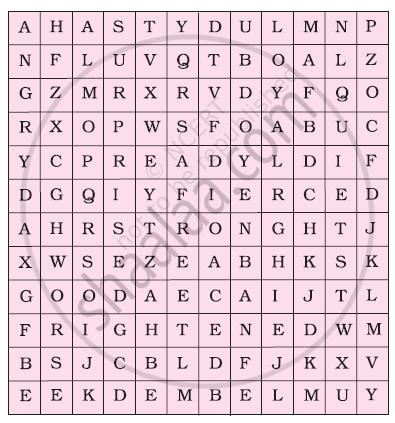
Answer the following question.
Why do you think the writer visited Miss Beam’s school?
Multiple Choice Question:
Such silly questions are baseless, still ______
Add im- or in- to each of the following words and use them in place of the italicised words in the sentences given below.
| patient, proper, possible, sensitive, competent |
He lacks competence. That’s why he can’t keep any job for more than a year.
Complete the following sentence by providing a reason:
In Act III, Scene II of the play, The Tempest, Stephano threatens to tie Trinculo to the next tree because ______.
Complete the following sentence by providing a reason:
Towards the end of the poem Birches, the poet expresses a wish to return to Earth because ______.
