Advertisements
Advertisements
प्रश्न
Look at the words the poet uses to describe what he sees and hears at Innisfree
- Bee-loud glade
- Evenings full of the linnet’s wings
- Lake water lapping with low sounds
What pictures do these words create in your mind?
Advertisements
उत्तर
- These words bring to our minds the image of buzzing bees.
- These words bring up the image of linnets flying across an evening sky.
- These words evoke not only the image but also the soft sound of a lake's water washing the shore.
संबंधित प्रश्न
A Russian girl, Maria Sharapova, reached the summit of women’s tennis when she was barely eighteen. As you read about her, see if you can draw a comparison between her and Santosh Yadav.
Match the following.
| something disarming | something that makes you feel friendly, taking away your suspiciousness |
| at odds with | in contrast to; not agreeing with |
| glamorous attire | attractive and exciting clothes |
| in almost no time | quickly, almost immediately |
| poised beyond her years | more calm, confident and in control than people of her age usually are |
| packed off | sent off |
| launched | started |
| heart wrenching | causing strong feelings of sadness |
Now rewrite the pair of sentences given below as one sentence.
You have nothing. That makes you very determined.
(a) Given below are five lines from a poem but they are not in the right order.
Get into groups of four. Read the lines and put them in the right order. Read the version that you develop to the whole class.
| The voice of thunder declares my arrival. |
| I emerge from the heart of the sea. |
| I descend and embrace the flowers. |
| I am dotted silver threads dropped from heaven. |
| The rainbow announces my departure. |
(b) Who is ‘I’ in these lines?
(c) Imagining yourself as the subject of this poem, write five lines about yourself in less than five minutes.
You may like to
- define yourself
- state what you do
- explain why people like/dislike you
- mention any other characteristic about yourself
Read the comic strip based on. H.G. Wells' novells.


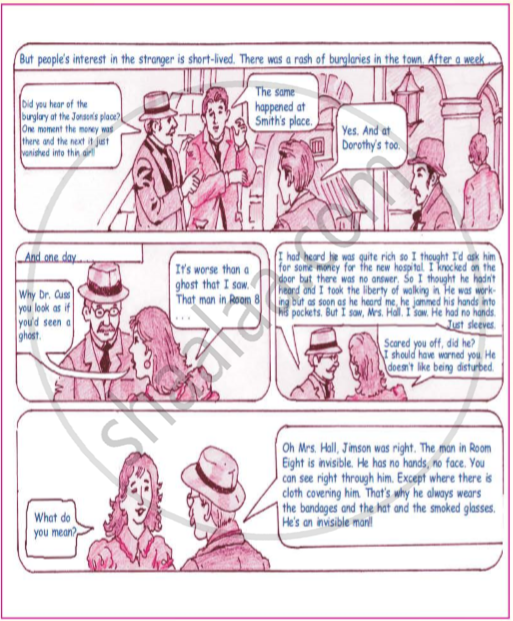
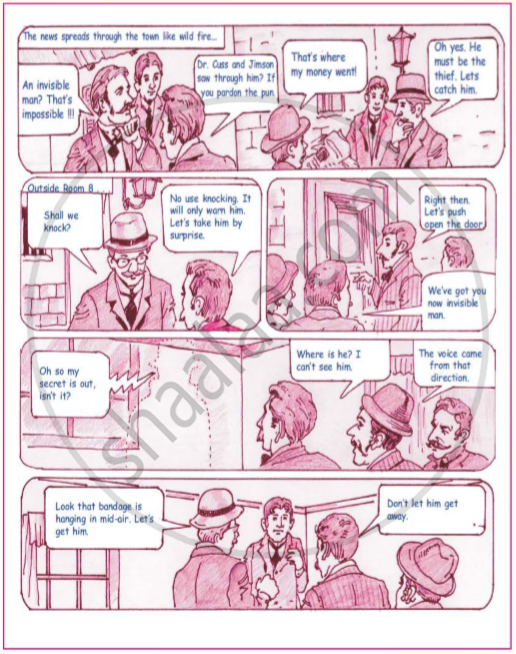
Answer the questions by ticking the correct option.
(a) The strange-looking man wanted ....
(i) the best room at the inn.
(ii} a room with a fire and a good lock.
(iii} a room with a good view.
(iv) a room where he could work quietly.
(b) Jimson was suspicious of the stranger because ...
(i} he did not answer Jimson's questions.
(ii} he did not want to talk about the weather.
(iii} he kept his back turned towards Jimson at all times.
(iv) he shouted atJimson when he entered his room.
(c) The people of the town gossiped about the stranger as ...
(i} he did not go out or talk to anyone in the town.
(ii} he had met with an accident and his face was bandaged.
(iii} he was new to the town and behaved rudely.
(iv) he stayed in his room and did not show his face to anyone.
(d) 'There was a rush of burglaries in the town. This means that ________
(i} there were many robberies in the town.
(ii) a few people in the town had seen a rob her.
(iii} the burglaries in the town were done in a rush.
(iv) the burglar was a rash and careless man.
(e) Although Jimson and Dr Cuss are suspicious of the strange guest, Mrs Hall tolerates him because ....
(i} she is not superstitious or ignorant.
(ii) she is sorry for the stranger who is bandaged.
(iii} the stranger is paying her a good amount of money for the room.
(iv} the stranger is polite and kind to Mrs Hall at all times.
(f) The stranger who was staying at the inn can be described as being ....
(I} violent
(ii} upright
(iii} dishonest
(iv) sensible
"Now tell us what 'twas all about,"
Young Peterkin, he cries;
And little wilhelmine looks up
with wonder-waiting eyes;
"Now tell us all about the war,
And what they fought each other for."
"It was the English," Kaspar cried,
"Who put the French to rout;
But what they fought each other for,
I could not well make out;
But everybody said,"quoth he,
"That 'twas a famous victory.
Read the lines given above and answer the question that follow.
Quote the lines that show the children were curious about the battle and its outcome?
It matters little where we pass the remnant of our days. They will not be many. The Indian’s night promises to be dark. Not a single star of hope hovers above his horizon. Sad-voiced winds moan in the distance. Grim fate seems to be on the Red Man’s trail, and wherever he will hear the approaching footsteps of his fell destroyer and prepare stolidly to meet his doom, as does the wounded doe that hears the approaching footsteps of the hunter.
A few more moons, a few more winters, and not one of the descendants of the mighty hosts that once moved over this broad land or lived in happy homes, protected by the Great Spirit, will remain to mourn over the graves of a people once more powerful and hopeful than yours. But why should I mourn at the untimely fate of my people? Tribe follows tribe, and nation follows nation, like the waves of the sea. It is the order of nature, and regret is useless. Your time of decay may be distant, but it will surely come, for even the White Man whose God walked and talked with him as friend to friend, cannot be exempt from the common destiny. We may be brothers after all. We will see.
Read the extract given below and answer the question that follow.
How does Seattle predict the future of his tribe to be?
It matters little where we pass the remnant of our days. They will not be many. The Indian’s night promises to be dark. Not a single star of hope hovers above his horizon. Sad-voiced winds moan in the distance. Grim fate seems to be on the Red Man’s trail, and wherever he will hear the approaching footsteps of his fell destroyer and prepare stolidly to meet his doom, as does the wounded doe that hears the approaching footsteps of the hunter.
A few more moons, a few more winters, and not one of the descendants of the mighty hosts that once moved over this broad land or lived in happy homes, protected by the Great Spirit, will remain to mourn over the graves of a people once more powerful and hopeful than yours. But why should I mourn at the untimely fate of my people? Tribe follows tribe, and nation follows nation, like the waves of the sea. It is the order of nature, and regret is useless. Your time of decay may be distant, but it will surely come, for even the White Man whose God walked and talked with him as friend to friend, cannot be exempt from the common destiny. We may be brothers after all. We will see.
Read the extract given below and answer the question that follow.
Why does Seattle say that they maybe brothers after all?
But even as he approached the boy, Mr. Oliver sensed that something was wrong. The boy appeared to be crying. His head hung down, he held his face in his hands, and his body shook convulsively. It was a strange, soundless weeping, and Mr. Oliver felt distinctly uneasy.
Well, what’s the matter, he asked, his anger giving way to concern. What are you crying for? The boy would not answer or look up. His body continued to be wracked with silent sobbing.
Oh, come on, boy. You shouldn’t be out here at this hour. Tell me the trouble. Look up.
Read the extract given below and answer the question that follow.
Describe the posture of the boy.
Read the extract given below and answer the questions that follow:
The buoy of the Inchcape Bell was seen
A darker speck on the ocean green;
Sir Ralph the Rover walked his deck,
And fixed eye on the darker speck.
(The Inchcape Rock: Robert Southey)
(i) Contrast the weather when Sir Ralph the Rover passed the Inchcape Rock the first time with the weather when he returned to the place.
(ii) Why had the Abbot of Aberbrothok hung a bell on the Inchcape Rock?
(iii) Why did Sir Ralph cut the bell from the Inchcape Rock? Describe the manner in which it sank underwater.
(iv) What did Sir Ralph say to reassure his men when it became very dark? What opinion did one of the sailors have about their location? What did they all wish for?
(v) How did the ship sink? What sound did Sir Ralph imagine he could hear in his dying moments? What is the message of the poem?
Why did Gopal’s wife find his activities strange?
Give the character sketch of the lady in The Bear Story’.
Does father lose all his hope of bringing the cat down?
Watch a tree or a plant, or walk across a field or park at the same time everyday for a week. Keep a diary of what you see and hear. At the end of the week, write a short paragraph or a poem about your experiences. Put your writing up on the class bulletin board.
Multiple Choice Question:
What does the expression leave their greens’ mean?
Look at the following phrases and their meanings. Use the phrase to fill in the blank in the sentence given below.
They _______________ on the last stage of their journey.
What was Rasheed’s fault at the fair?
Why did the daimio reward the farmer, but punish his neighbour for the same act?
What is ‘strange’ about Mr Nath’s Sundays?
The words helper, companion, partner and accomplice have very similar meanings, but each word is typically used in certain phrases. Can you fill in the blanks below with the most commonly used words? A dictionary may help you.
find a good …………..
In Act V, Scene I of the play The Tempest, Alonso says, "Irreparable is the loss." What is the irreparable loss being referred to here?
