Advertisements
Advertisements
प्रश्न
Notice how in a comic book, there are no speech marks when characters talk. Instead what they say is put in a speech ‘bubble’. However, if we wish to repeat or ‘report’ what they say, we must put it into reported speech.
Change the following sentences in the story to reported speech. The first one has been done for you.
Bring the man to me at once. The king ordered the guard________________________
Advertisements
उत्तर
Bring the man to me at once.
The king ordered the guard to bring the man to him at once.
संबंधित प्रश्न
Tick the right answer.
When a government bans something, it wants it (stopped/started).
Answer the following question in one or two sentences.
What was Kezia’s father’s routine
(i) before going to his office?
(ii) after coming back from his office?
(iii) on Sundays?
Read the following extracts from the story, and try to puzzle out the meanings of the encircled words from other words and phrases in the extract. Write the clues in the empty boxes. Then give your own explanation of the encircled words.
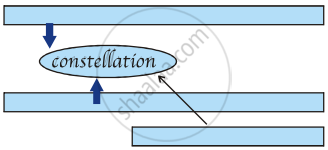
I saw individual stars, but I could not distinguish the constellation they belonged to. Then dawn came and put out all my stars.
Therefore, constellation means ______.
Six humans trapped by happenstance
In black and bitter cold.
Each one possessed a stick of wood,
Or so the story's told.
Their dying fire in need of logs;
The first man held his back.
For on the faces around the fire,
He noticed one was black.
Read the lines given above and answer the question that follow:
What does the phrase ‘six humans’ signify?
Of the seven hundred villages dotting the map of India, in which the majority of India’s five hundred million live, flourish and die, Kritam was probably the tiniest, indicated on the district survey map by a microscopic dot, the map being meant more for the revenue official out to collect tax than for the guidance of the motorist, who in any case could not hope to reach it since it sprawled far from the highway at the end of a rough track furrowed up by the iron-hooped wheels of bullock carts. But its size did not prevent its giving itself the grandiose name Kritam, which meant in Tamil coronet or crown on the brow of the subcontinent. The village consisted of fewer than thirty houses, only one of them built from brick and cement and painted a brilliant yellow and blue all over with
gorgeous carvings of gods and gargoyles on its balustrade, it was known as the Big House. The other houses, distributed in four streets, were generally of bamboo thatch, straw, mud and other unspecified material. Muni’s was the last house in the fourth street, beyond which stretched the fields. In his prosperous days Muni had owned a flock of sheep and goats and sallied forth every morning driving the flock to the highway a couple of miles away.
Read the extract given below and answer the question that follow.
Where was Muni’s house located?
Most terribly cold it was; it snowed, and was nearly quite dark, and evening— the last evening of the year. In this cold and darkness there went along the street a poor little girl, bareheaded, and with naked feet. When she left home she had slippers on, it is true; but what was the good of that? They were very large slippers, which her mother had hitherto worn; so large were they; and the poor little thing lost them as she scuffled away across the street, because of two carriages that rolled by dreadfully fast.
One slipper was nowhere to be found; the other had been laid hold of by an urchin, and off he ran with it; he thought it would do capitally for a cradle when he some day or other should have children himself. So the little maiden walked on with her tiny naked feet, that were quite red and blue from cold. She carried a quantity of matches in an old apron, and she held a bundle of them in her hand. Nobody had bought anything of her the whole livelong day; no one had given her a single farthing. She crept along trembling with cold and hunger—a very picture of sorrow, the poor little thing!
Read the extract given below and answer the question that follow.
Describe the condition of the girl.
Mark the right item.
The old farmer and his wife loved the dog
Who is the ‘he’ in the line "I couldn’t quite hear what he said" of the extract?
Does father lose hope?
How does father react to the mother's warning?
Fill in the blank in the sentence below with the words or phrases from the box. (You may not know the meaning of all the words. Look such words up in a dictionary, or ask your teacher.)
I started early to be on time, but I was ______. There was a traffic jam!
Word in the box given below indicates a large number of… For example, ‘a herd of cows’ refers to many cows. Complete the following phrase with a suitable word from the box.
a _______________ of cattle
Why did the Dog decide to lose his freedom?
How did the Emperor of Japan reward Taro?
Answer the following question:
Where was Kalpana Chawla born? Why is she called an Indian – American?
What does the child think about his/her teacher?
Multiple Choice Question:
How are words related to ideas?
Multiple Choice Question:
The ‘Whatif song haunts the speaker ______
What aspect of shylock's nature is revealed in his words, "To bait fish withal; if it will feed nothing else, it will feed any revenge"?
In the poem, John Brown, John Brown drops his medals into his mother's hands because ______.
