Advertisements
Advertisements
प्रश्न
Look at the notes given below and complete the paragraph that follows by choosing the correct options from the choices given below. Write the correct options in your answer sheet against the correct blank numbers.
Kalakshetra - cultural academy - preserves - Indian art - founded in 1936 - internationally recognized Indian Parliament Act - institution of national Importance.
Kalakshetra is a cultural academy dedicated to (a) especially Bharathanatyam. The academy (b) Arundale and under her guidance the institution achieved (c) for its unique style and
perfection. In 1993 an (d) recognized the Kalakshetra foundation as an institution of national importance.
(a) (i) preserving Indian art
(ii) preservation in Indian art
(iii) preserves Indian art
(iv) preserve Indian art
(b) (i) is being founded in 1936 by
(ii) was founded in 1936 by
(iii) has been founded in 1936 by
(iv) founded in 1936 by
(c) (i) internationally recognised
(ii) internationally recognition
(iii) international recognition
(iv) international recognised
(d) (i) an Act of the Indian Parliament
(ii) an Act by Indian Parliament
(iii) an Act in Indian Parliament
(iv) the Act by Indian Parliament
Advertisements
उत्तर
(a) (i) preserving Indian art
(b) (ii) was founded in 1936 by
(c) (iii) international recognition
(d) (i) an Act of the Indian Parliament
APPEARS IN
संबंधित प्रश्न
Have you ever been on a trip to any place in India, where you didn’t know the language spoken locally? How did you feel? How did you manage to communicate?
(a) Write down the positive and negative traits of Private Quelch’s character instances from the story.
| Positive traits | Instances from the story |
| i. | |
| ii. | |
| iii. | |
| iv. | |
| Negative traits | Instances from the story |
| i. | |
| ii. | |
| iii. | |
| iv. |
(b) Now, share your notes with the class. Add details if you need to.
(c) Attempt a character sketch of Private Quelch using your notes in about 100 words.
Answer the following question:
Describe Mr. Bramble as he has been described in the story.
Answer the following question:
Why was Mrs. Bramble upset when she came to hear that Bill had decided not to fight?
Answer the following question:
Who was Jerry Fisher? What did he say to try and convince Bill to change his mind?
A large part of the story is composed of conversation between the characters.
Can you convert it into a play and in groups, present your version of the play before the class? Before that, decide onthe members of cast, minimum props required and also the costumes.
Before you read the story write down the answers to these questions.
Which was the latest book that you read?
Who was the author?
Who were the main characters?
When did you read the book?
How long did you take to complete reading it?
What genre did it belong to?
Why would/wouldn't you recommend it?
Have you made choices that are acceptable and less ‘risky’ or have you followed the beaten track? Why?
Answer the following question.
Explain the ending of the song.
You already know the two literary devices generally used by writers and poets for comparison, i.e. metaphor and simile.
e.g. a) He was a lion in the battle, (metaphor)
b) He fought like a lion, (simile)
In (a) the writer talks of the soldier in terms of a lion. The comparison is implied.
In (b) the writer compares the soldier to a lion with the use of the word like, (as may also be used for such comparisons.)
Read the poem again and note down the metaphors and similes. Complete the following chart.
| Reference | Metaphor | Simile |
| world | all the world's a stage | |
| men, women | ||
| school-boy | ||
| lover | ||
| soldier | ||
| reputation | ||
| voice |
Which comparison(s) do you find most interesting? Why?
Answer the following question.
a) "…But up-and-down brushin'
And pokin' and fussin'
Didn't seem worth the time-I could bite!"
What do these lines convey?
During summer vacation, you and your friends decide to enroll in 'The School for Flying'. While training, you had an interesting and unforgettable experience. Here's an account of it. Complete it by using words from A.1.
It was the most amazing summer camp that we had ever been to. My friend Jonathan and I decided to join the flying-school. We underwent rigorous training and gained a lot of expertise, Jonathan in charting the course of flight and I, in flying the plane. 25 May 2010 was the Red Letter Day as we were to fly a plane for nearly half an hour without an instructor. At 6: 15 GMT we took the flight, Jonathan as a (1)............ and I, as the (2) ............ . We remembered all the instructions given to us at the academy and we were (3) ............ signals at frequent intervals. The day was clear but windy. We were (4) ................. hills and were flying along the coast. Suddenly, the weather turned turbulent. We (5)............ our position asking for advice. But unfortunately there was no communication from the other end. All of a sudden, we heard an explosion. The fuel tank of our plane had caught fire due to the lightning. We immediately decided to (6) ............... the plane and donned the (7) .......... that were available. We were blown off 55-60 kms away from the coast and we landed on the outskirts of a dense forest. We were not injured but were hungry and thirsty. We ate some wild fruit hoping it was safe. But unluckily it was disastrous for Jonathan as he had (8) ............ after that. We remembered our instructor's clear and (9)................ instructions in case of an emergency. We discussed various strategies and decided to (10).............. to the core about the life saving strategies. We started exploring the forest. We must have wandered for about an hour or so along the coast, when my eyes suddenly fell on something red in the crevice of a big rock. I went closer to it and to my great happiness and relief I saw a (11) ............. . It was (12).......... away in a cosy nook. Oh! What a relief it was! We were successful in rowing our way back from where we had started. Meanwhile, the coast guards were hunting for us. We had instantly become celebrities!
Complete the following news item by choosing the correct word from the options given below.

(a) (i) has celebrated
(ii) was celebrating
(iii) celebrated
(iv) was celebrated
(ii) was
(iii) was being
(iv) has been
(ii) had inaugurated
(iii) inaugurated
(iv) inaugurating
(ii) planted
(iii) were planting
(iv) had planted
(ii) had been urging
(iii) urged
(iv) urging
(ii) was presented
(iii) were presenting
(iv) had presented
Listen carefully to 'Meet the personality of the month programme' read out by teacher/ student from the page no 167 and as you are listening fill in the details.
ENVIRONMENTALIST: Mr Manu Srivastava
Causes of pollution
1. Atmosphere
|
a__________________ |
2. water
|
a___________________ |
3. Effects of pollution
| a________________ _________________ b________________ ________________ |
Human Rights activist- Ms.Shraddha Shankar
Reasons for working in the factory
| a. ____________________________________________________ ______________________________________________________ |
Effects
| a________________ _________________ b________________ _________________ c________________ _________________ |
Steps which can be taken
| a________________ _________________ b________________ _________________ c________________ _________________ |
In groups of four prepare a questionnaire for a pilot who has survived the Bermuda Triangle. Use the hints given below.
- Radar normal
- No disturbances
- Sudden communication failure
- Strange occurrence (use any of the theories or myths you have just read about)
On a cold winter night you hear a loud shrieking noise at repeated intervals. What might have caused this?
Write down your ideas using the pattern below.
| it |
might could must |
have been |
the owl hooting a ghost____________ |
Here are a police constable's notes or his investigation or the murder at Manor House. After reading the notes, discuss where the murder could have taken place. What was the motive behind the evil act? How was the act committed?
| Murder at Manor House Birlstone : January 6th Manor House - state of wild confusion and alarm - white faced servants - frightened butler - man horribly injured- terrible marks - we have no clues yet |
Prevention is better than cure.
Swine flu has been declared (as) a pandemic.
In groups of four discuss the following.
(a) What has been done by the authorities to cope with the problem?
(b) What are the consequences of such a major world-wide infection?
Write out the answer to the questions as a flowchart using the passive form of the verb.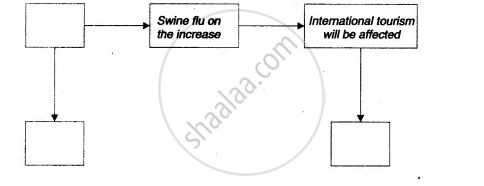
Either in groups or individually, make a power-point presentation on either of the two games. Incorporate points from the table above and any other interesting information I detail.
