Advertisements
Advertisements
प्रश्न
Prevention is better than cure.
Swine flu has been declared (as) a pandemic.
In groups of four discuss the following.
(a) What has been done by the authorities to cope with the problem?
(b) What are the consequences of such a major world-wide infection?
Write out the answer to the questions as a flowchart using the passive form of the verb.
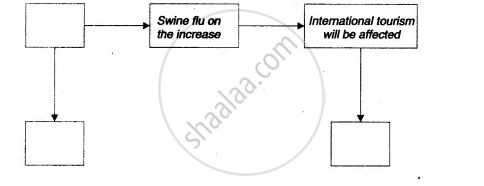
Advertisements
उत्तर
Meant for group discussion at class level.
Answers to questions (a) and (b) as are follows :
(а)
- Sufficient information about preventive measures has been disseminated through print and electronic media all over the country.
- Special laboratories for testing have been set up at almost all govt, hospitals.
- Hospitals have been supplied with the prescribed medicine ‘Tamiflu’ in sufficient quantities all over the countries.
- Health Ministry officials both at centre and state levels have been posted to spread awareness about the swine flu and how to cope up with its incidence.
(b) If such a major world-wide infection occurs, the results will be disastrous. These could be like :
- death of millions of people
- turmoil all over the world among humans
- international traffic ground to a halt
- economies of many countries will stand affected
- many sectors will be affected so much that more panic will prevail.
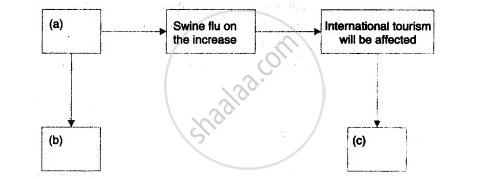
(a) Swine flu caused by a virus/Swine flue declared as pandemic
(b) International community gets on High Alert
(c) Panic conditions will prevail leading to international crisis. A worldwide effort is on to find the cure of the disease.
APPEARS IN
संबंधित प्रश्न
Have you ever been on a trip to any place in India, where you didn’t know the language spoken locally? How did you feel? How did you manage to communicate?
Here is a story about Swami and his grandmother. After reading the excerpt, change it into a conversation between Swami and his Grandmother.
After the night meal with his head on his granny’s lap, nestling close to her, Swaminathan felt very snug and safe in the faint atmosphere of cardamom and cloves. ‘Oh, Granny !’ he cried ecstatically. ‘You don’t know what a great fellow Rajam is.’ He told her the story of the first enmity between Rajam and Mani and the subsequent friendship.
‘You know, he has a real police dress,’ said Swaminathan. ‘Is it? What does he want a police dress for?’ asked Granny.
‘His father is the Police Superintendent. He is the master of every policeman here.’ Granny was impressed. She said that it must be a tremendous office indeed. She then recounted the days when her husband, Swaminathan’s grandfather, was a powerful sub-magistrate, in which office he made the police force tremble before him and the fiercest dacoits of the place flee. Swaminathan waited impatiently for her to finish the story. But she went on, rambled, confused, mixed up various incidents that took place at different times. ‘That will do, Granny,’ he said ungraciously. ‘Let me tell you something about Rajam. Do you know how many marks he gets in arithmetic?’
‘He gets all the marks, does he, child?’ asked Granny.
‘No silly. He gets ninety marks out of one hundred.’
‘Good. But you must also try and get marks like him…. You know, Swami, your grandfather used to frighten the examiners with his answers sometimes. When he answered a question, he did it in a tenth of the time that others took to do it. And then, his answers would be so powerful that his teachers would give him two hundred marks sometimes.
‘Oh, enough, Granny ! You go on bothering about old unnecessary stories. Won’t you listen to Rajam?’
‘Yes, dear, yes.’
‘Granny, when Rajam was a small boy, he killed a tiger.’
Swaminathan started the story enthusiastically : Rajam’s father was camping in a forest. He had his son with him. Two tigers came upon them suddenly, one knocking down the father from behind. The other began chasing Rajam, who took shelter behind a bush and shot it dead with his gun.
‘Granny, are you asleep?’ Swaminathan asked at the end of the story.
Now read the dialogue and complete the conversation:
Swarni: You don’t know what a great fellow Raj am is! In the beginning I could not get along with him but now he is my good friend. And you know, he has a real police dress.
Grandmother: Is it? What does he want a police dress for?
Swarni: His father is the Police Superintendent. He is the master of every policeman here.
Grandmother: I think, it must be a tremendous office. Do you know, your grandfather was a powerful submagistrate and the Police Force trembled before him? Even the fiercest dacoits of the place fled.
Swarni: That will do, Granny. It’s so boring. Let me tell you something about Raj am. Do you know how many marks he gets in arithmetic?
Grandmother: He gets all the marks, doesn’t he, child?
Given below are five qualities that Charles Hooper displayed during his struggle for survival.

Get into groups of four. Each team will choose one quality to talk about to the whole class for about one minute. But before you talk you have two minutes to think about it. You can make notes if you wish.
Answer the following question:
How did Harold come to know that his father was a boxer?
A large part of the story is composed of conversation between the characters.
Can you convert it into a play and in groups, present your version of the play before the class? Before that, decide onthe members of cast, minimum props required and also the costumes.
Answer the following question briefly.
What was John A. Pescud’s opinion about best sellers? Why?
Irony refers to the use of words to convey a meaning that is the opposite of their literal meaning. Working in pairs bring out the irony in the following:
(a) The title of the story, “The Best Seller”.
(b) Pescud’s claim, “When people in real life marry, they generally hunt up somebody in their own station. A fellow usually picks out a girl who went to the same high school and belonged to the same singing-society that he did.”
(c) The name Trevelyan.
c
I chatter, chatter, as I flow
To join the brimming river,
For men may come and men may go,
But I go on for ever
(a) Who does ‘I’ refer to in the given lines?
(b) How does it ‘chatter’?
(c) Why has the poet used the word ‘brimming’? What kind of a picture does it create?
(d) Explain the last two lines of the stanza.
Identify the rhyme scheme of the poem.
Rain in the hills and rain in the desert present entirely different scenario. In the
hills it revitalises the greenery and freshens the vegetation; it waters the parched
land and relieves the thirsty and panting souls in the desert.
(i) This has been a year of scanty rains. Imagine how the rain would be welcomed
when it pours in the hills and in the desert after a long dry spell. Choose one such
place and describe
(a) What are you likely to see?
(b) What would happen to the rain water?
(c) What would be the scene before and after the rain?
(ii) How would you express rain as
Answer the following question.
a) "…But up-and-down brushin'
And pokin' and fussin'
Didn't seem worth the time-I could bite!"
What do these lines convey?
Discuss in groups
What would you do in the following situations? Give reasons for your answer
If you were travelling by bus and you saw someone pick another passenger's
pocket.
- If you found a wallet on the road.
- If you were in a shop and you saw a well-dressed lady shoplifting.
- If your best friend is getting involved with an undesirable set of friends.
- If you were in school and you saw one of your class-mates steal another child's
pen.
Answer the following question briefly.
The convict says, "I am too old a bird to be caught with chaff." What does he mean
by this statement?
Here are a few questions and statements written down by the Cultural Secretary that she/ he needs to share. Tick the correct words from those given in brackets:
- How (much/many) (chair/chairs) do we need?
- (Much/Several) (school/schools) will be participating.
- (Several/Much) (student/students) have arrived.
- How (much/many) (information/informations) does this brochure give?
- We have only (a few/a little) sponsors for (some/much) events.
WRITING A MYSTERY STORY
Mysteries can be divided into several categories. There are puzzling stories, detective I crime stories, and suspense stories. They all give the reader a chance to become involved in the solution of the story through clues and character descriptions.
Characters
Before you start to write, think about the characters you might put in your story.
• What will each character do?
• Why is he or she important to the story?
• In what ways are your characters alike?
• How are they different?
• What can your characters learn from each other?
• One last thing to remember: your characters don't always have to be human. If an animal plays a part in the story, that animal is a character, too
Setting
A story has to happen in a place.
• The setting might be a place you are familiar with.
• It might even be another planet!
• A setting doesn't even have to be a real place.
Details
• Use your Imagination.
• Details help readers understand how something looks, how it feels, how it sounds - even how something smells or tastes!
Plot
• Your characters have to DO something!
• What they do is the Plot of your story.
• To make the plot exciting add Situations.
Ending
• The Ending of a story is the solution to the conflict.
• Solve the problem, dilemma or conflict faced by the main character.
• Show that your main character has changed or grown in some way.
• Tie up all the loose ends. Readers shouldn't have to choose between several hinted endings.
Study the following sentences. Select the one underlined word which is incorrect. Write the incorrect answer in the boxes provided. One has been done as an example.
e.g. The National Gallery of Art at Washington D.C., is one of the world’s greatest museums.
| at |
(a) Millions of people had entered its doors to see the paintings by some of the world’s finest artists
(b) But if, those priceless masterpieces are to be preserved, the gallery must protected them carefully.
(c) The 150 guards have successively prevented damage and theft.
(d) But, protecting the paintings from nature was a greater problem.
In Question 3, you read an eye-witness account of a robbery. On the basis of your reading of the Birlstone tragedy, in about 125 words, write Dr Wood's account of the discovery of John Douglas's body.
The Passive in Tentative Statements
The passive is often used in tentative statements where the writer tries to be as neutral as possible.
| considered | to | be… | ||
| It | is | said | ||
| known | to | have been… | ||
| They | are | acknowledged believed regarded as… |
8.1
Look at the box below. Write tentative statements following the pattern in the table above.

Group the prepositions in the box below to indicate their use as prepositions of place (P), movement (M) or time (T). There may be more than one category for each.
| between ________ along ________ since ________ up ________ among ________ in front of ________ after ________ |
past ________ on ________ behind ________ round ________ for ________ across ________ through ________ |
before ________ until ________ beside ________ out of ________ at ________ under ________ during ________ |
