Advertisements
Advertisements
प्रश्न
Look at the words given in the box below
|
snigger |
wriggle |
sneak |
squeak |
|
squawk |
titter |
pant |
chuckle |
|
giggle |
jeer |
chortle |
guffaw |
|
sigh |
sidle |
boo |
shriek |
|
scramble |
croak |
straggle |
plod |
|
gasp |
|
|
|
Now classify them according to their closeness in meaning to the words given below
|
A |
B |
C |
D |
E |
|
snigger |
wriggle |
squeak |
jeer |
sigh |
Advertisements
उत्तर
giggle boo plod snigger wriggle squeak jeer sight litter
chortle chuckle guffaw sneak straggle scramble sidle shriek squawk croak gasp pant
APPEARS IN
संबंधित प्रश्न
We sang our school fight song dozens of times – en route to Arlington National cemetery, and even on an afternoon cruise down the Potomac River. We visited the Lincoln Memorial twice, once in day – light, the second time at dusk. My classmates and I fell silent as we walked in the shadows of those 36 marble columns, one for every state in the Union that Lincoln laboured to preserve. I stood next to Frank at the base of the 19 foot seated statue. Spotlights made the white Georgian marble seem to glow. Together we read famous words from Lincoln’s speech at Gettysburg remembering the most bloody battle in the war between the status : “………….we here highly resolve that these dead shall not have died in vain – that this nation, under God, shall have a new birth of freedom………..”
As Frank motioned me into place to take my picture, I took one last look at Lincoln’s face. He seemed alive and so terribly sad.
The next morning I understand a little better why he wasn’t smiling. “Clifton,” a chaperone said, “could I see you for a moment?”
(1) When did the boys visit Lincoln Memorial?
(2) What made the Georgian marble glow?
(3) What did the words: “………. We here highly resolve that these dead shall not have died in vain – that this nation, under God, shall have a new birth of freedom …………” remind them?
(4) Do you believe in building memorials? What kind should they be, if your answer is ‘yes’? If no, give reasons why you do not believe in memorials?
Read the following passage and complete the activities given below:
What has not changed over the years? Does this suggest something to you?
Notice this expression in the text. Infer its meaning from the context.
blow-by-blow account
What, according to Russell, is the importance of love in life?
What is the central argument of the speaker?
What two things are compared in the poem?
Make groups and discuss the following:
What fatal dangers/problems did mankind face centuries ago, but are no longer a threat today?
State whether the following statement is True or False. Correct the false statement by finding evidence from the poem to support your remark.
Birds and insects were benefitted from the tree.
Answer the given question in your own words.
What was the first task given to the Swallow?
Go through the poem and state whether the following statement is true or false.
Planners deliberately find drawbacks in the old city planning.
The term 'Anaesthesia' in the poem means - 'The planner gives beautiful pictures of the new modern city'. Now find out what is Amnesia and Hypnosis in the given context.
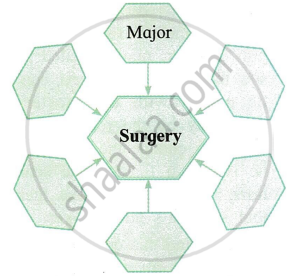
Fill in the web with words related to 'Surgery'.
Have you ever given up on something good? Share your story with your friend.
Complete the following statements with the help of the text.
To learn about meditation, you have to see ____________________________________________________________ Watch your thinking. Do not ________________________ Do not ____________________________________ Begin to learn ______________________________ Just watch thought. Do not ____________________________________________________.
Read the given extract (Act III)
Match column A with column B.
| Sr.No. | A | B |
| 1. | Dr. Thomas Stockmann | Opportunist |
| 2. | Katherine | Vulnerable |
| 3. | Peter Stockmann | Honest and upright |
| 4. | Petra | Coward |
| 5. | Hovstad | timid but supportive |
| 6. | Billing | Cuinng and corrupt |
| 7. | Aslaksen | Courageous |
Write a short note on the following:
The ‘four signs’ that Prince Siddharth beheld.
Visit a library:
Read Lewis Carroll’s book ‘Alice in Wonderland.’
Write any three of the silly remarks made by the characters other than Alice. Write why you think the remark is silly.
Read the following sentence aloud. Write who said it and to whom.
“You have nothing else?”
Write five words each -
with the suffix
- -less
- -ly
- -ness
Prepare a ‘PowerPoint’ presentation, using one slide for each of the above points. Present your review in a PPT format in the classroom.
‘And calls our Best away’ is a gentle way of expressing the unpleasant idea of a loved one dying. It is an example of euphemism. Think and write down 3 or 4 ways in which we can express the idea of ‘death’ in a tactful and gentle manner.
- _________________
- _________________
- _________________
- _________________
Make a list of your favourite fruits and vegetables and note down the time of the year when they are available in plenty.
Discuss how you will measure the worth of a book.
Describe Gulliver’s home in Lilliput.
Write what you can do to welcome birds in your surroundings.
Which event in the story tells us that the scarecrow was intelligent?
List all the pairs of antonyms you find in the passage.
Find a word that has a similar meaning.
unfair
Guess the meaning of the following word.
finely
Miranda was brought to the island ____________ years ago.
What did the Bodwells think when they heard the mother shout.
In New York, Mr. Scotti left the plane because he thought he.
Why did Shepherd-Barron reduce the PIN number from six digits to four?
Which theory of Ramanujan helps the ATMs to dispense cash?
How did Hamid’s friends show that they enjoyed eating the sweets?
Find a sentence/word from the text which express the following.
Words related to prize.
Why does the poet tell us to speak gently to young children?
Why did Alice follow the rabbit?
Tackling the Issues
Ask the class to discuss solutions to an issue that plagues contemporary society at large or just your community—for example, homelessness, violence, environmental degradation, hunger.
Half the class should mention idealistic solutions to the chosen issue; the other half should mention only realistic approaches to solving the problem.
See if, in listening to both sides, someone can come up with a proposal that is both realistic and unconventional—an idea that hasn't been tried yet.
Identify the speaker/character.
Wake up, child.
When the author returned from England to Dehradun, he found Grandfather's dream had come true because the______.
What does the peepul do?
Merlin was thrilled when the school arranged the trip because ______.
Narrate the story based on the story map
They all stood around the little jewel of blue means______.
What should we do to save the Earth?
Were the girl and her brother friendly with each other?
Match the rhyming words.
| filth | farmer |
| cook | harm |
| charm | wealth |
| armour | look |
Where is Jaswantgarh located?
Jaswant decided to stay in his post.
Look at the picture and Choose the correct word.

Write the rhyming word.
Nature - ______.
The bird-catcher decided to sit under the ________.
Robinson named the boy______.
Read the advertisement and answer the question given below.

What is the size of the screen?
Write a paragraph on the topic ‘Park’.
Read the passage carefully and answer the following question.
What is the main idea of the story?
Do we worry when the progress is slow?
