Advertisements
Advertisements
प्रश्न
Let R be the relation in the set N given by R = {(a, b) : a = b – 2, b > 6}. Choose the correct answer.
पर्याय
(2, 4) ∈ R
(3, 8) ∈ R
(6, 8) ∈ R
(8, 7) ∈ R
Advertisements
उत्तर
(6, 8) ∈ R
Explanation:
R = {(a, b) : a = b – 2, b > 6}
Here, since b > 6, hence (2, 4) ∉ R and
3 ≠ 8 – 2, ∴ (3, 8) ∉ R and
8 ≠ 7 – 2, ∴ (8, 7) ∉ R
Now for (6, 8), 8 > 6 and 6 = 8 – 2
∴ (6, 8) ∈ R ≠ R
Hence, option (6, 8) ∈ R is correct.
APPEARS IN
संबंधित प्रश्न
Show that the relation R in the set A of all the books in a library of a college, given by R = {(x, y) : x and y have the same number of pages} is an equivalence relation.
Show that the relation R defined in the set A of all triangles as R = {(T1, T2) : T1 is similar to T2}, is an equivalence relation. Consider three right angle triangles T1 with sides 3, 4, 5, T2 with sides 5, 12, 13 and T3 with sides 6, 8, and 10. Which triangles among T1, T2 and T3 are related?
Let L be the set of all lines in the XY plane and R be the relation in L defined as R = {(L1, L2) : L1 is parallel to L2}. Show that R is an equivalence relation. Find the set of all lines related to the line y = 2x + 4.
Let A = {1, 2, 3}. Then number of relations containing (1, 2) and (1, 3) which are reflexive and symmetric but not transitive is ______.
The binary operation *: R x R → R is defined as a *b = 2a + b Find (2 * 3)*4
An integer m is said to be related to another integer n if m is a multiple of n. Check if the relation is symmetric, reflexive and transitive.
Give an example of a relation which is symmetric but neither reflexive nor transitive?
Defines a relation on N:
xy is square of an integer, x, y ∈ N
Determine the above relation is reflexive, symmetric and transitive.
Show that the relation R on the set A = {x ∈ Z ; 0 ≤ x ≤ 12}, given by R = {(a, b) : a = b}, is an equivalence relation. Find the set of all elements related to 1.
Let L be the set of all lines in XY-plane and R be the relation in L defined as R = {L1, L2) : L1 is parallel to L2}. Show that R is an equivalence relation. Find the set of all lines related to the line y= 2x + 4.
If R and S are transitive relations on a set A, then prove that R ∪ S may not be a transitive relation on A.
Write the smallest reflexive relation on set A = {1, 2, 3, 4}.
If A = {3, 5, 7} and B = {2, 4, 9} and R is a relation given by "is less than", write R as a set ordered pairs.
Let A = {2, 3, 4, 5} and B = {1, 3, 4}. If R is the relation from A to B given by a R b if "a is a divisor of b". Write R as a set of ordered pairs.
Let A = {0, 1, 2, 3} and R be a relation on A defined as
R = {(0, 0), (0, 1), (0, 3), (1, 0), (1, 1), (2, 2), (3, 0), (3, 3)}
Is R reflexive? symmetric? transitive?
Let A = {2, 3, 4, 5, ..., 17, 18}. Let '≃' be the equivalence relation on A × A, cartesian product of Awith itself, defined by (a, b) ≃ (c, d) if ad = bc. Then, the number of ordered pairs of the equivalence class of (3, 2) is _______________ .
Mark the correct alternative in the following question:
Let R be a relation on the set N of natural numbers defined by nRm if n divides m. Then, R is _____________ .
Mark the correct alternative in the following question:
Consider a non-empty set consisting of children in a family and a relation R defined as aRb if a is brother of b. Then, R is _____________ .
For the matrix A = `[(2,3),(5,7)]`, find (A + A') and verify that it is a symmetric matrix.
Let L denote the set of all straight lines in a plane. Let a relation R be defined by lRm if and only if l is perpendicular to m ∀ l, m ∈ L. Then R is ______.
Let Z be the set of integers and R be the relation defined in Z such that aRb if a – b is divisible by 3. Then R partitions the set Z into ______ pairwise disjoint subsets
The following defines a relation on N:
x y is square of an integer x, y ∈ N
Determine which of the above relations are reflexive, symmetric and transitive.
Let A = {1, 2, 3}. Which of the following is not an equivalence relation on A?
Let A = {1, 2, 3} and R = {(1, 2), (2, 3), (1, 3)} be a relation on A. Then, R is ____________.
Given set A = {a, b, c}. An identity relation in set A is ____________.
A relation S in the set of real numbers is defined as `"xSy" => "x" - "y" + sqrt3` is an irrational number, then relation S is ____________.
A general election of Lok Sabha is a gigantic exercise. About 911 million people were eligible to vote and voter turnout was about 67%, the highest ever
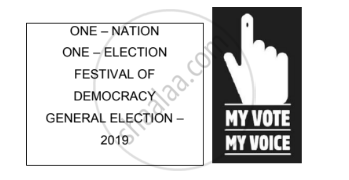
Let I be the set of all citizens of India who were eligible to exercise their voting right in the general election held in 2019. A relation ‘R’ is defined on I as follows:
R = {(V1, V2) ∶ V1, V2 ∈ I and both use their voting right in the general election - 2019}
- Mr. Shyam exercised his voting right in General Election-2019, then Mr. Shyam is related to which of the following?
Students of Grade 9, planned to plant saplings along straight lines, parallel to each other to one side of the playground ensuring that they had enough play area. Let us assume that they planted one of the rows of the saplings along the line y = x − 4. Let L be the set of all lines which are parallel on the ground and R be a relation on L.
Answer the following using the above information.
- Let R = `{ ("L"_1, "L"_2) ∶ "L"_1 bot "L"_2 "where" "L"_1, "L"_2 in "L" }` which of the following is true?
If A is a finite set consisting of n elements, then the number of reflexive relations on A is
Which one of the following relations on the set of real numbers R is an equivalence relation?
A market research group conducted a survey of 2000 consumers and reported that 1720 consumers like product P1 and 1450 consumers like product P2. What is the least number that must have liked both the products?
A relation in a set 'A' is known as empty relation:-
Given a non-empty set X, define the relation R in P(X) as follows:
For A, B ∈ P(X), (4, B) ∈ R iff A ⊂ B. Prove that R is reflexive, transitive and not symmetric.
Statement 1: The intersection of two equivalence relations is always an equivalence relation.
Statement 2: The Union of two equivalence relations is always an equivalence relation.
Which one of the following is correct?
For \(A=\{1,2\}\), which relation is the Universal Relation?
A relation \(R\) on \(A\) is reflexive when which condition holds?
Which relation demonstrates a symmetric relation?
Which relation satisfies the transitive condition for the pairs \((1,2)\) and \((2,3)\)?
Which pair of relations are called trivial relations?
What should be checked to determine whether a relation is transitive?
