मराठी

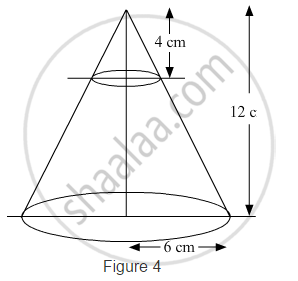
In Fig. 4, from the top of a solid cone of height 12 cm and base radius 6 cm, a cone of height 4 cm is removed by a plane parallel to the base. Find the total surface area of the remaining solid. - Mathematics

Advertisements
Advertisements

प्रश्न

In Fig. 4, from the top of a solid cone of height 12 cm and base radius 6 cm, a cone of height 4 cm is removed by a plane parallel to the base. Find the total surface area of the remaining solid. (Use `pi=22/7` and `sqrt5=2.236`)
थोडक्यात उत्तर
Advertisements

उत्तर

The remaining solid is a frustum of the given cone

Total surface area of the frustum = πl(r1+r2)+πr12+πr22

Where

h = Height of the frustum = 124 = 8 cm

r1 = Larger radius of the frustum = 6 cm

r2 = Smaller radius of the frustum

l = Slant height of the frustum
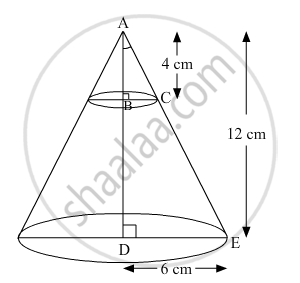
In the given figure, ∆ABC ​~ ∆ADE by AA similarity criterion.

`:.(BC)/(DC)=(AB)/(AD)`

`=>r_2/6=4/12`

r2=2 cm

We know

`l = sqrt(h^2+(r_1-r_2)^2)`

`=>l=sqrt(8^2+(6-1)^2)`

`=>l = 4sqrt5 `

Total surface area of the frustum = πl(r1+r2)+πr12+πr22

= π×4`sqrt5`(6+2)+π×62+π×22

`=pi(32sqrt5+40)`

`=22/7xx111.552`

= 350.592 cm2

Hence, the total surface area of the remaining solid is 350.592 cm2.

shaalaa.com
  या प्रश्नात किंवा उत्तरात काही त्रुटी आहे का?
पाठ 14: Surface Areas and Volumes - Exercise 14.3 [पृष्ठ ७९]

APPEARS IN

आरडी शर्मा Mathematics [English] Class 10
पाठ 14 Surface Areas and Volumes
Exercise 14.3 | Q 20 | पृष्ठ ७९

व्हिडिओ ट्यूटोरियलVIEW ALL [3]

संबंधित प्रश्‍न

The sum of the radius of base and height of a solid right circular cylinder is 37 cm. If the total surface area of the solid cylinder is 1628 sq. cm, find the volume of the cylinder. `("use " pi=22/7)`


2 cubes each of volume 64 cm3 are joined end to end. Find the surface area of the resulting cuboid.


A wooden article was made by scooping out a hemisphere from each end of a solid cylinder, as shown in given figure. If the height of the cylinder is 10 cm, and its base is of radius 3.5 cm, find the total surface area of the article.

 [Use `pi = 22/7`]


Find the area of the shaded region in Fig. 3, where arcs drawn with centres A, B, C and D intersect in pairs at mid-points P, Q, R and S of the sides AB, BC, CD and DA respectively of a square ABCD of side 12 cm. [Use π = 3.14]


A metallic cylinder has radius 3 cm and height 5 cm. To reduce its weight, a conical hole is drilled in the cylinder. The conical hole has a radius of `3/2` cm and its depth is `8/9 `cm. Calculate the ratio of the volume of metal left in the cylinder to the volume of metal taken out in conical shape.


A vessel is in the form of hemispherical bowl surmounted by a hollow cylinder of same diameter. The diameter of the hemispherical bowl is 14 cm and the total height of the vessel is 13 cm. Find the total surface area of the vessel. `[\text{Use}pi=22/7]`


Two cubes each of volume 27 cm3 are joined end to end to form a solid. Find the surface area of the resulting cuboid. 


Two solid cones and B are placed in a cylindrical tube as shown in fig .16.76. The ratio of their capacities are 2: 1 . Find the heights and capacities of the cones . Also, find the volume of the remaining portion of the cylinder.


If the total surface area of a solid hemisphere is 462 cm2, then find its volume.  


A copper wire of diameter 6 mm is evenly wrapped on a cylinder of length 18 cm and diameter 49 cm to cover its whole surface. Find the length and the volume of the wire. If the density of the copper be 8.8 g per cm3, then find the weight of the wire.


A right triangle whose sides are 15 cm and 20 cm (other than hypotenuse), is made to revolve about its hypotenuse. Find the volume and surface area of the double cone so formed. (Choose value of π as found appropriate)


Find the ratio of the volume of a cube to that of a sphere which will fit inside it.


The shape of the gilli used in a gilli-danda game is a combination of


If the areas of three adjacent faces of a cuboid are x, y and z, respectively, the volume of the cuboid is ______.


Two cubes each of volume 8 cm³ are joined end to end, then the surface area of the resulting cuboid is ______.


The curved surface area of glass having radii 3 cm and 4 cm respectively and slant height 10 cm is ______.


Two cones with same base radius 8 cm and height 15 cm are joined together along their bases. Find the surface area of the shape so formed.


There are two identical solid cubical boxes of side 7 cm. From the top face of the first cube a hemisphere of diameter equal to the side of the cube is scooped out. This hemisphere is inverted and placed on the top of the second cube’s surface to form a dome. Find

  1. the ratio of the total surface area of the two new solids formed
  2. volume of each new solid formed.

Statement A (Assertion): Total Surface area of the top is the sum of the curved surface area of the hemisphere and the curved surface area of the cone.

Statement R( Reason): Top is obtained by joining the plane surfaces of the hemisphere and cone together.


The ratio of total surface area of a solid hemisphere to the square of its radius is ______.


Share
Notifications

Englishहिंदीमराठी


      Forgot password?
Use app×