मराठी

A Right Triangle Whose Sides Are 15 Cm and 20 Cm (Other than Hypotenuse), is Made to Revolve About Its Hypotenuse. Find the Volume and Surface Area of the

Advertisements
Advertisements

प्रश्न

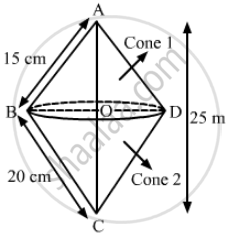
A right triangle whose sides are 15 cm and 20 cm (other than hypotenuse), is made to revolve about its hypotenuse. Find the volume and surface area of the double cone so formed. (Choose value of π as found appropriate)

बेरीज
Advertisements

उत्तर

We have,

In ΔABC, ∠B = 90° , AB = l=15 cm and BC = l= 20 cm

Let OD = OB = r , AO = hand CO = h

Using Pythagoras therom, 

`"AC" = sqrt("AB"^2 + "BC"^2)`

`=sqrt(15^2 + 20^2)`

`= sqrt(225 + 400)`

`= sqrt(625)`

⇒ h = 25 cm

As, ar(ΔABC)` = 1/2xxACxxBO=1/2xxABxxBC `

⇒ AC × BO = AB × BC

⇒ 25r = 15 × 20

`rArr r = (15xx20)/25`

⇒ r = 12 cm

Now, 

Volume of the double cone so formed = Volume of cone 1 +Volume of cone 2

`= 1/3 pir^2h_1 + 1/3pir^2h_2`

`= 1/3 pir^2 ("h"_1 + "h"_2)`

`= 1/3pi"r"^2"h"`

`= 1/3xx3.14xx12xx12xx25`

= 3768 cm

Also,

surace area of the solid so formed = CAS of cone 1 + CSA of cone 2 

= πrl1 + πrl2

= πr ( l1 + l2 )

`= 22/7xx12xx(15+20)`

`=22/7xx12xx35`

= 1320 cm

shaalaa.com
  या प्रश्नात किंवा उत्तरात काही त्रुटी आहे का?
पाठ 17: Volumes and Surface Areas of Solids - Exercise 19B [पृष्ठ ९००]

APPEARS IN

आर. एस. अग्रवाल Mathematics [English] Class 10
पाठ 17 Volumes and Surface Areas of Solids
Exercise 19B | Q 34 | पृष्ठ ९००

व्हिडिओ ट्यूटोरियलVIEW ALL [3]

संबंधित प्रश्‍न

504 cones, each of diameter 3.5 cm and height 3 cm, are melted and recast into a metallic sphere. Find the diameter of the sphere and hence find its surface area.
[Use π=22/7]


From a solid cylinder whose height is 2.4 cm and diameter 1.4 cm, a conical cavity of the same height and same diameter is hollowed out. Find the total surface area of the remaining solid to the nearest cm

[use `pi = 22/7`]


From a solid right circular cylinder of height 2.4 cm and radius 0.7 cm, a right circular cone of same height and same radius is cut out. Find the total surface area of the remaining solid.


A bucket has top and bottom diameter of 40 cm and 20 cm respectively. Find the volume of the bucket if its depth is 12 cm. Also, find the cost of tin sheet used for making the bucket at the rate of Rs. 1.20 per dm. (Use π = 3.14)


A frustum of a right circular cone has a diameter of base 20 cm, of top 12 cm, and height 3 cm. Find the area of its whole surface and volume.


The perimeters of the ends of a frustum of a right circular cone are 44 cm and 33 cm. If the height of the frustum be 16 cm, find its volume, the slant surface and the total surface.


A tent consists of a frustum of a cone capped by a cone. If the radii of the ends of the frustum be 13 m and 7 m , the height of the frustum be 8 m and the slant height of the conical cap be 12 m, find the canvas required for the tent. (Take : π = 22/7)


Two cubes each of volume 27 cm3 are joined end to end to form a solid. Find the surface area of the resulting cuboid. 


How many spherical lead shots each of diameter 4.2 cm can be obtained from a solid rectangular lead piece with dimension  6cm \[\times\] 42cm \[\times\] 21 cm.


A rocket is in the form of a circular cylinder closed at the lower end and a cone of the same radius is attached to the top. The radius of the cylinder is 2.5 m, its height is 21 m and the slant height of the cone is 8 m. Calculate the total surface area of the rocket.


From a solid cylinder of height 2.8 cm and diameter 4.2 cm, a conical cavity of the same height and same diameter is hollowed out. Find the total surface area of the remaining solid.


If the volumes of a cube is 1728 cm³, the length of its edge is equal to ______.


A plumbline (sahul) is the combination of (see figure) ______.


Ramesh made a bird-bath for his garden in the shape of a cylinder with a hemispherical depression at one end. The height of the cylinder is 1.45 m and its radius is 30 cm. Find the total surface area of the bird-bath.


There are two identical solid cubical boxes of side 7 cm. From the top face of the first cube a hemisphere of diameter equal to the side of the cube is scooped out. This hemisphere is inverted and placed on the top of the second cube’s surface to form a dome. Find

  1. the ratio of the total surface area of the two new solids formed
  2. volume of each new solid formed.

Statement A (Assertion): Total Surface area of the top is the sum of the curved surface area of the hemisphere and the curved surface area of the cone.

Statement R( Reason): Top is obtained by joining the plane surfaces of the hemisphere and cone together.


Share
Notifications

Englishहिंदीमराठी


      Forgot password?
Use app×