Advertisements
Advertisements
प्रश्न
A right triangle whose sides are 15 cm and 20 cm (other than hypotenuse), is made to revolve about its hypotenuse. Find the volume and surface area of the double cone so formed. (Choose value of π as found appropriate)
Advertisements
उत्तर
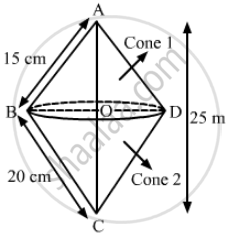
We have,
In ΔABC, ∠B = 90° , AB = l1 =15 cm and BC = l2 = 20 cm
Let OD = OB = r , AO = h1 and CO = h2
Using Pythagoras therom,
`"AC" = sqrt("AB"^2 + "BC"^2)`
`=sqrt(15^2 + 20^2)`
`= sqrt(225 + 400)`
`= sqrt(625)`
⇒ h = 25 cm
As, ar(ΔABC)` = 1/2xxACxxBO=1/2xxABxxBC `
⇒ AC × BO = AB × BC
⇒ 25r = 15 × 20
`rArr r = (15xx20)/25`
⇒ r = 12 cm
Now,
Volume of the double cone so formed = Volume of cone 1 +Volume of cone 2
`= 1/3 pir^2h_1 + 1/3pir^2h_2`
`= 1/3 pir^2 ("h"_1 + "h"_2)`
`= 1/3pi"r"^2"h"`
`= 1/3xx3.14xx12xx12xx25`
= 3768 cm3
Also,
surace area of the solid so formed = CAS of cone 1 + CSA of cone 2
= πrl1 + πrl2
= πr ( l1 + l2 )
`= 22/7xx12xx(15+20)`
`=22/7xx12xx35`
= 1320 cm2
APPEARS IN
संबंधित प्रश्न
504 cones, each of diameter 3.5 cm and height 3 cm, are melted and recast into a metallic sphere. Find the diameter of the sphere and hence find its surface area.
[Use π=22/7]
The sum of the radius of base and height of a solid right circular cylinder is 37 cm. If the total surface area of the solid cylinder is 1628 sq. cm, find the volume of the cylinder. `("use " pi=22/7)`
In Fig. 5, from a cuboidal solid metallic block, of dimensions 15cm ✕ 10cm ✕ 5cm, a cylindrical hole of diameter 7 cm is drilled out. Find the surface area of the remaining block [Use
`pi=22/7`]

2 cubes each of volume 64 cm3 are joined end to end. Find the surface area of the resulting cuboid.
A bucket made of aluminum sheet is of height 20cm and its upper and lower ends are of radius 25cm an 10cm, find cost of making bucket if the aluminum sheet costs Rs 70 per
100 cm2
Radii of circular ends of a solid frustum off a cone re 33cm and 27cm and its slant height are 10cm. find its total surface area?
How many spherical lead shots each of diameter 4.2 cm can be obtained from a solid rectangular lead piece with dimension 6cm \[\times\] 42cm \[\times\] 21 cm.
Three solid spheres of radii 3, 4 and 5 cm respectively are melted and converted into a single solid sphere. Find the radius of this sphere.
A cylindrical bucket 28 cm in diameter and 72 cm high is full of water. The water is emptied into a rectangular tank 66 cm long and 28 cm wide. Find the height of the water level in the tank.
A solid metallic sphere of diameter 28 cm is melted and recast into a number of smaller cones, each of diameter 4 \[\frac{2}{3}\] cm and height 3 cm. Find the number of cones so formed.
Two solid cones A and B are placed in a cylindrical tube as shown in fig .16.76. The ratio of their capacities are 2: 1 . Find the heights and capacities of the cones . Also, find the volume of the remaining portion of the cylinder.
A hemispherical bowl of internal diameter 30 cm contains some liquid. This liquid is to be poured into cylindrical bottles of diameter 5 cm and height 6 cm each. Find the number of bottles required.
The volume of a hemisphere is 19404 cm3. The total surface area of the hemisphere is
If the volumes of a cube is 1728 cm³, the length of its edge is equal to ______.
If two solid hemispheres of the same base radius r are joined together along their bases, then curved surface area of this new solid is ______.
Two identical solid hemispheres of equal base radius r cm are stuck together along their bases. The total surface area of the combination is 6πr2.
Two cones with same base radius 8 cm and height 15 cm are joined together along their bases. Find the surface area of the shape so formed.
There are two identical solid cubical boxes of side 7 cm. From the top face of the first cube a hemisphere of diameter equal to the side of the cube is scooped out. This hemisphere is inverted and placed on the top of the second cube’s surface to form a dome. Find
- the ratio of the total surface area of the two new solids formed
- volume of each new solid formed.
