हिंदी

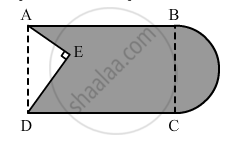
In Figure 4, from a rectangular region ABCD with AB = 20 cm, a right triangle AED with AE = 9 cm and DE = 12 cm, is cut off. - Mathematics

Advertisements
Advertisements

प्रश्न

In Figure 4, from a rectangular region ABCD with AB = 20 cm, a right triangle AED with AE = 9 cm and DE = 12 cm, is cut off. On the other end, taking BC as diameter, a semicircle is added on outside the region. Find the area of the shaded region.\[[Use\pi = 3 . 14]\]
Advertisements

उत्तर

In right-angled ∆AED:
AD2 = AE2 + ED2
⇒ AD2 = (92 + 122) cm2
           = (81 + 144) cm2
           = 225 cm2
⇒ AD = 15 cm
Now, area of the rectangular region ABCD

= AB x AD 
= (20 X15 ) cm2

= 300 cm2
Area of ∆AED
\[= \frac{1}{2} \times AE \times DE\]
\[ = \left( \frac{1}{2} \times 9 \times 12 \right) {cm}^2 \]
\[ = 54 {cm}^2\]
We have:
AD = BC = 15 cm
Since, BC is the diameter of the circle, therefore radius of the circle = 152 cm152 cm
Now, area of the semi-circle

\[= \frac{1}{2} \times \pi \times r^2 \]

\[ = \left( \frac{1}{2} \times 3 . 14 \times \frac{15}{2} \times \frac{15}{2} \right) {cm}^2 \]

\[ = 88 . 3125 {cm}^2\]

Area of the shaded region = Area of the rectangle + Area of the semi-circle - Area of the triangle

                                           = (300 + 88.3125 - 54) cm2
                                           = 334.3125 cm2

shaalaa.com
  क्या इस प्रश्न या उत्तर में कोई त्रुटि है?
2013-2014 (March) Foreign Set 3

वीडियो ट्यूटोरियलVIEW ALL [3]

संबंधित प्रश्न

A cubical block of side 10 cm is surmounted by a hemisphere. What is the largest diameter that the hemisphere can have? Find the cost of painting the total surface area of the solid so formed, at the rate of Rs. 5 per 100 sq. cm. [Use π = 3.14]


A tent is in the shape of a cylinder surmounted by a conical top. If the height and diameter of the cylindrical part are 2.1 m and 4 m respectively, and the slant height of the top is 2.8 m, find the area of the canvas used for making the tent. Also, find the cost of the canvas of the tent at the rate of Rs 500 per m2.

(Note that the base of the tent will not be covered with canvas.) [Use `pi = 22/7`]


A vessel is in the form of hemispherical bowl surmounted by a hollow cylinder of same diameter. The diameter of the hemispherical bowl is 14 cm and the total height of the vessel is 13 cm. Find the total surface area of the vessel. `[\text{Use}pi=22/7]`


If the radius of the base of a right circular cylinder is halved, keeping the height the same, then the ratio of the volume of the cylinder thus obtained to the volume of original cylinder is:


A solid metal sphere of 6 cm diameter is melted and a circular sheet of thickness 1 cm is prepared. Determine the diameter of the sheet.


If the total surface area of a solid hemisphere is 462 cm2, then find its volume.  


From a solid cylinder of height 2.8 cm and diameter 4.2 cm, a conical cavity of the same height and same diameter is hollowed out. Find the total surface area of the remaining solid.


Five identical cubes, each of edge 5 cm, are placed adjacent to each other. Find the volume of the resulting cuboid.


Find the ratio of the volume of a cube to that of a sphere which will fit inside it.


Two cones with same base radius 8 cm and height 15 cm are joined together along their bases. Find the surface area of the shape so formed.


Share
Notifications

Englishहिंदीमराठी


      Forgot password?
Use app×