Advertisements
Advertisements
प्रश्न
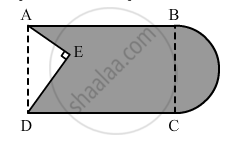
In Figure 4, from a rectangular region ABCD with AB = 20 cm, a right triangle AED with AE = 9 cm and DE = 12 cm, is cut off. On the other end, taking BC as diameter, a semicircle is added on outside the region. Find the area of the shaded region.\[[Use\pi = 3 . 14]\]
Advertisements
उत्तर
In right-angled ∆AED:
AD2 = AE2 + ED2
⇒ AD2 = (92 + 122) cm2
= (81 + 144) cm2
= 225 cm2
⇒ AD = 15 cm
Now, area of the rectangular region ABCD
= AB x AD
= (20 X15 ) cm2
\[ = \left( \frac{1}{2} \times 9 \times 12 \right) {cm}^2 \]
\[ = 54 {cm}^2\]
AD = BC = 15 cm
Since, BC is the diameter of the circle, therefore radius of the circle = 152 cm152 cm
Now, area of the semi-circle
\[= \frac{1}{2} \times \pi \times r^2 \]
\[ = \left( \frac{1}{2} \times 3 . 14 \times \frac{15}{2} \times \frac{15}{2} \right) {cm}^2 \]
\[ = 88 . 3125 {cm}^2\]
Area of the shaded region = Area of the rectangle + Area of the semi-circle −- Area of the triangle
= (300 + 88.3125 −- 54) cm2
= 334.3125 cm2
APPEARS IN
संबंधित प्रश्न
The sum of the radius of base and height of a solid right circular cylinder is 37 cm. If the total surface area of the solid cylinder is 1628 sq. cm, find the volume of the cylinder. `("use " pi=22/7)`
A cubical block of side 7 cm is surmounted by a hemisphere. What is the greatest diameter the hemisphere can have? Find the surface area of the solid. [Use `pi = 22/7`]
A tent is in the shape of a cylinder surmounted by a conical top. If the height and diameter of the cylindrical part are 2.1 m and 4 m respectively, and the slant height of the top is 2.8 m, find the area of the canvas used for making the tent. Also, find the cost of the canvas of the tent at the rate of Rs 500 per m2.
(Note that the base of the tent will not be covered with canvas.) [Use `pi = 22/7`]
From a solid cylinder whose height is 2.4 cm and diameter 1.4 cm, a conical cavity of the same height and same diameter is hollowed out. Find the total surface area of the remaining solid to the nearest cm2
[use `pi = 22/7`]
Find the area of the shaded region in Fig. 3, where arcs drawn with centres A, B, C and D intersect in pairs at mid-points P, Q, R and S of the sides AB, BC, CD and DA respectively of a square ABCD of side 12 cm. [Use π = 3.14]

Three solid spheres of radii 3, 4 and 5 cm respectively are melted and converted into a single solid sphere. Find the radius of this sphere.
How many cubes of 10 cm edge can be put in a cubical box of 1 m edge?
Match the following columns:
| Column I | Column II |
| (a) The radii of the circular ends of a bucket, in the form of the frustum of a cone of height 30 cm, are 20 cm and 10 cm respectively. The capacity of the bucket is ........cm3. |
(p) 2418π |
| (b) The radii of the circular ends of a conical bucket of height 15 cm are 20 and 12 cm respectively. The slant height of the bucket is ........ cm. |
(q) 22000 |
| (c) The radii of the circular ends of a solid frustum of a cone are 33 cm and 27 cm and its slant height is 10 cm. The total surface area of the bucket is .........cm2. |
(r) 12 |
| (d) Three solid metallic spheres of radii 3 cm, 4 cm and 5 cm are melted to form a single solid sphere. The diameter of the resulting sphere is ........ cm. |
(s) 17 |
A cone of height 24 cm and radius of base 6 cm is made up of modelling clay. A child reshapes it in the form of a sphere. Find the radius of the sphere and hence find the surface area of this sphere.
The radius of spherical balloon increases from 8 cm to 12 cm. The ratio of the surface areas of balloon in two cases is ______.
