Advertisements
Advertisements
प्रश्न
The perimeters of the ends of a frustum of a right circular cone are 44 cm and 33 cm. If the height of the frustum be 16 cm, find its volume, the slant surface and the total surface.
Advertisements
उत्तर
The height of the frustum of the cone is h= 16 cm. The perimeters of the circular ends are 44 cm and 33 cm. Let the radii of the bottom and top circles are r1 cm and r2 cm respectively. Then, we have
2πr1= 44
⇒ πr1= 22
⇒ `r_1+(22xx7)/22`
⇒ r1 = 7
2πr2 = 33
⇒ `pi r_2=33/2`
⇒ `r_2=33/2xx7/22`
⇒ `r_2=21/4`
The slant height of the bucket is
`l=sqrt((r_1-r_2)^2+h^2)`
`=sqrt((7_21/4)^2+h^2)`
= 16.1 cm
The curved/slant surface area of the frustum cone is
`= pi(r_1+r_2)xxl`
`=(pir_1+pir_2)xxl`
= (22 + 16.5)xx16.1
= 619.85 cm2
Hence Curved surface area = 619.85cm2
The volume of the frustum of the cone is
`V=1/3pi(r_1^2+r_1r_2+r_2^2)xxh`
`=1/3pi(7^2+7xx5.25+5.25^2)xx16`
= 1900 cm3
Hence Volume of frustum = 1900cm3
The total surface area of the frustum cone is
`=pi(r_1+r_2)xxl+pi r_1^2+pi r_2^2`
`=619.85+22/7xx7^2+22/7xx5.25^2`
= 860.25 Square cm
Hence Total surface area = 860.25 cm2
संबंधित प्रश्न
The largest possible sphere is carved out of a wooden solid cube of side 7 em. Find the volume of the wood left. (Use\[\pi = \frac{22}{7}\]).
Water in a canal, 6 m wide and 1.5 m deep, is flowing at a speed of 4 km/h. How much area will it irrigate in 10 minutes, if 8 cm of standing water is needed for irrigation?
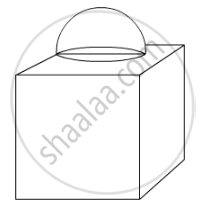
In Fig. 5, is a decorative block, made up two solids – a cube and a hemisphere. The base of the block is a cube of side 6 cm and the hemisphere fixed on the top has diameter of 3.5 cm. Find the total surface area of the bock `(Use pi=22/7)`
A toy is in the form of a cone of radius 3.5 cm mounted on a hemisphere of same radius. The total height of the toy is 15.5 cm. Find the total surface area of the toy [Use π =`22/7`]
A cubical block of side 7 cm is surmounted by a hemisphere. What is the greatest diameter the hemisphere can have? Find the surface area of the solid. [Use `pi = 22/7`]
A hemispherical depression is cut out from one face of a cubical wooden block such that the diameter l of the hemisphere is equal to the edge of the cube. Determine the surface area of the remaining solid.
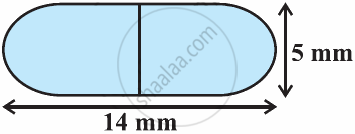
A medicine capsule is in the shape of cylinder with two hemispheres stuck to each of its ends (see the given figure). The length of the entire capsule is 14 mm and the diameter of the capsule is 5 mm. Find its surface area. [Use π = `22/7`]
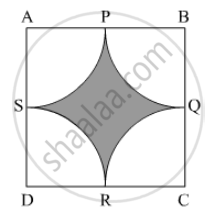
Find the area of the shaded region in Fig. 3, where arcs drawn with centres A, B, C and D intersect in pairs at mid-points P, Q, R and S of the sides AB, BC, CD and DA respectively of a square ABCD of side 12 cm. [Use π = 3.14]
A bucket has top and bottom diameter of 40 cm and 20 cm respectively. Find the volume of the bucket if its depth is 12 cm. Also, find the cost of tin sheet used for making the bucket at the rate of Rs. 1.20 per dm2 . (Use π = 3.14)
Radii of circular ends of a solid frustum off a cone re 33cm and 27cm and its slant height are 10cm. find its total surface area?
How many spherical lead shots each of diameter 4.2 cm can be obtained from a solid rectangular lead piece with dimension 6cm \[\times\] 42cm \[\times\] 21 cm.
The inner and outer radii of a hollow cylinder are 15 cm and 20 cm, respectively. The cylinder is melted and recast into a solid cylinder of the same height. Find the radius of the base of new cylinder.
A cylindrical bucket 28 cm in diameter and 72 cm high is full of water. The water is emptied into a rectangular tank 66 cm long and 28 cm wide. Find the height of the water level in the tank.
A cubical block of side 10 cm is surmounted by a hemisphere. What is the largest diameter that the hemisphere can have? Find the cost of painting the total surface area of the solid so formed, at the rate of ₹ 5 per 100 sq cm. [Use π = 3.14.]
Water is flowing through a cylindrical pipe of internal diameter 2 cm, into a cylindrical tank of base radius 40 cm, at the rate of 0.4 m per second. Determine the rise in level of water in the tank in half an hour.
A cone of height 24 cm and radius of base 6 cm is made up of modelling clay. A child reshapes it in the form of a sphere. Find the radius of the sphere and hence find the surface area of this sphere.
If the surface areas of two spheres are in ratio 16 : 9, then their volumes will be in the ratio ______.
Eight solid sphere of same size are made by melting a solid metallic cylinder of base diameter 6 cm and height 32 cm. The diameter of each sphere is ______.
If two solid hemispheres of the same base radius r are joined together along their bases, then curved surface area of this new solid is ______.
The ratio of total surface area of a solid hemisphere to the square of its radius is ______.
