मराठी

2 cubes each of volume 64 cm3 are joined end to end. Find the surface area of the resulting cuboid. - Mathematics

Advertisements
Advertisements

प्रश्न

2 cubes each of volume 64 cm3 are joined end to end. Find the surface area of the resulting cuboid.

बेरीज
Advertisements

उत्तर

Given that,

Volume of cubes = 64 cm3

(Edge)3 = 64

Edge = 4 cm
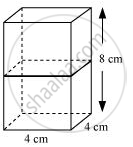
If cubes are joined end to end, the dimensions of the resulting cuboid will be 4 cm, 4 cm, 8 cm.

∴ Surface area of cuboids = 2(lb + bh + lh)

= 2[(4 × 4) + (4 × 8) + (4 × 8)]

= 2(16 + 32 + 32)

= 2(16 + 64)

= 2 × 80

= 160 cm2.

shaalaa.com
  या प्रश्नात किंवा उत्तरात काही त्रुटी आहे का?
पाठ 13: Surface Areas and Volumes - Exercise 13.1 [पृष्ठ २४४]

APPEARS IN

एनसीईआरटी Mathematics [English] Class 10
पाठ 13 Surface Areas and Volumes
Exercise 13.1 | Q 1 | पृष्ठ २४४

व्हिडिओ ट्यूटोरियलVIEW ALL [3]

संबंधित प्रश्‍न

In Fig. 4, from the top of a solid cone of height 12 cm and base radius 6 cm, a cone of height 4 cm is removed by a plane parallel to the base. Find the total surface area of the remaining solid. (Use `pi=22/7` and `sqrt5=2.236`)


Find the area of the shaded region in Fig. 3, where arcs drawn with centres A, B, C and D intersect in pairs at mid-points P, Q, R and S of the sides AB, BC, CD and DA respectively of a square ABCD of side 12 cm. [Use π = 3.14]


A solid is in the form of a right circular cylinder, with a hemisphere at one end and a cone at the other end. The radius of the common base is 3.5 cm and the heights of the cylindrical and conical portions are 10 cm. and 6 cm, respectively. Find the total surface area of the solid. (Use π =`22/7`)


If the radii of circular ends of a bucket 24cm high are 5cm and 15cm. find surface area of
bucket?


Radii of circular ends of a solid frustum off a cone re 33cm and 27cm and its slant height are 10cm. find its total surface area?


From a solid cylinder of height 7 cm and base diameter 12 cm, a conical cavity of same height and same base diameter is hollowed out. Find the total surface area of the remaining solid. [User `pi22/7`]


Two cubes each of volume 27 cm3 are joined end to end to form a solid. Find the surface area of the resulting cuboid. 


The largest cone is curved out from one face of solid cube of side 21 cm. Find the volume of the remaining solid. 


If r1 and r2 be the radii of two solid metallic spheres and if they are melted into one solid sphere, prove that the radius of the new sphere is \[\left( r_1^3 + r_2^3 \right)^\frac{1}{3}\].


A solid metal sphere of 6 cm diameter is melted and a circular sheet of thickness 1 cm is prepared. Determine the diameter of the sheet.


From a solid cube of side 7 cm , a conical cavity of height 7 cm and radius 3 cm is hollowed out . Find the volume of the remaining solid.


A cubical block of side 10 cm is surmounted by a hemisphere. What is the largest diameter that the hemisphere can have? Find the cost of painting the total surface area of the solid so formed, at the rate of ₹5 per 100 sq cm. [Use ππ = 3.14]


A copper wire of diameter 6 mm is evenly wrapped on a cylinder of length 18 cm and diameter 49 cm to cover its whole surface. Find the length and the volume of the wire. If the density of the copper be 8.8 g per cm3, then find the weight of the wire.


If the areas of three adjacent faces of a cuboid are x, y and z, respectively, the volume of the cuboid is ______.


A bucket open at the top is in the form of a frustum of a cone with a capacity of 12308.8 cm3. The radii of the top and bottom of the circular ends of the bucket are 20 cm and 12 cm respectively. Find the height of the bucket and also the area of the metal sheet used in making it. (Use π = 3.14)


Two cubes each of volume 8 cm³ are joined end to end, then the surface area of the resulting cuboid is ______.


The curved surface area of glass having radii 3 cm and 4 cm respectively and slant height 10 cm is ______.


Two identical solid hemispheres of equal base radius r cm are stuck together along their bases. The total surface area of the combination is 6πr2.


A solid cone of radius r and height h is placed over a solid cylinder having same base radius and height as that of a cone. The total surface area of the combined solid is `pir [sqrt(r^2 + h^2) + 3r + 2h]`.


Share
Notifications

Englishहिंदीमराठी


      Forgot password?
Use app×