Advertisements
Advertisements
प्रश्न
In a village, a well with 10 m inside diameter, is dug 14 m deep. Earth taken out of it is spread all around to a width 5 m to form an embankment. Find the height of the embankment. What value of the villagers is reflected here?
Advertisements
उत्तर
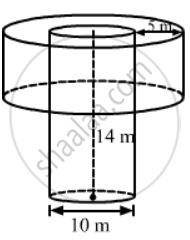
We have,
Radius of well, R = `10/2` = 5 m,
Depth of the well, H = 14 m and
Width of the embarkment = 5 m,
Also, the outer radius of the embankment, r = R + 5 = 5 + 5 = 10 m
And , the inner radius of the embarkment = R = 5m
Let the height of the embankment = 5 m,
Also, the outer radius of the embankment, r = R + 5 = 5 + 5 = 10 m
And, the inner radius of the embankment = R = 5 m
Let the height of the embarkment be h.
Now,
Volume of the embankment = Volume of the earth taken out
⇒ Volume of embankment = Volume of the well
⇒ (πr2 - πR2) h = πR2H
⇒ π (r2 - R2) h = πR2H
⇒ (r2 - R2) h = R2H
⇒ (102 - 52) h = 5 × 5 × 14
⇒ (100 - 25) h = 25 × 14
⇒ 75 h = 25 × 14
`⇒ "h" = (25xx14)/75 `
`therefore "h" = 14/3 "m"`
So, the height of the embankment is `14/3` m
Value: We must lanour hard to make maximum use of the available resources.
Disclaimer: The answer provided in the textbook is incorrect. It has been corrected above.
APPEARS IN
संबंधित प्रश्न
A hemispherical bowl of internal diameter 36 cm contains liquid. This liquid is filled into 72 cylindrical bottles of diameter 6 cm. Find the height of each bottle, if 10% liquid is wasted in this transfer.
A toy is in the form of a cone of base radius 3.5 cm mounted on a hemisphere of base diameter 7 cm. If the total height of the toy is 15.5 cm, find the total surface area of the top (Use π = 22/7)
2 cubes each of volume 64 cm3 are joined end to end. Find the surface area of the resulting cuboid.
A solid is in the form of a right circular cylinder, with a hemisphere at one end and a cone at the other end. The radius of the common base is 3.5 cm and the heights of the cylindrical and conical portions are 10 cm. and 6 cm, respectively. Find the total surface area of the solid. (Use π =`22/7`)
A bucket has top and bottom diameter of 40 cm and 20 cm respectively. Find the volume of the bucket if its depth is 12 cm. Also, find the cost of tin sheet used for making the bucket at the rate of Rs. 1.20 per dm2 . (Use π = 3.14)
The perimeters of the ends of a frustum of a right circular cone are 44 cm and 33 cm. If the height of the frustum be 16 cm, find its volume, the slant surface and the total surface.
If the radii of circular ends of a bucket 24cm high are 5cm and 15cm. find surface area of
bucket?
A bucket made of aluminum sheet is of height 20cm and its upper and lower ends are of radius 25cm an 10cm, find cost of making bucket if the aluminum sheet costs Rs 70 per
100 cm2
A vessel is in the form of hemispherical bowl surmounted by a hollow cylinder of same diameter. The diameter of the hemispherical bowl is 14 cm and the total height of the vessel is 13 cm. Find the total surface area of the vessel. `[\text{Use}pi=22/7]`
If the radius of the base of a right circular cylinder is halved, keeping the height the same, then the ratio of the volume of the cylinder thus obtained to the volume of original cylinder is:
A solid cuboid of iron with dimensions 53 cm ⨯ 40 cm ⨯ 15 cm is melted and recast into a cylindrical pipe. The outer and inner diameters of pipe are 8 cm and 7 cm respectively. Find the length of pipe.
If r1 and r2 be the radii of two solid metallic spheres and if they are melted into one solid sphere, prove that the radius of the new sphere is \[\left( r_1^3 + r_2^3 \right)^\frac{1}{3}\].
Volume and surface area of a solid hemisphere are numerically equal. What is the diameter of hemisphere?
A solid sphere of radius r is melted and cast into the shape of a solid cone of height r, the radius of the base of the cone is
How many lead shots each 3 mm in diameter can be made from a cuboid of dimensions 9 cm × 11 cm × 12 cm ?
A plumbline (sahul) is a combination of

The volume of a hemisphere is 19404 cm3. The total surface area of the hemisphere is
A cone of height 24 cm and radius of base 6 cm is made up of modelling clay. A child reshapes it in the form of a sphere. Find the radius of the sphere and hence find the surface area of this sphere.
Two cubes each of volume 8 cm³ are joined end to end, then the surface area of the resulting cuboid is ______.
The ratio of total surface area of a solid hemisphere to the square of its radius is ______.
