Advertisements
Advertisements
प्रश्न
|
Khurja is a city in the Indian state of Uttar Pradesh famous for the pottery. Khurja pottery is traditional Indian pottery work which has attracted Indians as well as foreigners with a variety of tea sets, crockery and ceramic tile works. A huge portion of the ceramics used in the country is supplied by Khurja and is also referred as "The Ceramic Town". One of the private schools of Bulandshahr organised an Educational Tour for class 10 students to Khurja. Students were very excited about the trip. Following are the few pottery objects of Khurja.
Students found the shapes of the objects very interesting and they could easily relate them with mathematical shapes viz sphere, hemisphere, cylinder etc. |
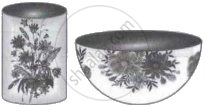
Maths teacher who was accompanying the students asked the following questions:
- The internal radius of hemispherical bowl (filled completely with water) in I is 9 cm and the radius and height of the cylindrical jar in II are 1.5 cm and 4 cm respectively. If the hemispherical bowl is to be emptied in cylindrical jars, then how many cylindrical jars are required?
- If in the cylindrical jar full of water, a conical funnel of the same height and same diameter is immersed, then how much water will flow out of the jar?
Advertisements
उत्तर
a. Given, the radius by the hemispherical bowl, r1 = 9 cm
Radius of the cylindrical jar, r2 = 1.5 cm
Height of cylindrical jar, h2 = 4 cm
Now, Volume of hemispherical bowl = `2/3 πr_1^3`
= `2/3 π(9)^3`
And Volume of cylindrical jar = `πr_2^2h_2`
= π(1.5)2 × 4
Required number of cylindrical jar = `"Volume of hemispherical bowl"/"Volume of cylindrical jar"`
= `(2/3 π(9)^3)/(π(1.5)^2 xx 4)`
= `(2 xx 9 xx 9 xx 9)/(3 xx 1.5 xx 1.5 xx 4)`
= `(3 xx 9 xx 9 xx 10 xx 10)/(15 xx 15 xx 2)`
= `(24,300)/450`
= 54
Hence, 54 cylindrical jars are required.
b. Volume of water flow out of the jar = Volume of the conical funnel
= `1/3 πr_2^2h_2`
= `1/3 xx22/7 xx (1.5)^2 xx 4`
= `1/3 xx 22/7 xx 1.5 xx 1.5 xx 4`
= `(22 xx 15 xx 15 xx 4)/(3 xx 7 xx 10 xx 10)`
= `19800/2100`
= 9.43 cubic cm
Therefore, the water flowing out of the jar is 9.43 cubic cm.
APPEARS IN
संबंधित प्रश्न
504 cones, each of diameter 3.5 cm and height 3 cm, are melted and recast into a metallic sphere. Find the diameter of the sphere and hence find its surface area.
[Use π=22/7]
From a solid cylinder of height 2.8 cm and diameter 4.2 cm, a conical cavity of the same height and same diameter is hollowed out. Find the total surface area of the remaining solid [take π=22/7]
A cubical block of side 7 cm is surmounted by a hemisphere. What is the greatest diameter the hemisphere can have? Find the surface area of the solid. [Use `pi = 22/7`]
Water in a canal, 5·4 m wide and 1·8 m deep, is flowing with a speed of 25 km/hour. How much area can it irrigate in 40 minutes, if 10 cm of standing water is required for irrigation?
A toy is in the form of a cone surmounted on a hemisphere. The diameter of the base and the height of cone are 6cm and 4cm. determine surface area of toy?
A tent consists of a frustum of a cone capped by a cone. If the radii of the ends of the frustum be 13 m and 7 m , the height of the frustum be 8 m and the slant height of the conical cap be 12 m, find the canvas required for the tent. (Take : π = 22/7)
The largest cone is curved out from one face of solid cube of side 21 cm. Find the volume of the remaining solid.
If r1 and r2 be the radii of two solid metallic spheres and if they are melted into one solid sphere, prove that the radius of the new sphere is \[\left( r_1^3 + r_2^3 \right)^\frac{1}{3}\].
There are two identical solid cubical boxes of side 7 cm. From the top face of the first cube a hemisphere of diameter equal to the side of the cube is scooped out. This hemisphere is inverted and placed on the top of the second cube’s surface to form a dome. Find
- the ratio of the total surface area of the two new solids formed
- volume of each new solid formed.
The boilers are used in thermal power plants to store water and then used to produce steam. One such boiler consists of a cylindrical part in middle and two hemispherical parts at its both ends.
Length of the cylindrical part is 7 m and radius of cylindrical part is `7/2` m.
Find the total surface area and the volume of the boiler. Also, find the ratio of the volume of cylindrical part to the volume of one hemispherical part.


