English

In Fig. 4, from the top of a solid cone of height 12 cm and base radius 6 cm, a cone of height 4 cm is removed by a plane parallel to the base. Find the total surface area of the remaining solid. - Mathematics

Advertisements
Advertisements

Question

In Fig. 4, from the top of a solid cone of height 12 cm and base radius 6 cm, a cone of height 4 cm is removed by a plane parallel to the base. Find the total surface area of the remaining solid. (Use `pi=22/7` and `sqrt5=2.236`)
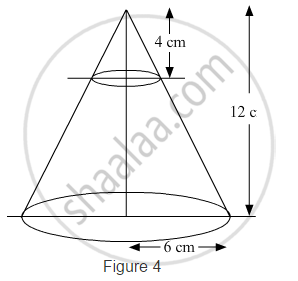
Answer in Brief
Advertisements

Solution

The remaining solid is a frustum of the given cone

Total surface area of the frustum = πl(r1+r2)+πr12+πr22

Where

h = Height of the frustum = 124 = 8 cm

r1 = Larger radius of the frustum = 6 cm

r2 = Smaller radius of the frustum

l = Slant height of the frustum
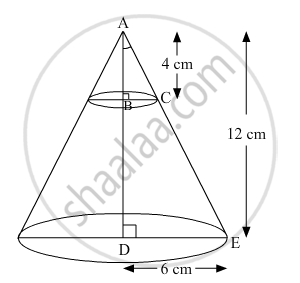
In the given figure, ∆ABC ​~ ∆ADE by AA similarity criterion.

`:.(BC)/(DC)=(AB)/(AD)`

`=>r_2/6=4/12`

r2=2 cm

We know

`l = sqrt(h^2+(r_1-r_2)^2)`

`=>l=sqrt(8^2+(6-1)^2)`

`=>l = 4sqrt5 `

Total surface area of the frustum = πl(r1+r2)+πr12+πr22

= π×4`sqrt5`(6+2)+π×62+π×22

`=pi(32sqrt5+40)`

`=22/7xx111.552`

= 350.592 cm2

Hence, the total surface area of the remaining solid is 350.592 cm2.

shaalaa.com
  Is there an error in this question or solution?
Chapter 14: Surface Areas and Volumes - Exercise 14.3 [Page 79]

RELATED QUESTIONS

504 cones, each of diameter 3.5 cm and height 3 cm, are melted and recast into a metallic sphere. Find the diameter of the sphere and hence find its surface area.
[Use π=22/7]


Water in a canal, 6 m wide and 1.5 m deep, is flowing at a speed of 4 km/h. How much area will it irrigate in 10 minutes, if 8 cm of standing water is needed for irrigation?


A toy is in the form of a cone of base radius 3.5 cm mounted on a hemisphere of base diameter 7 cm. If the total height of the toy is 15.5 cm, find the total surface area of the top (Use π = 22/7)


A solid wooden toy is in the form of a hemisphere surrounded by a cone of same radius. The radius of hemisphere is 3.5 cm and the total wood used in the making of toy is 166 `5/6`  cm3. Find the height of the toy. Also, find the cost of painting the hemispherical part of the toy at the rate of Rs 10 per cm2 .[Use`pi=22/7`]


A cubical block of side 7 cm is surmounted by a hemisphere. What is the greatest diameter the hemisphere can have? Find the surface area of the solid. [Use `pi = 22/7`]


A medicine capsule is in the shape of cylinder with two hemispheres stuck to each of its ends (see the given figure). The length of the entire capsule is 14 mm and the diameter of the capsule is 5 mm. Find its surface area. [Use π = `22/7`]


A wooden article was made by scooping out a hemisphere from each end of a solid cylinder, as shown in given figure. If the height of the cylinder is 10 cm, and its base is of radius 3.5 cm, find the total surface area of the article.

 [Use `pi = 22/7`]


A tent of height 77dm is in the form a right circular cylinder of diameter 36m and height 44dm surmounted by a right circular cone. Find the cost of canvas at Rs.3.50 per m2 ?


The perimeters of the ends of a frustum of a right circular cone are 44 cm and 33 cm. If the height of the frustum be 16 cm, find its volume, the slant surface and the total surface.


A tent consists of a frustum of a cone capped by a cone. If the radii of the ends of the frustum be 13 m and 7 m , the height of the frustum be 8 m and the slant height of the conical cap be 12 m, find the canvas required for the tent. (Take : π = 22/7)


Two cubes each of volume 27 cm3 are joined end to end to form a solid. Find the surface area of the resulting cuboid. 


A cylindrical bucket 28 cm in diameter and 72 cm high is full of water. The water is emptied into a rectangular tank 66 cm long and 28 cm wide. Find the height of the water level in the tank.


If r1 and r2 be the radii of two solid metallic spheres and if they are melted into one solid sphere, prove that the radius of the new sphere is \[\left( r_1^3 + r_2^3 \right)^\frac{1}{3}\].


A solid metallic sphere of diameter 21 cm is melted and recast into a number of smaller cones, each of diameter 3.5 cm and height 3 cm. Find the number of cones so formed.


A spherical ball of radius 3 cm is melted and recast into three spherical balls. The radii of two of these balls are 1.5 cm and 2 cm. Find the radius of the third ball.


Match the following columns:

Column I Column II
(a) The radii of the circular ends of
a bucket, in the form of the frustum of a cone of height 30 cm, are 20 cm
and 10 cm respectively. The
capacity of the bucket is ........cm3.
(p) 2418π
(b) The radii of the circular ends
 of a conical bucket of height
15 cm are 20 and 12 cm
respectively. The slant height
of the bucket is ........ cm.
(q) 22000
(c) The radii of the circular ends of
a solid frustum of a cone are 33 cm
and 27 cm and its slant height is
10 cm. The total surface area of
the bucket is .........cm2.
(r) 12
(d) Three solid metallic spheres of
radii 3 cm, 4 cm and 5 cm are
melted to form a single solid
sphere. The diameter of the
resulting sphere is ........ cm.
(s) 17

A bucket open at the top is in the form of a frustum of a cone with a capacity of 12308.8 cm3. The radii of the top and bottom of the circular ends of the bucket are 20 cm and 12 cm respectively. Find the height of the bucket and also the area of the metal sheet used in making it. (Use π = 3.14)


Two cubes each of volume 8 cm³ are joined end to end, then the surface area of the resulting cuboid is ______.


If two solid hemispheres of same base radius r are joined together along their bases, then curved surface area of this new solid is ______.


The ratio of total surface area of a solid hemisphere to the square of its radius is ______.


Share
Notifications

Englishहिंदीमराठी


      Forgot password?
Use app×