Advertisements
Advertisements
Question
From a solid cylinder of height 7 cm and base diameter 12 cm, a conical cavity of same height and same base diameter is hollowed out. Find the total surface area of the remaining solid. [User `pi22/7`]
Advertisements
Solution
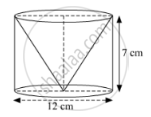
It is given that, height (h) of cylindrical part = height (h) of the conical part = 7 cm
Diameter of the cylindrical part = 12 cm
∴Radius (r) of the cylindrical part `12/2 cm=6cm`
∴ Radius of conical part = 6 cm
Slant height (l) of conical part `=sqrt(r^2+h^2)cm`
`=sqrt(6^2+7^2)cm`
`=sqrt(36+49)cm`
`=sqrt85cm`
`9.22 cm`
Total surface area of the remaining solid
= CSA of cylindrical part + CSA of conical part + Base area of the circular part
= 2πrh + πrl +πr2
`=2xx22/7xx6xx7cm^2+22/7xx6xx9cm^2+22/7xx6xx6cm^2`
`=264cm^2+173.86^2+113.14cm^2`
`=551cm^2`
RELATED QUESTIONS
In Fig. 5, is a decorative block, made up two solids – a cube and a hemisphere. The base of the block is a cube of side 6 cm and the hemisphere fixed on the top has diameter of 3.5 cm. Find the total surface area of the bock `(Use pi=22/7)`

The radii of the circular bases of a frustum of a right circular cone are 12 cm and 3 cm and the height is 12 cm. Find the total surface area and the volume of the frustum.
How many spherical lead shots each of diameter 4.2 cm can be obtained from a solid rectangular lead piece with dimension 6cm \[\times\] 42cm \[\times\] 21 cm.
A solid is in the form of a cylinder with hemispherical ends. Total height of the solid is 19 cm and the diameter of the cylinder is 7 cm. Find the volume and total surface area of the solid.
Two cubes each of volume 27 cm3 are joined end to end to form a solid. Find the surface area of the resulting cuboid.
If the total surface area of a solid hemisphere is 462 cm2, then find its volume.
A cubical block of side 10 cm is surmounted by a hemisphere. What is the largest diameter that the hemisphere can have? Find the cost of painting the total surface area of the solid so formed, at the rate of ₹5 per 100 sq cm. [Use ππ = 3.14]
A hemispherical bowl of internal diameter 30 cm contains some liquid. This liquid is to be poured into cylindrical bottles of diameter 5 cm and height 6 cm each. Find the number of bottles required.
Find the ratio of the volume of a cube to that of a sphere which will fit inside it.
Two identical solid hemispheres of equal base radius r cm are stuck together along their bases. The total surface area of the combination is 6πr2.
