Advertisements
Advertisements
प्रश्न
In ΔABC, right angled at B. If tan A = `1/sqrt3` , find the value of
- sin A cos C + cos A sin C
- cos A cos C − sin A sin C
If ΔABC, ∠B = 90° and Tan A = `1/sqrt(3)`. Prove that
- Sin A. cos C + cos A. Sin c = 1
- cos A. cos C - sin A. sin C = 0
Advertisements
उत्तर १
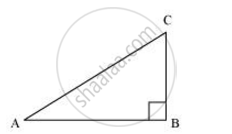
tan A = `1/sqrt3`
`"BC"/"AB"=1/sqrt3`
If BC is k, then AB will be `sqrt3k`, where k is a positive integer.
In ΔABC,
AC2 = AB2 + BC2
= `(sqrt3k)^2 + (k)^2`
= 3k2 + k2
= 4k2
∴ AC = 2k
sin A = `("Side adjacent to ∠A")/"Hypotenuse" = ("BC")/("AC") = k/(2k) = 1/2`
cos A = `("Side adjacent to ∠A")/"Hypotenuse" = ("AB")/("AC") = (sqrt3k)/(2k) = sqrt3/2`
sin C = `("Side adjacent to ∠C")/"Hypotenuse" = ("AB")/("AC") = (sqrt3k)/(2k) = sqrt3/2`
cos C = `("Side adjacent to ∠C")/"Hypotenuse" = ("BC")/("AC") = (k)/(2k) = 1/2`
(i) sin A cos C + cos A sin C
= `(1/2)(1/2)+(sqrt3/2)(sqrt3/2) `
= `1/4 + 3/4`
= `4/4`
= 1
(ii) cos A cos C − sin A sin C
= `(sqrt3/2)(1/2)-(1/2)(sqrt3/2)`
= `sqrt3/4 - sqrt3/4`
= 0
उत्तर २
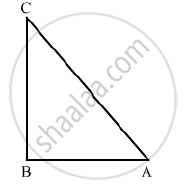
In ΔABC, ∠B = 90°,
As, tan A = `1/sqrt(3)`
⇒ `("BC")/("AB") = 1/sqrt(3)`
Let BC = x and AB = x = `sqrt(3)`
Using Pythagoras the get
AC = `sqrt("AB"^2 + "BC"^2)`
= `sqrt((xsqrt(3))^2 + x^2)`
= `sqrt(3x^2 + x^2)`
= `sqrt(4x^2)`
= 2x
Now,
(i) LHS = sin A. cos C + cos A . sin C
= `("BC")/("AC") . ("BC")/("AC") + ("AB")/("AC") .("AB")/("AC")`
= `(("BC")/("AC"))^2 + (("AB")/("AC"))^2`
= `(x/(2x))^2 + ((xsqrt(3))/(2x))^2`
= `1/4 +3/4`
= 1
= RHS
(ii) LHS = cos A . cos C - sinA . sinC
= `("AB")/("AC") .("BC")/("AC") -("BC")/("AC") .("AB")/("AC")`
= `(xsqrt(3))/(2x) .x/2x - x/2x.(xsqrt(3))/(2x)`
= `sqrt(3)/4 - sqrt(3)/4`
= 0
= RHS
संबंधित प्रश्न
In ΔABC right angled at B, AB = 24 cm, BC = 7 m. Determine:
sin C, cos C
If ∠A and ∠B are acute angles such that cos A = cos B, then show that ∠A = ∠B.
If cot θ = `7/8`, evaluate cot2 θ.
State whether the following are true or false. Justify your answer.
cos A is the abbreviation used for the cosecant of angle A.
In the following, trigonometric ratios are given. Find the values of the other trigonometric ratios.
`sin theta = 11/5`
In the following, trigonometric ratios are given. Find the values of the other trigonometric ratios.
`cos theta = 7/25`
If `tan theta = a/b`, find the value of `(cos theta + sin theta)/(cos theta - sin theta)`
If 3 cot θ = 2, find the value of `(4sin theta - 3 cos theta)/(2 sin theta + 6cos theta)`.
if `tan theta = 12/13` Find `(2 sin theta cos theta)/(cos^2 theta - sin^2 theta)`
If `sin theta = a/b` find sec θ + tan θ in terms of a and b.
Evaluate the following
`sin^2 30° cos^2 45 ° + 4 tan^2 30° + 1/2 sin^2 90° − 2 cos^2 90° + 1/24 cos^2 0°`
Evaluate the Following
(cos 0° + sin 45° + sin 30°)(sin 90° − cos 45° + cos 60°)
Evaluate the Following
`(sin 30^@ - sin 90^2 + 2 cos 0^@)/(tan 30^@ tan 60^@)`
If sin (A − B) = sin A cos B − cos A sin B and cos (A − B) = cos A cos B + sin A sin B, find the values of sin 15° and cos 15°.
`(sin theta)/(1 + cos theta)` is ______.
In ΔABC, ∠ABC = 90° and ∠ACB = θ. Then write the ratios of sin θ and tan θ from the figure.

Prove that: cot θ + tan θ = cosec θ·sec θ
Proof: L.H.S. = cot θ + tan θ
= `square/square + square/square` ......`[∵ cot θ = square/square, tan θ = square/square]`
= `(square + square)/(square xx square)` .....`[∵ square + square = 1]`
= `1/(square xx square)`
= `1/square xx 1/square`
= cosec θ·sec θ ......`[∵ "cosec" θ = 1/square, sec θ = 1/square]`
= R.H.S.
∴ L.H.S. = R.H.S.
∴ cot θ + tan θ = cosec·sec θ
Find will be the value of cos 90° + sin 90°.
If `θ∈[(5π)/2, 3π]` and 2cosθ + sinθ = 1, then the value of 7cosθ + 6sinθ is ______.
If θ is an acute angle and sin θ = cos θ, find the value of tan2 θ + cot2 θ – 2.
