Advertisements
Advertisements
प्रश्न
In ΔABC, right angled at B. If tan A = `1/sqrt3` , find the value of
- sin A cos C + cos A sin C
- cos A cos C − sin A sin C
If ΔABC, ∠B = 90° and Tan A = `1/sqrt(3)`. Prove that
- Sin A. cos C + cos A. Sin c = 1
- cos A. cos C - sin A. sin C = 0
Advertisements
उत्तर १
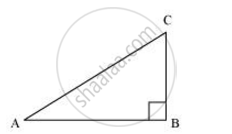
tan A = `1/sqrt3`
`"BC"/"AB"=1/sqrt3`
If BC is k, then AB will be `sqrt3k`, where k is a positive integer.
In ΔABC,
AC2 = AB2 + BC2
= `(sqrt3k)^2 + (k)^2`
= 3k2 + k2
= 4k2
∴ AC = 2k
sin A = `("Side adjacent to ∠A")/"Hypotenuse" = ("BC")/("AC") = k/(2k) = 1/2`
cos A = `("Side adjacent to ∠A")/"Hypotenuse" = ("AB")/("AC") = (sqrt3k)/(2k) = sqrt3/2`
sin C = `("Side adjacent to ∠C")/"Hypotenuse" = ("AB")/("AC") = (sqrt3k)/(2k) = sqrt3/2`
cos C = `("Side adjacent to ∠C")/"Hypotenuse" = ("BC")/("AC") = (k)/(2k) = 1/2`
(i) sin A cos C + cos A sin C
= `(1/2)(1/2)+(sqrt3/2)(sqrt3/2) `
= `1/4 + 3/4`
= `4/4`
= 1
(ii) cos A cos C − sin A sin C
= `(sqrt3/2)(1/2)-(1/2)(sqrt3/2)`
= `sqrt3/4 - sqrt3/4`
= 0
उत्तर २
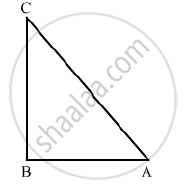
In ΔABC, ∠B = 90°,
As, tan A = `1/sqrt(3)`
⇒ `("BC")/("AB") = 1/sqrt(3)`
Let BC = x and AB = x = `sqrt(3)`
Using Pythagoras the get
AC = `sqrt("AB"^2 + "BC"^2)`
= `sqrt((xsqrt(3))^2 + x^2)`
= `sqrt(3x^2 + x^2)`
= `sqrt(4x^2)`
= 2x
Now,
(i) LHS = sin A. cos C + cos A . sin C
= `("BC")/("AC") . ("BC")/("AC") + ("AB")/("AC") .("AB")/("AC")`
= `(("BC")/("AC"))^2 + (("AB")/("AC"))^2`
= `(x/(2x))^2 + ((xsqrt(3))/(2x))^2`
= `1/4 +3/4`
= 1
= RHS
(ii) LHS = cos A . cos C - sinA . sinC
= `("AB")/("AC") .("BC")/("AC") -("BC")/("AC") .("AB")/("AC")`
= `(xsqrt(3))/(2x) .x/2x - x/2x.(xsqrt(3))/(2x)`
= `sqrt(3)/4 - sqrt(3)/4`
= 0
= RHS
