Advertisements
Advertisements
प्रश्न
If 3 cot A = 4, Check whether `((1-tan^2 A)/(1+tan^2 A)) = cos^2 "A" - sin^2 "A"` or not.
Advertisements
उत्तर १
It is given that 3cot A = 4 or cot A = `4/3`
Consider a right triangle ABC, right-angled at point B.
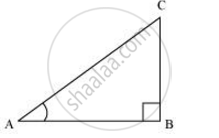
cot A =` ("Side adjacent to ∠A")/("Side opposite to ∠A")`
`("AB")/("BC") = 4/3`
If AB is 4k, then BC will be 3k, where k is a positive integer.
In ΔABC,
(AC)2 = (AB)2 + (BC)2
= (4k)2 + (3k)2
= 16k2 + 9k2
= 25k2
AC = 5k
cos A = `("Side adjacent to ∠A")/"Hypotenuse" = ("AB")/("AC")`
= `(4k)/(5k)`
= `4/5`
sin A = `("Side adjacent to ∠A")/"Hypotenuse" = ("BC")/("AC")`
= `(3k)/(5k)`
= `3/5`
tan A = `("Side adjacent to ∠A")/"Hypotenuse" = ("BC")/("AB")`
= `(3k)/(4k)`
= `3/4`
`(1-tan^2 A)/(1+tan^2 A) = ((1 - (3/4)^2)/(1+(3/4)^2))`
= `((1-9/16)/(1+9/16))`
= `(7/16)/(25/16)`
= `7/25`
`cos^2 A + sin^2 A = (4/5)^2 - (3/5)^2`
= `16/25 - 9/25`
= `7/25`
∴ `(1-tan^2A)/(1+tan^2 A)= cos^2A - sin^2A`
उत्तर २
3 cot A = 4, check = `(1 - tan^2 A)/(1 + tan^2 A) = cos^2 A - sin^2 A`
cot A = `"adjacent side"/"opposite side" = 4/3`
Let x be the hypotenuse
By Applying Pythagoras theorem
AC2 = AB2 + BC2
x2 = 42 + 32
x2 = 252
x = 5
tan A = `1/(cos^2 A)` = `3/4`
cos A = `"adjacent side"/"hypotenuse" = 4/5`
sin A = `3/5`
L.H.S = `(1 - tan^2 A)/(1 + tan^2 A)`
= `(1 - (3/4)^2)/(1 + (3/4)^2)`
= `((16 - 9)/16)/((16 + 9)/16)`
= `7/25`
R.H.S cos2A - sin2 A = `(4/5)^2 - (3/5)^2`
= `(16 - 9)/25`
= `7/25`
