Advertisements
Advertisements
प्रश्न
State whether the following are true or false. Justify your answer.
sec A = `12/5` for some value of angle A.
पर्याय
True
False
Advertisements
उत्तर
This statement is True.
Explanation:
sec A = `12/5`
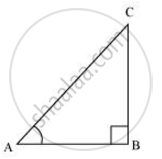
`"Hypotenuse"/"Side adjacent to ∠A" - 12/5`
`("AC")/("AB") = (12/5)`
Let AC be 12k, AB will be 5k, where k is a positive integer.
Applying Pythagoras theorem in ΔABC, we obtain
AC2 = AB2 + BC2
(12k)2 = (5k)2 + BC2
144k2 = 25k2 + BC2
BC2 = 119k2
BC = 10.9k
It can be observed that for given two sides AC = 12k and AB = 5k,
BC should be such that,
AC − AB < BC < AC + AB
12k − 5k < BC < 12k + 5k
7k < BC < 17 k
However, BC = 10.9k
Clearly, such a triangle is possible and hence, such value of sec A is possible.
Hence, the given statement is true.
संबंधित प्रश्न
If cot θ = `7/8`, evaluate cot2 θ.
State whether the following are true or false. Justify your answer.
cos A is the abbreviation used for the cosecant of angle A.
State whether the following are true or false. Justify your answer.
cot A is the product of cot and A.
In the following, trigonometric ratios are given. Find the values of the other trigonometric ratios.
`cos A = 4/5`
In the following, one of the six trigonometric ratios is given. Find the values of the other trigonometric ratios.
`tan theta = 8/15`
In the following, one of the six trigonometric ratios is given. Find the values of the other trigonometric ratios.
`cos theta = 12/2`
If 3 cot θ = 2, find the value of `(4sin theta - 3 cos theta)/(2 sin theta + 6cos theta)`.
Evaluate the following
cos 60° cos 45° - sin 60° ∙ sin 45°
Evaluate the following
`2 sin^2 30^2 - 3 cos^2 45^2 + tan^2 60^@`
Evaluate the Following
4(sin4 60° + cos4 30°) − 3(tan2 60° − tan2 45°) + 5 cos2 45°
Evaluate the Following
(cos 0° + sin 45° + sin 30°)(sin 90° − cos 45° + cos 60°)
Evaluate the Following
4(sin4 30° + cos2 60°) − 3(cos2 45° − sin2 90°) − sin2 60°
Find the value of x in the following :
`sqrt3 sin x = cos x`
sin (45° + θ) – cos (45° – θ) is equal to ______.
Prove that sec θ + tan θ = `cos θ/(1 - sin θ)`.
Proof: L.H.S. = sec θ + tan θ
= `1/square + square/square`
= `square/square` ......`(∵ sec θ = 1/square, tan θ = square/square)`
= `((1 + sin θ) square)/(cos θ square)` ......[Multiplying `square` with the numerator and denominator]
= `(1^2 - square)/(cos θ square)`
= `square/(cos θ square)`
= `cos θ/(1 - sin θ)` = R.H.S.
∴ L.H.S. = R.H.S.
∴ sec θ + tan θ = `cos θ/(1 - sin θ)`
If sec θ = `1/2`, what will be the value of cos θ?
Find an acute angle θ when `(cos θ - sin θ)/(cos θ + sin θ) = (1 - sqrt(3))/(1 + sqrt(3))`
If f(x) = `3cos(x + (5π)/6) - 5sinx + 2`, then maximum value of f(x) is ______.
If θ is an acute angle and sin θ = cos θ, find the value of tan2 θ + cot2 θ – 2.
(3 sin2 30° – 4 cos2 60°) is equal to ______.
