Advertisements
Advertisements
प्रश्न
How have the people of the community helped one another? What role do the women of Kalikuda play during these days?
Advertisements
उत्तर
The people of the community helped one another by joining hands under the leadership of Prashant. They jointly pressurized the merchant to give rice as everybody was starving. A fire was lighted to cook the rice. It was the first time after the cyclone had hit the area that everyone ate their fill. A team of youth volunteers was organized to clean the shelter and to tend to the wounds and fractures of the people who had been injured because of the cyclone.
When the military helicopter dropped some food parcels but did not return, the youth task force gathered empty utensils from the shelter and deputed the children to lie in the sand with these utensils on their stomachs to communicate to the passing helicopters that they were hungry.
The women of Kalikuda looked after the orphaned children. Though they became grief stricken after a few days, on Prashant’s insistence, they also started working in the food-for work programme started by an NGO.
संबंधित प्रश्न
Read the comic strip based on. H.G. Wells' novells.


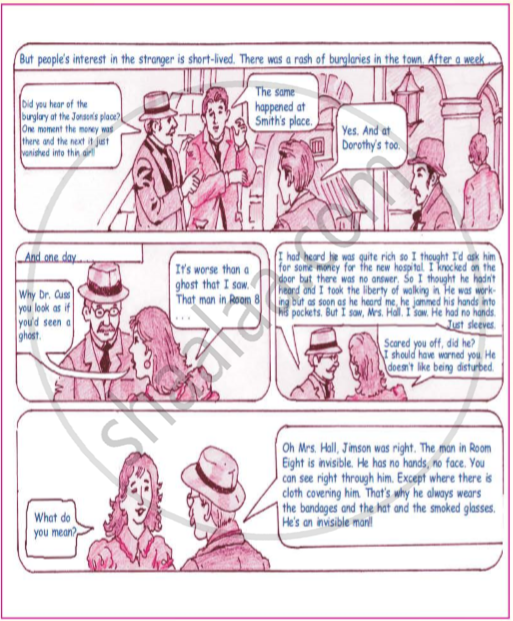
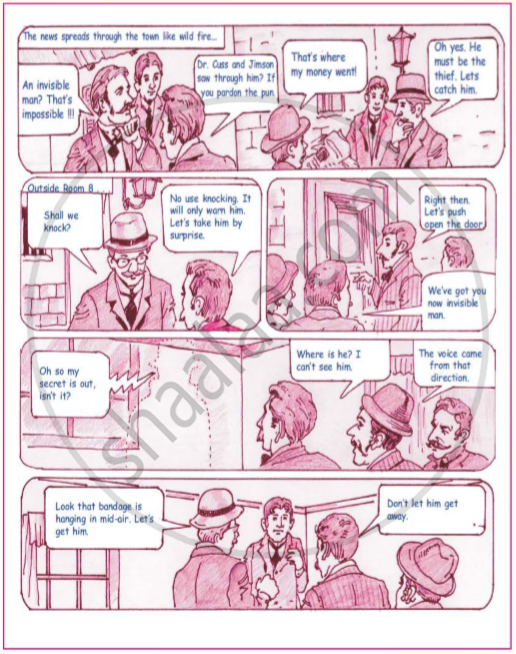
Answer the questions by ticking the correct option.
(a) The strange-looking man wanted ....
(i) the best room at the inn.
(ii} a room with a fire and a good lock.
(iii} a room with a good view.
(iv) a room where he could work quietly.
(b) Jimson was suspicious of the stranger because ...
(i} he did not answer Jimson's questions.
(ii} he did not want to talk about the weather.
(iii} he kept his back turned towards Jimson at all times.
(iv) he shouted atJimson when he entered his room.
(c) The people of the town gossiped about the stranger as ...
(i} he did not go out or talk to anyone in the town.
(ii} he had met with an accident and his face was bandaged.
(iii} he was new to the town and behaved rudely.
(iv) he stayed in his room and did not show his face to anyone.
(d) 'There was a rush of burglaries in the town. This means that ________
(i} there were many robberies in the town.
(ii) a few people in the town had seen a rob her.
(iii} the burglaries in the town were done in a rush.
(iv) the burglar was a rash and careless man.
(e) Although Jimson and Dr Cuss are suspicious of the strange guest, Mrs Hall tolerates him because ....
(i} she is not superstitious or ignorant.
(ii) she is sorry for the stranger who is bandaged.
(iii} the stranger is paying her a good amount of money for the room.
(iv} the stranger is polite and kind to Mrs Hall at all times.
(f) The stranger who was staying at the inn can be described as being ....
(I} violent
(ii} upright
(iii} dishonest
(iv) sensible
Form pairs - one student will read the text for 'Hockey', and the second student will read the text for 'Football'.
Hockey

The game starts when the umpire blows his whistle for the opening pass-back. The passback is made at the centre of the field to start the game (also after half- time and after each goal is scored). The ball, which may be pushed or hit, must not be directed over the centre line. All players of the opposing team must stand at least 5 yard from the ball and all players of both teams, other than the player making the pass-back must be in their own half of the field.
There are two umpires to control the game and to administer the rules. These umpires are the sole judges of the game. The umpires are responsible for keeping time for the duration of the game.


In front of each goal is an area known as the penalty area. This is a rectangular area, 40.2m wide and extending 16. Sm into the field where the goalkeeper operates.
A standard adult football match consists of two periods of 45 minutes each, known as halves. Each half runs continuously, meaning that the clock is not stopped when the ball is out of play. There is usually a 15-minute half-time break between halves. The end of the match is known as full-time. Anytime during the match, a team can substitute upto three players maximum.
The game is controlled by a referee who is the official timekeeper for the match, and may make an allowance for time lost through substitutions, injured players requiring attention, or other stoppages. There are also two linesmen who keep guard of the touchlines or sidelines, signalling when the ball crosses the boundary lines. The referee alone signals the end of the match.
Handling the ball deliberately, pushing or tripping an opponent, or hitting a player from behind are examples of fouls, punishable by a direct free kick or penalty kick depending on where the offence occurred. Other fouls are punishable by an indirect free kick.
The referee may punish a player's or substitute's misconduct by a caution (yellow card) or sending-off (red card). A player is given a yellow card is said to have been 'booked'.
• Red - Serious misconduct resulting in ejection from the game. If a player has been sent off, no substitute can be brought in his place.
"Now tell us what 'twas all about,"
Young Peterkin, he cries;
And little wilhelmine looks up
with wonder-waiting eyes;
"Now tell us all about the war,
And what they fought each other for."
"It was the English," Kaspar cried,
"Who put the French to rout;
But what they fought each other for,
I could not well make out;
But everybody said,"quoth he,
"That 'twas a famous victory.
Read the lines given above and answer the question that follow.
Name the two opposing sides. Who won?
Abou Ben Adhem (may his tribe increase!)
Awoke one night from a deep dream of peace,
And saw, within the moonlight in his room,
Making it rich, and like a lily in bloom,
An angel writing in a book of gold:-
Read the lines given above and answer the following question.
What did Ben Adhem see one night in his room, when he was awakened?
An old man with steel rimmed spectacles and very dusty clothes sat by the side of the road. There was a pontoon bridge across the river and carts, trucks, and men, women and children were crossing it. The mule-drawn carts staggered up the steep bank from the bridge with soldiers helping push against the spokes of the wheels. The trucks ground up and away heading out of it all and the peasants plodded along in the ankle deep dust. But the old man sat there without moving. He was too tired to go any farther.
Read the extract given below and answer the question that follow.
What does the term “pontoon bridge” mean?
Joe did not see the Guardians of the Poor on that day, on the next, nor on the day following. In fact, he never saw them at all on Maggie’s account, for in less than a week Mrs. Joe Thompson would as soon leave thought of taking up her own abode in the almshouse as sending Maggie there.
What light and blessing did that sick and helpless child bring to the home of Joe Thompson, the poor wheelwright! It had been dark, and cold, and miserable there for a long time just because his wife had nothing to love and care for out of herself, and so became soar, irritable, ill-tempered, and self-afflicting in the desolation of her woman’s nature. Now the sweetness of that sick child, looking ever to her in love, patience, and gratitude, was as honey to her soul, and she carried her in her heart as well as in her arms, a precious burden. As for Joe Thompson, there was not a man in all the neighbourhood who drank daily of a more precious wine of life than he. An angel had come into his house, disguised as a sick, helpless, and miserable child, and filled all its dreary chambers with the sunshine of love.
Read the extract given below and answer the question that follow.
Why did Joe not see the Guardians of the poor on that day or ever again?
“He liked to tease and play”. Who is teasing whom? How?
Why did the king send two messengers throughout his kingdom?
How was the wicked farmer punished for his greed?
What was the condition on which Nishad said he will cooperate with Maya?
What does the phrase, “he ran as still as Water” mean?
Watch a tree or a plant, or walk across a field or park at the same time everyday for a week. Keep a diary of what you see and hear. At the end of the week, write a short paragraph or a poem about your experiences. Put your writing up on the class bulletin board.
Why is it a great pleasure to walk through the meadows?
What lesson does the young child narrator learn from his mother?
Word in the box given below indicates a large number of… For example, ‘a herd of cows’ refers to many cows. Complete the following phrase with a suitable word from the box.
a _________________ of flowers
Who says this to whom and why?
“I can’t pay you a penny for the wretched beast you sold me.”
Complete the following sentences from memory choosing a phrase from those given in brackets.
Uncle told me that the shopkeeper had made ____________
Who according to poet’s brother stares the poet?
Study the following phrases and their meanings. Use them appropriately to complete the sentences that follow.
……………. when you are crossing the main road.
What does Cares say to bless the young couple?
