Advertisements
Advertisements
प्रश्न
Given the following data for incident wavelength and the stopping potential obtained from an experiment on the photoelectric effect, estimate the value of Planck's constant and the work function of the cathode material. What is the threshold frequency and corresponding wavelength? What is the most likely metal used for emitter?
| Incident wavelength (in Å) | 2536 | 3650 |
| Stopping potential (in V) |
1.95 | 0.5 |
Advertisements
उत्तर
Data: λ = 2536 Å = 2.536 × 10⁻⁷ m,
λ' = 3650 Å = 3.650 × 10⁻⁷ m,
V0 = 1.95 V, V0' = 0.5 V, c = 3 × 10⁸ m/s,
e = 1.6 × 10⁻¹⁹ C
(i) `"V"_0"e" = "hc"/lambda - phi and "V"_0'"e" = "hc"/(lambda') - phi`
∴ `("V"_0 - "V"_0')"e" = "hc" (1/lambda - 1/(lambda '))`
∴ (1.95 - 0.5)(1.6 × 10⁻¹⁹)
= h (3 × 10⁸)`(10^7/2.536 - 10^7/3.650)`
∴ 2.32 × 10-19 = h(3 × 10¹⁵)(0.3943 - 0.2740)
∴ h = `(2.32 xx 10^(-34))/0.3609 = 6.428 xx 10^(-34)` J.s
This is the value of Planck's constant.
(ii) `phi = "hc"/lambda - "V"_0"e"`
`= ((6.428 xx 10^-34)(3 xx 10^8))/(2.536 xx 10^-7) - (1.95)(1.6 xx 10^-19)`
`= 7.604 xx 10^-19 - 3.12 xx 10^-19 = 4.484 xx 10^-19`J
`= (4.484 xx 10^-19"J")/(1.6 xx 10^-19 "J"//"eV")`
= 2.803 eV
This the work function of the cathode material.
(iii) Φ = hv0
∴ The threshold frequency, `"v"_0 = phi/"h"`
`= (4.484 xx 10^-19 "J")/(6.428 xx 10^-34 "J.s") = 6.976 xx 10^14` Hz
(iv) `"v"_0 = "c"/lambda_0`
∴ The threshold wavelength, `lambda_0 = "c"/"v"_0`
`= (3 xx 10^8)/(6.976 xx 10^14) = 4.300 xx 10^-7` = 4300 Å
(v) The most likely metal used for emitter: calcium.
APPEARS IN
संबंधित प्रश्न
Is it always possible to see the photoelectric effect with a red light?
It is observed in an experiment on the photoelectric effect that an increase in the intensity of the incident radiation does not change the maximum kinetic energy of the electrons. Where does the extra energy of the incident radiation go? Is it lost? State your answer with explanatory reasoning.
Find the kinetic energy of the emitted electron, if in photoelectric effect energy of incident Photon is 4 eV and work function is 2.4 eV.
If the total energy of radiation of frequency 1014 Hz is 6.63 J, Calculate the number of photons in the radiation.
The work function of a surface is 3.1 eV. A photon of frequency 1 × 10¹⁵ Hz. Is an incident on it. Calculate the incident wavelength is photoelectric emission occurs or not.
The energy of the incident photon on the metal surface is 3 W and then 5 W, where W is the work function for that metal. The ratio of velocities of emitted photoelectrons is ______.
For photoelectric emission from certain metal, the cut-off frequency is v. If radiation of frequency 2v impinges on the metal plate, the maximum possible velocity of the emitted electron will be (m is the electron mass) ____________.
In photoelectric effect, graph of saturation current versus frequency of light is plotted. The nature of the graph will be ____________.
When wavelength of incident radiation on the metal surface is reduced from 'λ1' to 'λ2', the kinetic energy of emitted photoelectrons is tripled. The work function of the metal is ______.
(h = Planck's constant, c =velocity of light)
Photoelectrons are emitted from a photosensitive surface for the light of wavelengths λ1 = 360 nm and λ2 = 600 nm. What is the ratio of work functions for lights of wavelength 'λ1' to 'λ2'?
When a metal with work function 0.6 eV is illuminated with light of energy 2 eV, the stopping potential will be ____________.
Two incident radiations having energies two times and ten times of the work function of a metal surface, produce photoelectric effect. The ratio of maximum velocities of emitted photo electrons respectively is ____________.
When light of wavelength '`lambda`' is incident on photosensitive surface, photons of power 'P' are emitted. The number of photons (n) emitted in 't' second is (h = Planck's constant, c = velocity of light in vacuum) ____________.
The ratio of slopes m1: ro2 of the lines given in the following graphs is, ______.
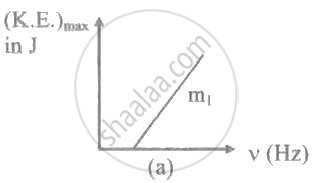
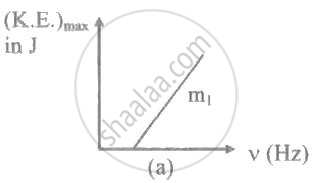
A light of frequency 'v' is incident on the metal surface whose threshold frequency is 'v0'. If v = v0, then [c = speed of light in medium] ____________.
When the work function of a metal increases, maximum kinetic energy of emitted photoelectrons ____________.
When ultraviolet light of wavelength 100 nm is incident upon a sample of silver metal, a potential difference of 7.7 volt is required to stop the photoelectrons from reaching the collector plate. The potential required to stop photo electrons when light of wavelength 200 nm is incident upon silver is ______.
The maximum kinetic energy of the photoelectrons ejected will be ______ eV when the light of wavelength 350 nm is incident on a cesium surface. The work function of cesium = 1.9 eV.
A point isotropic light source of power P = 12 watts is located on the axis of a circular mirror of radius R = 3 cm. If the distance of the source from the centre of the mirror is a = 39 cm and the reflection coefficient of the mirror is α = 0.70 then the force exerted by the light ray on the mirror is ______ × 10-10 N.
For a given photosensitive material and frequency (> threshold frequency) of incident radiation, the photoelectric current varies with the intensity of incident light as:
In a photocell, frequency of incident radiation is increased by keeping other factors constant (v > v0), the stopping potential ______.
Light of wavelength λ, which is less than threshold wavelength is incident on a photosensitive material. If incident wavelength is decreased so that emitted photoelectrons are moving with same velocity, then stopping potential will ______.
Light of two different frequencies whose photons have energies 1.3 eV and 2.8 eV respectively, successfully illuminate a metallic surface whose work function is 0.8 eV. The ratio of maximum speeds of emitted electrons will be ______.
If the maximum kinetic energy of emitted electrons in the photoelectric effect is 2eV, the stopping potential will be ______.
Explain the failure of wave theory of light to account for the observations from experiments on photoelectric effect.
Give Einstein's explanation of the photoelectric effect.
Explain the formation of clouds at high altitude.
