Advertisements
Advertisements
प्रश्न
The maximum kinetic energy of the photoelectrons depends only on ______
पर्याय
potential
frequency
incident angle
pressure
Advertisements
उत्तर
The maximum kinetic energy of the photoelectrons depends only on frequency.
APPEARS IN
संबंधित प्रश्न
The electrons are emitted in the photoelectric effect from a metal surface.
Find the energy of photon which have momentum 2 × 10-16 gm-cm/sec.
With the help of a circuit diagram describing an experiment to study the photoelectric effect.
What is the photoelectric effect? Define stopping potential and photoelectric work function.
With the help of a circuit diagram describe the experiment to study the characteristics of the photoelectric effect. Hence discuss any 2 characteristics of the photoelectric effect.
Threshold frequency for a metal is 1015 Hz. Light of `lambda` = 4000 Å falls on its surface. Which of the following statements is correct?
The threshold frequency for a certain photosensitive metal is v0. When it is illuminated by light of frequency v = 2v0, the maximum velocity of photoelectrons is v0. What will be the maximum velocity of the photoelectrons when the same metal is illuminated by light of frequency
v = 5v0?
When certain metal surface is illuminated with a light of wavelength A., the stopping potential is V, When the same surface is illuminated by light of wavelength 2λ, the stopping potential is `("V"/3)`. The threshold wavelength for the surface is ______.
When wavelength of incident radiation on the metal surface is reduced from 'λ1' to 'λ2', the kinetic energy of emitted photoelectrons is tripled. The work function of the metal is ______.
(h = Planck's constant, c =velocity of light)
The photo electric effect to take place for a metal, the minimum frequency required is 5.792 × 10¹⁴ Hz. A light of wavelength 6000 Å is incident on that metal surface. What is the corresponding frequency of light and will there be photoelectric emissions? [velocity of light = 3 × 10⁸ m/s]
Photoelectrons are emitted from a photosensitive surface for the light of wavelengths λ1 = 360 nm and λ2 = 600 nm. What is the ratio of work functions for lights of wavelength 'λ1' to 'λ2'?
When a certain metallic surface is illuminated with monochromatic light of wavelength '`lambda`', the stopping potential for photoelectric effect is '3V0'. If the same surface is illuminated with a light of wavelength '`2 lambda`', the stopping potential is found as 'V0'. The threshold wavelength for this surface is ____________.
When light of wavelength '`lambda`' is incident on photosensitive surface, photons of power 'P' are emitted. The number of photons (n) emitted in 't' second is (h = Planck's constant, c = velocity of light in vacuum) ____________.
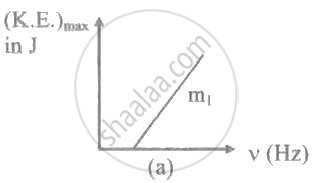
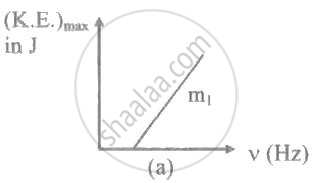
The ratio of slopes m1: ro2 of the lines given in the following graphs is, ______.
The radiation corresponding to the 3 → 2 transition of a hydrogen atom falls on a gold surface to generate photoelectrons. These electrons are passed through a magnetic field of 5 × 10⁻⁴ T. Assume that the radius of the largest circular path followed by these electrons is 7 mm, and the work function of the metal is ______.
(Mass of electron = 9.1 × 10⁻³¹ kg)
In a photoelectric experiment, ultraviolet light of wavelength 280 nm is used with a lithium cathode having work function Φ = 2.5 eV. If the wavelength of incident light is switched to 400 nm, find out the change in the stopping potential.
(h = 6.63 × 10⁻³⁴ Js, c = 3 × 10⁸ ms-1)
The radiation emitted, when an electron jumps from n = 3 to n = 2 orbit is a hydrogen atom, falls on a metal to produce photoelectron. The electrons from the metal surface with maximum kinetic energy are made to move perpendicular to a magnetic field of `1/320`T in a radius of 10-3m. Find the 320 work function of metal:
The wavelength of light incident on a metal surface is reduced from 300 nm to 200 nm (both are less than threshold wavelength). What is the change in the stopping potential for photoelectrons emitted from the surface will be ______ V. (Take h = 6.6 × 10⁻³⁴ J-s)
When ultraviolet light of wavelength 100 nm is incident upon a sample of silver metal, a potential difference of 7.7 volt is required to stop the photoelectrons from reaching the collector plate. The potential required to stop photo electrons when light of wavelength 200 nm is incident upon silver is ______.
The maximum kinetic energy of the photoelectrons ejected will be ______ eV when the light of wavelength 350 nm is incident on a cesium surface. The work function of cesium = 1.9 eV.
A point isotropic light source of power P = 12 watts is located on the axis of a circular mirror of radius R = 3 cm. If the distance of the source from the centre of the mirror is a = 39 cm and the reflection coefficient of the mirror is α = 0.70 then the force exerted by the light ray on the mirror is ______ × 10-10 N.
When monochromatic light of frequency v1 falls on a metal surface, the stopping potential required is found to be V1. If the radiation of frequency v2 is incident on the surface, the stopping potential required V2 is ______. (v2 > v1)
Explain the failure of wave theory of light to account for the observations from experiments on photoelectric effect.
By increasing the voltage in an electron diffraction tube, the radius of the diffraction rings will ______.
Draw a neat labelled diagram of photo-current as a function of accelerating potential for fixed incident intensity but different incident frequencies for the same emitter material.
Light of wavelength 'λ' falls on a metal having work function \[\frac {hc}{λ_0}\]. Photoelectric effect will take place only if (λ0 is the threshold wavelength) ______.
A parallel plate capacitor with air between the plates has capacitance 9 pF. The separation between the plates becomes thrice and the space between them is filled with a medium of dielectric constant 6. The capacitance becomes 'x' pF. The value of 'x' is ______.
