Advertisements
Advertisements
प्रश्न
A neutron having kinetic energy 12.5 eV collides with a hydrogen atom at rest. Nelgect the difference in mass between the neutron and the hydrogen atom and assume that the neutron does not leave its line of motion. Find the possible kinetic energies of the neutron after the event.
Advertisements
उत्तर
Given:
Initial kinetic energy of the neutron, K = 12.5 eV
The velocities of the two bodies of equal masses undergoing elastic collision in one dimension gets interchanged after the collision.
Since the hydrogen atom is at rest, after collision, the velocity of the neutron will be zero.
Hence, it has zero energy.
APPEARS IN
संबंधित प्रश्न
(i) State Bohr's quantization condition for defining stationary orbits. How does the de Broglie hypothesis explain the stationary orbits?
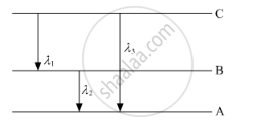
(ii) Find the relation between three wavelengths λ1, λ2 and λ3 from the energy-level diagram shown below.
Draw a neat, labelled energy level diagram for H atom showing the transitions. Explain the series of spectral lines for H atom, whose fixed inner orbit numbers are 3 and 4 respectively.
How many electrons in an atom may have the following quantum numbers?
n = 3, l = 0
The ratio of kinetic energy of an electron in Bohr’s orbit to its total energy in the same orbit is
(A) – 1
(B) 2
(C) 1/2
(D) – 0.5
if `E_p` and `E_k` represent potential energy and kinetic energy respectively, of an orbital electron, then, according to B9hr's theory:
a)`E_k = -E_p"/"2`
b) `E_k = -E_p`
c) `E_k = -2E_p`
d) `E_k = 2E_p`
Using Bohr’s postulates, obtain the expression for total energy of the electron in the nth orbit of hydrogen atom.
Using Bohr’s postulates for hydrogen atom, show that the total energy (E) of the electron in the stationary states tan be expressed as the sum of kinetic energy (K) and potential energy (U), where K = −2U. Hence deduce the expression for the total energy in the nth energy level of hydrogen atom.
Write postulates of Bohr’s Theory of hydrogen atom.
According to Bohr's model of hydrogen atom, an electron can revolve round a proton indefinitely, if its path is ______.
Ratio of longest to shortest wavelength in Balmer series is ______.
The first ionization energy of H is 21.79 × 10⁻¹⁹ J. The second ionization energy of He atom is ______ × 10-19J.
A 100 eV electron collides with a stationary helium ion (He+) in its ground state and exits to a higher level. After the collision, He+ ions emit two photons in succession with wavelengths 1085 Å and 304 Å. The energy of the electron after the collision will be ______ eV.
Given h = 6.63 × 10⁻³⁴ Js.
What is the energy associated with first orbit of Li2+ (RH = 2.18 × 10⁻¹⁸)?
In hydrogen atom, transition from the state n = 6 to n = 1 results in ultraviolet radiation. Infrared radiation will be obtained in the transition ______.
Write the ionisation energy value for the hydrogen atom.
The energy of an electron in the nth orbit of the hydrogen atom is En = -13.6/n2eV. The negative sign of energy indicates that ______.
What is the velocity of an electron in the 3rd orbit of hydrogen atom if its velocity in the 1st orbit is v0?
Which from following is CORREСТ relationship between wavelength and momentum of electron?
What spectrum would an atom emit if its electron spiralled inward while emitting radiation continuously?
What does Bohr’s first postulate allow an electron in an atom to do?
