Advertisements
Advertisements
प्रश्न
Electrons are emitted from an electron gun at almost zero velocity and are accelerated by an electric field E through a distance of 1.0 m. The electrons are now scattered by an atomic hydrogen sample in ground state. What should be the minimum value of E so that red light of wavelength 656.3 nm may be emitted by the hydrogen?
Advertisements
उत्तर
Given:
Distance travelled by the electron, d = 1.0 m
Wavelength of red light ,λ = 656.3 nm = 656.3 × 10^-9 m
Since the given wavelength lies in Balmer series, the transition that requires minimum energy is from n1 = 3 to n2 = 2.
Energy of this transition will be equal to the energy (E) that will be required for the transition from the ground state to n = 3.
`E_1 = 13.6 (1/n_1^2 1/n_2^2)`
`rArr E_1 = 13.6 (1 - 1/9)`
`= (13.6xx8)/9 = 12.09 eV`
Energy, E (eV) = 12.09 eV
∴ `V = 12.09 V`
Electric field, `E = V/d = 12.09/1 = 12.09 V//m`
∴ Minimum value of the electric field = 12.09 V/m = 12.1 V/m
APPEARS IN
संबंधित प्रश्न
The first excited energy of a He+ ion is the same as the ground state energy of hydrogen. Is it always true that one of the energies of any hydrogen-like ion will be the same as the ground state energy of a hydrogen atom?
When white radiation is passed through a sample of hydrogen gas at room temperature, absorption lines are observed in Lyman series only. Explain.
The minimum orbital angular momentum of the electron in a hydrogen atom is
Which of the following curves may represent the speed of the electron in a hydrogen atom as a function of trincipal quantum number n?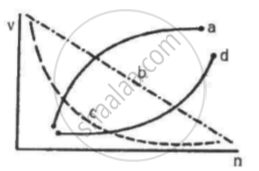
A hydrogen atom in ground state absorbs 10.2 eV of energy. The orbital angular momentum of the electron is increased by
An electron with kinetic energy 5 eV is incident on a hydrogen atom in its ground state. The collision
(a) Find the first excitation potential of He+ ion. (b) Find the ionization potential of Li++ion.
Find the maximum Coulomb force that can act on the electron due to the nucleus in a hydrogen atom.
A hydrogen atom in a state having a binding energy of 0.85 eV makes transition to a state with excitation energy 10.2 e.V (a) Identify the quantum numbers n of the upper and the lower energy states involved in the transition. (b) Find the wavelength of the emitted radiation.
A hydrogen atom in state n = 6 makes two successive transitions and reaches the ground state. In the first transition a photon of 1.13 eV is emitted. (a) Find the energy of the photon emitted in the second transition (b) What is the value of n in the intermediate state?
The average kinetic energy of molecules in a gas at temperature T is 1.5 kT. Find the temperature at which the average kinetic energy of the molecules of hydrogen equals the binding energy of its atoms. Will hydrogen remain in molecular from at this temperature? Take k = 8.62 × 10⁻⁵ eV K−1.
Find the temperature at which the average thermal kinetic energy is equal to the energy needed to take a hydrogen atom from its ground state to n = 3 state. Hydrogen can now emit red light of wavelength 653.1 nm. Because of Maxwellian distribution of speeds, a hydrogen sample emits red light at temperatures much lower than that obtained from this problem. Assume that hydrogen molecules dissociate into atoms.
A hydrogen atom in ground state absorbs a photon of ultraviolet radiation of wavelength 50 nm. Assuming that the entire photon energy is taken up by the electron with what kinetic energy will the electron be ejected?
A hydrogen atom moving at speed υ collides with another hydrogen atom kept at rest. Find the minimum value of υ for which one of the atoms may get ionized.
The mass of a hydrogen atom = 1.67 × 10⁻²⁷ kg.
Positronium is just like a H-atom with the proton replaced by the positively charged anti-particle of the electron (called the positron which is as massive as the electron). What would be the ground state energy of positronium?
In the Auger process an atom makes a transition to a lower state without emitting a photon. The excess energy is transferred to an outer electron which may be ejected by the atom. (This is called an Auger electron). Assuming the nucleus to be massive, calculate the kinetic energy of an n = 4 Auger electron emitted by Chromium by absorbing the energy from a n = 2 to n = 1 transition.
What is the process called when an atom absorbs a photon whose energy exactly matches the energy required for an electronic transition?
What are absorption lines in a continuous spectrum?
What is a key limitation of continuous spectra that is resolved by the observation of discrete emission lines?
