Advertisements
Advertisements
प्रश्न
Calculate the smallest wavelength of radiation that may be emitted by (a) hydrogen, (b) He+ and (c) Li++.
Advertisements
उत्तर
Given:
For the smallest wavelength, energy should be maximum.
Thus, for maximum energy, transition should be from infinity to the ground state.
`therefore n_1 = 1`
`n_2 = ∞`
(a) Wavelength of the radiation emitted`(lamda)` is given by
`1/lamda = RZ^2 (1/n_1^2 - 1/n_2^2 )`
For hydrogen,
Atomic number, Z = 1
R = Rydberg constant = `1.097xx10^7m^-1`
On substituting the respective values,
`lamda = 1/(1.097xx10) = 1/1.097xx 10^-7`
= 0.911 × 10-7
= 91.01 × 10-9 = 91 nm
(b)
For He+,
Atomic number, Z = 2
Wavelength of the radiation emitted by He+ `(lamda)` is given by
`1/lamda = RZ^2 (1/n_1^2 - 1/n_2^2)`
`therefore 1/lamda = (2)^2 (1.097xx10^7 )(1/((1^2)) - 1/((∞^2))`
`therefore lamda = (91 nm)/4 =23 nm`
(c) For Li^++ ,
Atomic number, Z = 3
Wavelength of the radiation emitted by Li++ (λ) is given by
`1/lamda = RZ^2 (1/n_1^2 - 1/n_2^2)`
`therefore 1/lamda = (3)^2 xx (1.097 xx 10^7) (1/1^2 - 1/∞^2)`
`rArr lamda = (91 nm)/Z^2 = 91/9 = 10 nm `
APPEARS IN
संबंधित प्रश्न
Find the wavelength of the electron orbiting in the first excited state in hydrogen atom.
The first excited energy of a He+ ion is the same as the ground state energy of hydrogen. Is it always true that one of the energies of any hydrogen-like ion will be the same as the ground state energy of a hydrogen atom?
Which wavelengths will be emitted by a sample of atomic hydrogen gas (in ground state) if electrons of energy 12.2 eV collide with the atoms of the gas?
What will be the energy corresponding to the first excited state of a hydrogen atom if the potential energy of the atom is taken to be 10 eV when the electron is widely separated from the proton? Can we still write En = E1/n2, or rn = a0 n2?
In which of the following systems will the radius of the first orbit (n = 1) be minimum?
Which of the following curves may represent the speed of the electron in a hydrogen atom as a function of trincipal quantum number n?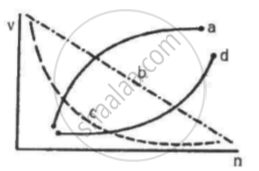
Let An be the area enclosed by the nth orbit in a hydrogen atom. The graph of ln (An/A1) against ln(n)
(a) will pass through the origin
(b) will be a straight line with slope 4
(c) will be a monotonically increasing nonlinear curve
(d) will be a circle
Ionization energy of a hydrogen-like ion A is greater than that of another hydrogen-like ion B. Let r, u, E and L represent the radius of the orbit, speed of the electron, energy of the atom and orbital angular momentum of the electron respectively. In ground state
Whenever a photon is emitted by hydrogen in Balmer series, it is followed by another photon in Lyman series. What wavelength does this latter photon correspond to?
A gas of hydrogen-like ions is prepared in a particular excited state A. It emits photons having wavelength equal to the wavelength of the first line of the Lyman series together with photons of five other wavelengths. Identify the gas and find the principal quantum number of the state A.
Average lifetime of a hydrogen atom excited to n = 2 state is 10−8 s. Find the number of revolutions made by the electron on the average before it jumps to the ground state.
Show that the ratio of the magnetic dipole moment to the angular momentum (l = mvr) is a universal constant for hydrogen-like atoms and ions. Find its value.
Electrons are emitted from an electron gun at almost zero velocity and are accelerated by an electric field E through a distance of 1.0 m. The electrons are now scattered by an atomic hydrogen sample in ground state. What should be the minimum value of E so that red light of wavelength 656.3 nm may be emitted by the hydrogen?
In a hydrogen atom the electron moves in an orbit of radius 0.5 A° making 10 revolutions per second, the magnetic moment associated with the orbital motion of the electron will be ______.
The Balmer series for the H-atom can be observed ______.
- if we measure the frequencies of light emitted when an excited atom falls to the ground state.
- if we measure the frequencies of light emitted due to transitions between excited states and the first excited state.
- in any transition in a H-atom.
- as a sequence of frequencies with the higher frequencies getting closely packed.
Positronium is just like a H-atom with the proton replaced by the positively charged anti-particle of the electron (called the positron which is as massive as the electron). What would be the ground state energy of positronium?
Why do only discrete frequencies appear in atomic emission spectra?
