Advertisements
Advertisements
प्रश्न
Give the structure of A, B and C in the following reaction:
\[\ce{CH3CH2I ->[NaCN] A ->[OH-][Partial hydrolysis] B ->[NaOH + Br2] C}\]
Advertisements
उत्तर
\[\begin{array}{cc}
\phantom{.......................}\ce{O}\\
\phantom{.......................}||\\
\ce{\underset{Iodoethane}{CH3CH2I} ->[NaCN] \underset{(A)}{\underset{Propane nitrile}{CH3CH2CN}} ->[OH-][Partial hydrolysis] \underset{(B)}{\underset{Propanamide}{CH3CH2-C-NH2}} ->[NaOH + Br2] \underset{(C)}{\underset{Ethanamine}{CH3CH2-NH2}}}
\end{array}\]
APPEARS IN
संबंधित प्रश्न
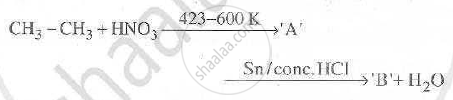
Identify the compounds 'A' and 'B' in the following equation:
How do you convert the following: Ethanenitrile to ethanamine
Give the structures of A, B and C in the following reactions :

Give the structures of A, B and C in the following reaction:
\[\ce{C6H5NO2 ->[Fe/HCl] A ->[HNO2][273 K] B ->[C6H5OH] C}\]
Write the reaction of aliphatic primary amine with nitrous acid.
Give a plausible explanation for the following:
Why are amines less acidic than alcohols of comparable molecular masses?
The following amines is the product of Gabriel phthalimide synthesis.
Write the order of reactivity of alkyl halides with ammonia.
Which of the following reagents is used in Hofmann's elimination reaction of amines?
The source of nitrogen in Gabriel synthesis of amines is ______.
Hoffmann Bromamide Degradation reaction is shown by ______.
Best method for preparing primary amines from alkyl halides without changing the number of carbon atoms in the chain is ______.
The reagents that can be used to convert benzenediazonium chloride to benzene are:
(i) \[\ce{SnCl2/HCl}\]
(ii) \[\ce{CH3CH2OH}\]
(iii) \[\ce{H3PO2}\]
(iv) \[\ce{LiAlH4}\]
Which of the following reactions are correct?
(i)

(ii)

(iii)

(iv)

How will you carry out the following conversion?

Assertion: Hoffmann’s bromamide reaction is given by primary amines.
Reason: Primary amines are more basic than secondary amines.
When primary amines are treated with HCl, the product obtained is which of the following?
The amine 'A' when treated with nitrous acid gives yellow oily substance. The amine A is ______.
Write short note on the following:
Ammonolysis
