Advertisements
Advertisements
प्रश्न
Find the length of the chord AC where AB and CD are the two diameters perpendicular to each other of a circle with radius `4sqrt(2)` cm and also find ∠OAC and ∠OCA
Advertisements
उत्तर
Radius of a circle = `4sqrt(2)` cm
In the right ΔAOC,
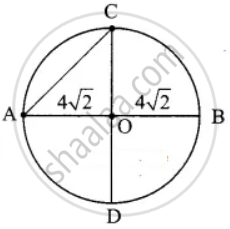
AC2 = OA2 + OC2
AC2 = `(4sqrt(2))^2 + (4sqrt(2))^2`
= 32 + 32 = 64
AC = `sqrt(64)`
= 8
Length of the chord = 8 cm,
∠OAC = ∠OCA = 45°
Since OAC is an isosceles right angle triangle.
APPEARS IN
संबंधित प्रश्न
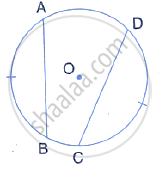
In the given figure, if arc AB = arc CD, then prove that the quadrilateral ABCD is an isosceles– trapezium (O is the centre of the circle).
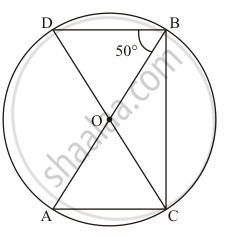
In the given figure, AB and CD are diameters of a circle with centre O. If ∠OBD = 50°, find ∠AOC.
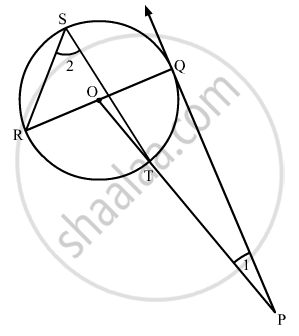
In Fig. 8.79, PQ is a tangent from an external point P to a circle with centre O and OP cuts the circle at T and QOR is a diameter. If ∠POR = 130° and S is a point on the circle, find ∠1 + ∠2.
In following fig. ABC is an equilateral triangle . A circle is drawn with centre A so that ot cuts AB and AC at M and N respectively. Prove that BN = CM.
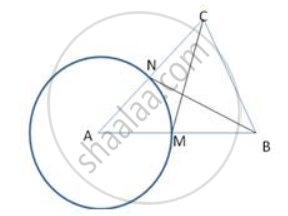
In an equilateral triangle, prove that the centroid and center of the circum-circle (circumcentre) coincide.
If O is the center of the circle in the figure alongside, then complete the table from the given information.
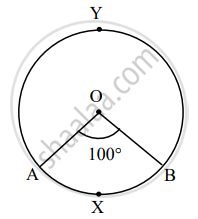
The type of arc
| Type of circular arc | Name of circular arc | Measure of circular arc |
| Minor arc | ||
| Major arc |
If the angle between two radii of a circle is 130°, then the angle between the tangents at the ends of the radii is ______
If d1, d2 (d2 > d1) be the diameters of two concentric circles and c be the length of a chord of a circle which is tangent to the other circle, then ______
In the following figure, O is the centre of the circle, BD = OD and CD ⊥ AB. Find ∠CAB.

Find the length of the arc of a circle which subtends an angle of 60° at the centre of the circle of radius 42 cm.
