Advertisements
Advertisements
प्रश्न
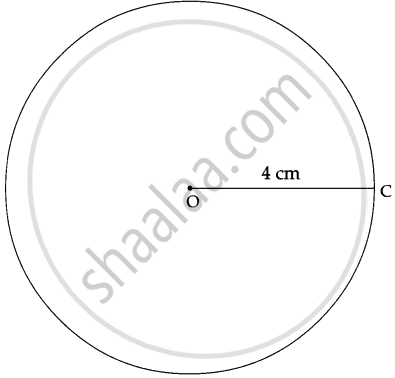
Draw circle with the radii given below.
4 cm
Advertisements
उत्तर
संबंधित प्रश्न
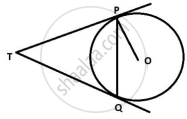
Two tangents TP and TQ are drawn to a circle with centre O from an external point T. Prove that ∠PTQ = 2∠OPQ.
In fig. a circle touches all the four sides of quadrilateral ABCD with AB = 6cm, BC = 7cm, CD = 4cm. Find AD.
Fill in the blank:
A point whose distance from the centre of a circle is greater than its radius lies in ..................... of the circle.
Fill in the blank
A continuous piece of a circle is ............... of the circle
Use the figure given below to fill in the blank:
________ is a radius of the circle.
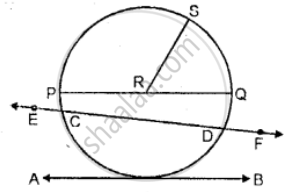
Use the figure given below to fill in the blank:
AB is a ______ of the circle.

The ratio between the circumference and diameter of any circle is _______
If the angle between two tangents drawn from a point P to a circle of radius ‘a’ and centre ‘O’ is 90°, then OP = ______
A point P is 13 cm from the centre of the circle. The length of the tangent drawn from P to the circle is 12cm. Find the radius of the circle.
From the figure, identify three radii.

