Advertisements
Advertisements
प्रश्न
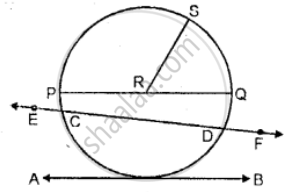
Use the figure given below to fill in the blank:
________ is a radius of the circle.
Advertisements
उत्तर
RS is a radius of the circle.
APPEARS IN
संबंधित प्रश्न
Fill in the blanks:
A point, whose distance from the centre of a circle is greater than its radius lies in __________ of the circle. (exterior/ interior)
Write True or False. Give reason for your answer.
A circle is a plane figure.
If the quadrilateral sides touch the circle prove that sum of pair of opposite sides is equal to the sum of other pair.
A point P is 25 cm away from the center of a circle and the length of tangent drawn from P to the circle is 24 cm. Find the radius of the circle.
In two concentric circles, a chord of length 8 cm of the large circle touches the smaller circle. If the radius of the larger circle is 5 cm, then find the radius of the smaller circle.
In a cyclic quadrilateral ABCD, if m ∠A = 3 (m ∠C). Find m ∠A.
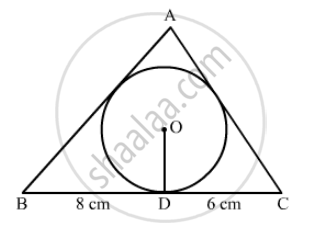
In the given figure, a ∆ABC is drawn to circumscribe a circle of radius 4 cm such that the segments BD and DC are of lengths 8 cm and 6 cm respectively. Find the lengths of sides AB and AC, when area of ∆ABC is 84 cm2.
Draw a circle of radius of 4.2 cm. Mark its center as O. Takes a point A on the circumference of the circle. Join AO and extend it till it meets point B on the circumference of the circle,
(i) Measure the length of AB.
(ii) Assign a special name to AB.
In the following figure, O is the centre of the circle. Name all radii of the circle.

A 7 m broad pathway goes around a circular park with a circumference of 352 m. Find the area of road.
