Advertisements
Advertisements
प्रश्न
Find the equation of a line drawn perpendicular to the line `x/4 + y/6 = 1`through the point, where it meets the y-axis.
Advertisements
उत्तर
Equation of line AB,
`"x"/4 + "y"/6 = 1` or 3x + 2y = 12,
2y = −3x + 12
y = `(-3)/2 "x" + 12/2`
Slope of line AB = `(-3)/2`
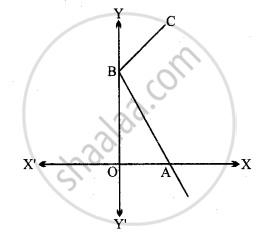
AB ⊥ BC,
∴ Slope of BC = `2/3`
∵ The line intersects the y-axis, hence the point is B(0, 6).
∴ Equation of line BC
y – 6 = `2/3 ("x" - 0)`
or 3y – 18 = 2x
or 2x – 3y + 18 = 0
APPEARS IN
संबंधित प्रश्न
Find the value of x for which the points (x, –1), (2, 1) and (4, 5) are collinear.
Without using distance formula, show that points (–2, –1), (4, 0), (3, 3) and (–3, 2) are vertices of a parallelogram.
If three point (h, 0), (a, b) and (0, k) lie on a line, show that `q/h + b/k = 1`
Find the value of p so that the three lines 3x + y – 2 = 0, px + 2y – 3 = 0 and 2x – y – 3 = 0 may intersect at one point.
Find the equation of the lines through the point (3, 2) which make an angle of 45° with the line x –2y = 3.
Using the method of slope, show that the following points are collinear A (16, − 18), B (3, −6), C (−10, 6) .
Without using Pythagoras theorem, show that the points A (0, 4), B (1, 2) and C (3, 3) are the vertices of a right angled triangle.
Without using the distance formula, show that points (−2, −1), (4, 0), (3, 3) and (−3, 2) are the vertices of a parallelogram.
Find the angle between the X-axis and the line joining the points (3, −1) and (4, −2).
Line through the points (−2, 6) and (4, 8) is perpendicular to the line through the points (8, 12) and (x, 24). Find the value of x.
Find the angle between X-axis and the line joining the points (3, −1) and (4, −2).
Find the equation of a straight line with slope − 1/3 and y-intercept − 4.
Find the equation of a straight line with slope −2 and intersecting the x-axis at a distance of 3 units to the left of origin.
Find the equation of the right bisector of the line segment joining the points (3, 4) and (−1, 2).
Find the angles between the following pair of straight lines:
3x + 4y − 7 = 0 and 4x − 3y + 5 = 0
Find the angles between the following pair of straight lines:
(m2 − mn) y = (mn + n2) x + n3 and (mn + m2) y = (mn − n2) x + m3.
If θ is the angle which the straight line joining the points (x1, y1) and (x2, y2) subtends at the origin, prove that \[\tan \theta = \frac{x_2 y_1 - x_1 y_2}{x_1 x_2 + y_1 y_2}\text { and } \cos \theta = \frac{x_1 x_2 + y_1 y_2}{\sqrt{{x_1}^2 + {y_1}^2}\sqrt{{x_2}^2 + {y_2}^2}}\].
Find the tangent of the angle between the lines which have intercepts 3, 4 and 1, 8 on the axes respectively.
Show that the tangent of an angle between the lines \[\frac{x}{a} + \frac{y}{b} = 1 \text { and } \frac{x}{a} - \frac{y}{b} = 1\text { is } \frac{2ab}{a^2 - b^2}\].
Write the coordinates of the image of the point (3, 8) in the line x + 3y − 7 = 0.
The reflection of the point (4, −13) about the line 5x + y + 6 = 0 is
If x + y = k is normal to y2 = 12x, then k is ______.
Point of the curve y2 = 3(x – 2) at which the normal is parallel to the line 2y + 4x + 5 = 0 is ______.
If the slope of a line passing through the point A(3, 2) is `3/4`, then find points on the line which are 5 units away from the point A.
A ray of light coming from the point (1, 2) is reflected at a point A on the x-axis and then passes through the point (5, 3). Find the coordinates of the point A.
The equation of the line passing through (1, 2) and perpendicular to x + y + 7 = 0 is ______.
Find the equation of the line passing through the point (5, 2) and perpendicular to the line joining the points (2, 3) and (3, – 1).
Find the angle between the lines y = `(2 - sqrt(3)) (x + 5)` and y = `(2 + sqrt(3))(x - 7)`
If the equation of the base of an equilateral triangle is x + y = 2 and the vertex is (2, – 1), then find the length of the side of the triangle.
One vertex of the equilateral triangle with centroid at the origin and one side as x + y – 2 = 0 is ______.
If the vertices of a triangle have integral coordinates, then the triangle can not be equilateral.
The vertex of an equilateral triangle is (2, 3) and the equation of the opposite side is x + y = 2. Then the other two sides are y – 3 = `(2 +- sqrt(3)) (x - 2)`.
Line joining the points (3, – 4) and (– 2, 6) is perpendicular to the line joining the points (–3, 6) and (9, –18).
The lines whose vector equations are `r = 2hati - 3hatj + 7hatk + lambda (2hati + phatj + 5hatk) and r = hati - 2hatj + 3hatk + µ(3hati + phatj + phatk)` are perpendicular for all values of λ and µ if p =
