Advertisements
Advertisements
प्रश्न
Find out the phase relationship between voltage and current in a pure inductive circuit.
Advertisements
उत्तर
Consider a circuit containing a pure inductor of inductance L connected across an alternating voltage source. The alternating voltage is given by the equation.
υ = Vm sin ωt …(1)
The alternating current flowing through the inductor induces a self-induced emf or back emf in the circuit. The back emf is given by
Back emf, ε -L `"di"/"dt"`
By applying Kirchoff’s loop rule to the purely inductive circuit, we get

AC circuit with inductor
υ + ε = 0
Vm sin ωt = L`"di"/"dt"`
di = L`"V"_"m"/"L"` sin ωt dt
i = `"V"_"m"/"L" int` sin ωt dt = `"V"_"m"/"L"_omega` (-cos ωt) + constant
The integration constant in the above equation is independent of time. Since the voltage in the circuit has only time dependent part, we can set the time independent part in the current (integration constant) into zero.
`[(cos omega"t" = sin(pi/2 - omega"t")),(- sin (pi/2 - omega"t") = sin (omega"t" - pi/2))]`
i = `"V"_"m"/"L"_omega sin (omega"t" - pi/2) or ` i = `"I"_"m" sin(omega"t" - pi/2)` ....(2)
where `"V"_"m"/"L"_omega = "I"_"m"`, the peak value of the alternating current in the circuit. From equation (1) and (2), it is evident that current lags behind the applied voltage by `pi/2` in an inductive circuit.
This fact is depicted in the phasor diagram. In the wave diagram also, it is seen that current lags the voltage by 90°.
Inductive reactance XL:
The peak value of current Im is given by Im = `"V"_"m"/"L"_omega`. Let us compare this equation with Im = `"V"_"m"/"R"` from resistive circuit. The equantity ωL Plays the same role as the resistance in resistive circuit. This is the resistance offered by the inductor, called inductive reactance (XL). It is measured in ohm.
XL = ωL
The inductive reactance (XL) varies directly as the frequency.
XL = 2πfL …….. (3)
where ƒ is the frequency of the alternating current. For a steady current, ƒ= 0. Therefore, XL = 0. Thus an ideal inductor offers no resistance to steady DC current.
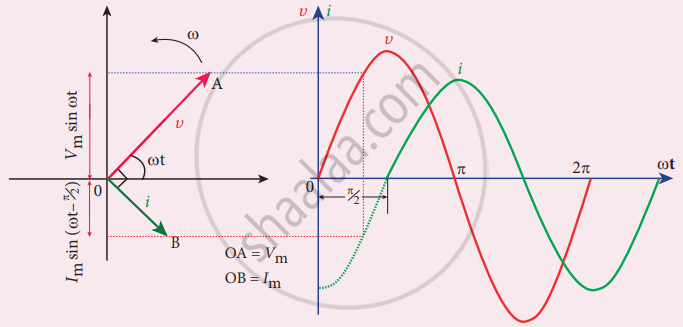
Phasor diagram and wave diagram for AC circuit with L
APPEARS IN
संबंधित प्रश्न
Name the transformer used in the power transmitting station of a power plant.
What type of current is transmitted from the power station?
Explain the significance of Lenz’s law to show the conservation of energy in electromagnetic induction.
Give the advantage of AC in long distance power transmission with an illustration.
A 220 V input is supplied to a transformer. The output circuit draws a current of 2.0 A at 440 V. If the ratio of output to input power is 0.8, then the current drawn by primary winding is ______.
A power transmission line feeds input power at 2300 V to a stepdown transformer with its primary windings having 4000 turns. What should be the number of turns in the secondary in order to get output power at 230 V?
A 60 W load is connected to the secondary of a transformer whose primary draws line voltage. If a current of 0.54 A flows in the load, what is the current in the primary coil? Comment on the type of transformer being used.
What is a transformer?
Which loss is reduced by laminations in the core?
