Advertisements
Advertisements
प्रश्न
Fig., below shows the reading obtained while measuring the diameter of a wire with a screw gauge. The screw advances by 1 division on the main scale when circular head is rotated once.
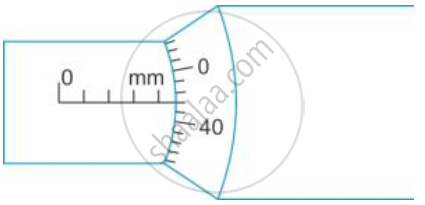 Find:
Find:
(i) Pitch of the screw gauge,
(ii) Least count of the screw gauge and
(iii) The diameter of the wire.
Advertisements
उत्तर
No. of divisions on the circular scale = 50
(i) Pitch = Distance moved ahead in one revolution
= 1 mm/1 = 1 mm.
(ii) L.C. = Pitch/No. of divisions on the circular head
= (1/50) mm
= 0.02 mm
(iii) Main scale reading = 4 mm
No. of circular division coinciding with m.s.d. (p) = 47
Circular scale reading = p × L.C.
= (47 × 0.02) mm
= 0.94 mm
Diameter (Total reading) = M.s.r. + circular scale reading
= (4 + 0.94) mm
= 4.94 mm
APPEARS IN
संबंधित प्रश्न
Explain the terms : Least count of a screw gauge.
How are they determined?
In the vernier callipers, there are 10 divisions on the vernier scale and 1 cm on the main scale is divided into 10 parts. While measuring the length, the zero of the vernier lies just ahead of the 1.8 cm mark and the 4th division of vernier coincides with a main scale division.
(a) Find the length.
(b) If zero error of vernier callipers is -0.02 cm,
What is the correct length ?
A screw has a pitch equal to 0.5 mm. What should be the number of divisions on its head so as to read correctly up to 0.001 mm with its help?
A pendulum completes 2 oscillations in 5 s. What is its time period? If g = 9.8 m s-2, find its length.
The final result of the calculation in an experiment is 125,347,200. Express the number in term of significant place when accuracy is between 1 and 1000
Explain the term least count of a screw gauge. How are they determined?
State whether the following statement is true or false by writing T/F against it.
The least count of a screw gauge can be lowered by increasing the number of divisions on its thimble.
Thickness of a cricket ball is measured by ______.
The precision of vernier calipers is ______ mm.
