Advertisements
Advertisements
प्रश्न
Fig., below shows the reading obtained while measuring the diameter of a wire with a screw gauge. The screw advances by 1 division on the main scale when circular head is rotated once.
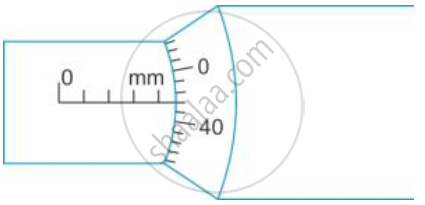 Find:
Find:
(i) Pitch of the screw gauge,
(ii) Least count of the screw gauge and
(iii) The diameter of the wire.
Advertisements
उत्तर
No. of divisions on the circular scale = 50
(i) Pitch = Distance moved ahead in one revolution
= 1 mm/1 = 1 mm.
(ii) L.C. = Pitch/No. of divisions on the circular head
= (1/50) mm
= 0.02 mm
(iii) Main scale reading = 4 mm
No. of circular division coinciding with m.s.d. (p) = 47
Circular scale reading = p × L.C.
= (47 × 0.02) mm
= 0.94 mm
Diameter (Total reading) = M.s.r. + circular scale reading
= (4 + 0.94) mm
= 4.94 mm
APPEARS IN
संबंधित प्रश्न
Name the part of the vernier callipers which is used to measure the following
Internal diameter of a mug
Name the part of the vernier callipers which is used to measure the following
Depth of a small bottle
State the purpose of ratchet in a screw gauge.
State whether the following statement is true or false by writing T/F against it.
The least count of a screw gauge can be lowered by increasing the number of divisions on its thimble.
What is the least count in the case of the following instrument?
Screw gauge
